
February 25, 2026
Trump has lost the ability to entertain. Sadly, he hasn't lost the ability to offend | Moira Donegan
Thesis: Donald Trump's recent State of the Union address revealed his decline as an entertainer, marked by a rambling performance heavy on falsehoods and light on substance.
Stakes: As his approval ratings plummet and pressing national issues remain unaddressed, Trump’s reliance on offensive rhetoric over meaningful policy threatens to alienate voters and undermine democratic discourse.
Takeaway: While Trump may have lost the ability to engage and entertain, his penchant for divisive and misleading statements remains intact, raising concerns about the future of political civility and the integrity of governance.
Stoic Response
Correspondence to a Roman Magistrate
From the Wisdom of the Ancients
Esteemed Magistrate,
In the spirit of Seneca, who taught that "a good character is the foundation of all virtue," and Musonius Rufus, who emphasized the importance of truth in discourse, I write to reflect upon the recent spectacle that has unfolded in our political arena. The State of the Union address, delivered by a leader who once captivated the masses, now reveals a disconcerting decline in both substance and spirit. It is a reminder that the art of governance should not be conflated with mere entertainment.
The Weight of Words and Their Consequences
As we contemplate the current political landscape, I urge you to consider the gravity of our leader’s words. A striking statistic reveals that his approval rating has plummeted to a mere 38%. This decline is not merely a reflection of personal failure; it signals a broader discontent among the populace, who yearn for genuine engagement on pressing issues rather than the diversion of falsehoods. The moral stakes are clear: when leaders forsake truth for theatrics, they jeopardize the very fabric of our democracy, alienating the citizens they profess to serve.
The Call for Integrity and Civility
In these tumultuous times, we must heed the lessons of our forebears who understood the value of integrity and civility. As Musonius Rufus posited, "The true man is he who is not swayed by the opinions of others." We must strive to cultivate a political discourse grounded in respect and truth. This is not merely an ideal but a necessity for the health of our society. The absence of civility in our exchanges, as evidenced by the recent address, threatens to erode the trust that binds us together as a nation.
Practical Maxims for Governance
Let us, therefore, embrace the following maxims as guiding principles in our endeavors:
-
Uphold Truth: Seek veracity in all communications; the integrity of our governance depends upon it.
-
Foster Civility: Engage with respect, for every voice matters in the chorus of democracy.
-
Prioritize Substance Over Spectacle: Focus on meaningful policies that address the needs of the people rather than empty rhetoric.
-
Embrace Accountability: Leaders must be held to the highest standards of truthfulness and responsibility, for their actions shape the future of our society.
May your actions reflect the wisdom of the ancients and serve the greater good.
Yours in service to the Republic,
[Your Name]
Article Rewritten Through Stoic Lens
Journal Entry: Reflections on the State of Union
Observations on the Nature of Discourse
In the recent address delivered by our leader, I found myself contemplating the nature of communication and the role of truth within it. The spectacle, once vibrant and engaging, has devolved into a mere shadow of its former self. The words spoken were heavy with distortion and light on substance, a reminder that even the highest offices can fall prey to the allure of empty rhetoric.
Acceptance of Impermanence
It is evident that the tides of public favor are shifting. The approval ratings, once a source of pride, now reflect a decline. Yet, in this, I find a lesson in the impermanence of fortune. Just as the seasons change, so too do the sentiments of the populace. It is not the approval of the masses that defines a leader, but the integrity of their actions and the truth of their words.
The Illusion of Entertainment
The fusion of governance and entertainment, once heralded as a new dawn, now reveals its folly. The address, which should have served as a moment of unity and reflection, instead became a disjointed ramble. In this, I see an opportunity to cultivate virtue—an opportunity to rise above the noise and seek clarity in our own actions.
The Nature of Falsehood
Falsehoods, like shadows, may momentarily obscure the light, but they cannot extinguish it. The leader's claims regarding healthcare and immigration were not mere misstatements; they were reflections of a deeper malaise that afflicts our discourse. Here lies a chance for us to embody truth in our own lives, to speak with sincerity and to act with compassion, even when faced with the harshness of reality.
The Responsibility of Leadership
A leader's duty is to guide, to uplift, and to inspire. Yet, when divisive language is employed, it serves only to fracture the bonds that hold us together. The blame cast upon immigrants and the marginalized reveals a profound misunderstanding of our shared humanity. In this, we must recognize our own responsibility to foster understanding and empathy, to counteract the rhetoric of division with the language of unity.
Contemplation on Civic Virtue
As I observed the reactions of those present—Republicans clapping, Democrats sitting in silence—I was struck by the state of civility in our political arena. The ability to engage in discourse with respect is a cornerstone of democracy. Let us not forget that true strength lies in our capacity to listen, to engage, and to rise above the fray.
Conclusion: Embracing the Path of Virtue
In the face of such tumult, I am reminded that our greatest challenge is not the words of a single leader, but our own response to them. We must strive to embody the virtues of wisdom, courage, and justice in our daily lives. Let us accept the current state of affairs as a call to action—a reminder that we have the power to shape our discourse, to elevate the conversation, and to nurture the seeds of truth and civility in our communities.
Thus, I shall carry forth these reflections, seeking to cultivate virtue in the face of adversity, and to remain steadfast in my commitment to truth, no matter how turbulent the waters may become.
Source Body Text
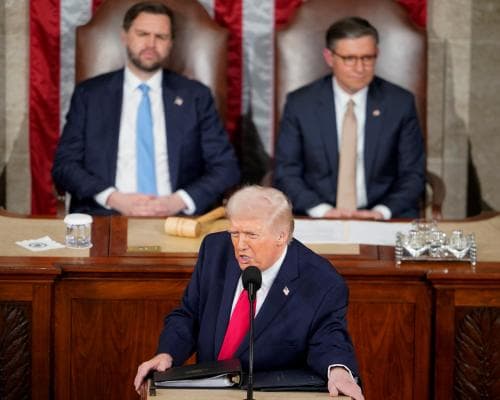
It is one of Donald Trump’s unique talents that he reveals the absurd obsolescence of long-held traditions. In presidential election years, his screaming bloviations on stage make the exercise of gathering the candidates together seem futile. In power, when he divorces facts from policymaking and relies instead on myth and grift to guide his decisions, he renders useless and impotent vast fields of expertise. When he lies in public, and insists that his fantasies and distortions will dictate the course of government action, he makes those of us in the news business wonder if there’s any point, any more, in gathering and printing the truth. Likewise, many Americans who watched the State of the Union address on Tuesday night might have wondered what the point of these speeches is any more. The constitution mandates that the president provide periodic updates to Congress on the condition of the country. But nowhere does the constitution call for the kind of in-person, televised address that has become an annual staple of the presidency in the era of mass media. And certainly none of the Framers could have pictured the speech that Trump delivered on Tuesday night: a rambling, nearly two-hour address that was heavy on falsehoods, ad libs, and digressions that sometimes seemed like bids to kill time – and remarkably light on policy substance. Throughout the speech, Trump seemed tired. He had difficulty reading from his teleprompter; he gripped the podium with a tightness bordering on desperation, and towards the end of the broadcast, his voice became audibly raspy. He was showing his age. The speechwriters, too, seem to have been exhausted. The address touched on Trump’s typical themes: the supposed criminality and inferiority of immigrants; the mendaciousness of his opponents; his personal virtues and resentments. But the president offered very few new policy ideas, contradicted himself on crucial issues, misrepresented pertinent facts and substantively addressed few of what polls reveal to be the nation’s most pressing concerns. He stopped frequently to address veterans in the crowd and to issue them medals as stunts for the television broadcast; he offered a long and strange digression about the gold medal Olympic match recently won by the US men’s hockey team, many of whom paraded into the House chambers wearing their medals. A decade ago, Trump crystallized a longstanding trend in American politics by avowedly fusing governance and entertainment. But Tuesday’s long-winded and boring spectacle showed that he has lost even the ability to entertain. He has not, of course, lost the ability to offend. Trump lied, saying that he has brought healthcare costs down at a moment when his attacks on Affordable Care Act subsidies have in fact massively increased the premiums paid by many Americans in just the past two months. He made a non-sequitur tangent to attack the rights of trans kids; he claimed, with a kind of vulgar brazenness, that his kidnapping of the Venezuelan leader Nicolás Maduro, and his administration’s subsequent economic blackmail of that country, was creating new opportunities for the Venezuelan people. He claimed that Democrats’ withholding of funding for the Department of Homeland Security over abusive immigration enforcement was causing fallout for areas effected by this week’s east coast blizzard, as the DHS was unable to help clear snow. (The federal agency does not do this.) Even his filler lines reeked with the stench of hypocrisy. “We are building a nation,” he said, “where every child has a chance to build higher and go further.” It was a sentiment that called to mind Liam Conejo Ramos, and all the other children imprisoned in ICE’s concentration camps, whose education, promise, dreams and freedom have been sacrificed to the administration’s racism. In typical form, Trump spent a large swath of his speech attacking immigrants, who he smeared in terms that evoked the algorithm-driven social media where he spends so much of his time. He claimed that reckless driving was due to immigrants being unable to read English-language road signs. He blamed them for crime, lingering on uncomfortable descriptions of the bodily injury, pain and death experienced by those who have experienced violence at the hands of undocumented immigrants, tragedies his administration has been eager to exploit. Perhaps most galling of all, he blamed immigrants – in particular, the Somali-American population in Minnesota – for importing corruption to the United States. “There are large parts of the world where bribery, fraud and corruption are the norm, not the exception,” Trump said, arguing, in a racist line of reasoning previously advanced by his vice-president, JD Vance, that corruption is an congenital condition of cultures that immigrants bring with them to America. However, it is Trump, not any Somali immigrant, who has repeatedly concocted thin pretexts to accept large sums of money from rich people and companies with business before his administration. If Donald Trump wants to find the source of corruption in America, he can simply look in the mirror. It is a problem for the administration that Trump was able to only deliver such flimsy material, and only in so tepid and unconvincing a performance: his poll numbers are cratering. Trump’s approval rating has reached a new nadir: a CNN aggregation of recent polls finds his approval rating at a shockingly feeble 38%. Economic opportunities are lacking, and inflation has not come down in the way that Trump promised it would. Tariffs have hit consumers hard, and Trump seems determined to stick to his policy of pursuing them even after the US supreme court threw them out in a decision last week; ordinary American shoppers, once again, seem doomed to pay the price. Trump and his cronies have repeatedly boasted of a booming stock market, but a staggering proportion of American economic growth seems to be bound up in speculation over the AI industry – investments that will disappear if the technology fails, and result in diminished consumer power if they succeed. Either way, the American worker feels that she is strapped and suffering. Trump’s speech, meanwhile, insisted blithely that everything is fine. It had nothing to offer her. Perhaps the most memorable moment in the deeply forgettable evening came during one of the several moments throughout the evening when Trump berated the Democrats. After pointing at them in the House chamber and calling them “crazy”, Trump said: “We’re lucky we have a country, with people like this. Democrats are destroying our country, but we stopped it, just in the nick of time.” Republicans stood and clapped, but the Democrats just sat there, politely tolerant, while they were berated and smeared. Why did they just sit there and take it? Why were they there at all? This is another thing that Trump has shown to be outdated: civility. Moira Donegan is a Guardian US columnist