
March 29, 2026
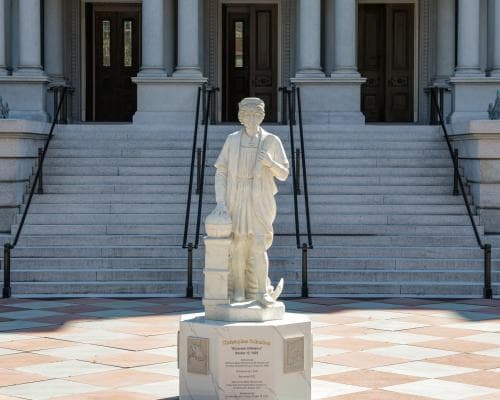
Protesters dumped a Columbus statue in 2020. Trump installed a replica near the White House
In a recent report, Jamil Smith critiques the Trump administration's decision to install a statue of Christopher Columbus near the White House, labeling Columbus as a "hero" despite his documented history of genocide and enslavement. The article highlights the power dynamics involved in historical narratives, arguing that this installation is not just a celebration of Columbus but a deliberate choice to ignore the suffering of Indigenous peoples and rewrite history. Smith contrasts this with the actions of protesters who removed a Columbus statue in 2020, asserting that their actions challenged the dominant narrative. Ultimately, he concludes that the administration's stance reflects a troubling disregard for historical truth and the implications of power in shaping collective memory.
Stoic Response
Address to the Students in the Stoa
Greetings, students of wisdom. Today, we gather not merely to discuss philosophy but to confront a pressing issue that tests our understanding of virtue and justice. The recent decision to honor Christopher Columbus—a figure steeped in a history of violence and oppression—demands our scrutiny.
Challenge the Unhealthy Judgments
-
Acknowledge the Narrative: Recognize that history is often shaped by those in power. The portrayal of Columbus as a hero is not a mere oversight; it is a deliberate choice that overlooks the suffering of countless individuals.
-
Question Authority: Understand that the assertion of Columbus as a hero attempts to impose a narrative. Do not accept it blindly. Reflect on the implications of such judgments.
-
Seek Truth Over Myth: We must distinguish between the glorified tales of conquest and the painful truths of history. What does it mean for us to honor a figure whose actions led to genocide and enslavement?
Anchor in Discipline of Desire, Impulse, and Assent
-
Discipline Your Desires:
- Desire for Acceptance: Resist the urge to conform to popular narratives. True wisdom lies in seeking what is just, not merely what is accepted.
- Desire for Comfort: Understand that confronting uncomfortable truths is essential. Growth often comes from discomfort.
-
Control Your Impulses:
- Impulse to Celebrate: Before celebrating any figure, consider the full weight of their actions. Reflect deeply on the consequences of those actions on marginalized communities.
- Impulse to Dismiss: Do not dismiss the voices of those who challenge the dominant narrative. Engage with them and understand their perspective.
-
Exercise Assent Wisely:
- Assent to Truth: Commit to acknowledging the full scope of history, including its darker chapters. Let your assent be guided by facts, not by the allure of myth.
- Reject Misinformation: When faced with narratives that distort reality, stand firm in your understanding of justice and truth.
Call to Action
-
Educate Yourself and Others: Share knowledge about the true history of figures like Columbus. Engage in discussions that challenge prevailing myths.
-
Support Justice: Stand with those who seek to rectify historical wrongs. Recognize that actions taken today shape the narratives of tomorrow.
-
Cultivate Critical Thinking: Always question the narratives presented to you. Seek out diverse sources and perspectives to form a well-rounded understanding.
In this pursuit, remember: The truth may be uncomfortable, but it is the foundation upon which justice is built. Let us not merely be passive observers of history, but active participants in shaping a more truthful and just society.
Article Rewritten Through Stoic Lens
A Stoic Reflection on the Columbus Statue Controversy
Introduction
In recent events, the Trump administration has taken a definitive stance regarding the installation of a statue of Christopher Columbus near the White House. This decision raises important questions about virtue, historical narratives, and the nature of power. As Stoic philosophers, we must examine the implications of such actions through the lens of reason, virtue, and the distinction between what is within our control and what is not.
The Concept of Heroism
The administration's declaration of Columbus as a "hero" merits careful consideration. Heroism, in a civic context, is not merely a matter of admiration; it is a narrative shaped by collective agreement. Thus, when a statue is erected and labeled as heroic, it reflects a choice about which stories are deemed worthy of honor. This decision is not an objective historical claim but rather a subjective editorial one, influenced by the prevailing power dynamics.
Historical Accountability
Columbus' historical record is well-documented and devoid of ambiguity. The suffering endured by the Indigenous Taíno population following his arrival is a matter of historical fact. Forced labor, violence, and starvation led to the decimation of entire communities. Such truths exist, yet they are often set aside by those in power who prefer a more favorable narrative. To honor Columbus, then, requires a conscious decision to disregard these facts.
The act of memorializing Columbus is not an isolated incident; it is part of a broader pattern where monuments serve dual purposes: they honor while simultaneously instilling fear. This has been evident throughout history, as seen in the proliferation of Confederate statues post-Civil War. By choosing to honor a figure with a troubling legacy, the administration is not merely making a historical claim; it is engaging in a dangerous act of narrative control.
The Role of Protest
The protests that led to the removal of a Columbus statue in Baltimore in 2020 were not an attempt to rewrite history. Rather, they were a challenge to the dominant narrative that glorifies conquest while ignoring the suffering it caused. The protesters understood the significance of their actions, contesting the notion that the pain of marginalized communities is inconsequential. They sought to reclaim the narrative from those in power who had imposed their version of history.
In this context, the installation of a replica statue by the administration can be viewed as a declaration of intent. It suggests a refusal to engage with the complexities of history and an insistence that the prevailing narrative remains unchallenged. This is not merely a cultural dispute; it reflects a profound imbalance of power.
The Nature of Power and Responsibility
The decisions made by those in power often reflect a governing logic that prioritizes narrative over truth. When the United States voted against recognizing the transatlantic slave trade as a crime against humanity, it exemplified a tendency to rewrite history in a way that absolves power from accountability. Acknowledging past harms is meaningless if it does not lead to a commitment to rectify their consequences.
The worldview that permits such actions is one that views sovereign peoples as objects to be overwritten rather than agents of their own stories. Columbus embodies this mindset: a figure who "discovered" lands already inhabited, whose violence has been woven into the fabric of American mythology. The installation of his statue at the White House is a clear indication of the narrative being promoted.
The Importance of Reflection
Symbols carry weight; they shape public perception and dictate which stories are considered authoritative. The statue's presence signals that the voices of those who protested and the truths they sought to illuminate are rendered irrelevant. The question is not merely what Columbus did, but whether society allows this knowledge to inform its collective conscience.
The protesters who challenged the narrative surrounding Columbus provided one answer. The administration's choice to honor him offers a contrasting perspective. The American story has ample room for truth, yet the choice to embrace myth over reality persists.
Conclusion
In the face of such challenges, it is essential to cultivate virtue, wisdom, courage, justice, and temperance. As Stoics, we must recognize what lies within our control: our responses to these narratives and our commitment to truth. The past cannot be erased, nor should it be ignored. Instead, we must carry it forward with the intention of fostering understanding and justice. The task before us is to ensure that the lessons of history are not merely acknowledged but actively shape our present and future.
Source Body Text
The Trump administration recently took a position on a man with a documented record of genocide and enslavement. “In this White House,” a spokesman announced last week, following the installation of a statue on the grounds of the Eisenhower Executive Office Building, “Christopher Columbus is a hero.” It is worth pausing on that word. A hero, in the civic sense, is not merely someone whom people admire. It is someone whose story the country agrees to tell in a particular way. Heroism is a narrative decision. When the White House installs a statue and declares the man it depicts a hero, it isn’t making a historical claim. It is making an editorial one, asserting the authority to decide which version of the past gets to occupy the seat of American power – or to stand on its grounds. Columbus’ historical record is not ambiguous. The Indigenous Taíno population collapsed within decades of his arrival as forced labor, starvation and violence ravaged entire communities. He authorized the enslavement of Indigenous people and the trafficking of women and girls. His own contemporaries documented as much. The accounts existed, and powerful people repeatedly and deliberately set them aside so they could tell a more beneficent story about themselves. Honoring Columbus at the White House does not require discovering these facts. It requires deciding they do not matter. This is hardly without precedent. Monuments such as this have never been neutral. Leaders and acolytes alike use them to simultaneously honor and terrorize. That’s why hundreds of Confederate statues went up after the civil war, most during the early and mid-1900s. Columbus serves a similar function now. By choosing to honor the demonstrably dishonorable, this president is not making a historical argument. He is doing something far more dangerous. We now have an American president who looks at a documented record of genocide and enslavement, decides it changes nothing, and then insists that we all know as much. The statue installed last week is a replica of one that protesters dumped into Baltimore’s Inner Harbor in the summer of 2020, in the weeks after Minneapolis police officer Derek Chauvin murdered George Floyd. Columbus had long occupied American civic space as a founding hero, laundered through myth into something we have taught children to celebrate. Many of us learned it as a rhyme – “In 1492, Columbus sailed the ocean blue” – without learning what happened afterwards. Those protesters understood exactly what they were doing. They were contesting a narrative: rejecting the claim that conquest is heroic, that the suffering underpinning American mythology is beside the point, that the people harmed by that mythology should continue to live beneath its monuments. They were not rewriting history. They were refusing the version of it that more powerful people imposed upon them. Trump’s answer is to install a replica of that same statue on the White House grounds. When people frame such an event as part of a “culture war,” they mischaracterize it as though two sides are simply disputing the meaning of the past, each with an equal claim on the story. That framing misses the power differential entirely. Identity is not a distraction from power. It is how power works. At the UN, the United States recently voted against a resolution declaring the transatlantic slave trade a crime against humanity. In Florida, the state attorney general is demanding that the NFL abandon its Rooney rule, the league’s longstanding policy mandating that teams interview minority candidates for open coaching and executive positions before making a hire. Both reflect a governing logic in which history imposes no obligation – power acknowledges a historical harm, then rewrites the story so that any obligation arising from it becomes the real injustice. Acknowledging the past is pointless if we excuse ourselves from addressing its consequences. This administration has spoken openly about the United States “taking” Cuba, casting sovereign peoples as objects to overwrite rather than agents of their own story. Columbus fits that worldview with uncomfortable precision: a figure who wrote over existing civilizations and called it “discovery,” whose violence America folded into a founding legend because the legend required it. Installing this statue at the White House now is not a coincidence. It is a declaration of narrative intent. It renders debate irrelevant. Objection becomes noise. Trump doesn’t need to defend conquest, whether in Iran, Venezuela, or here in the US. He just needs us to accept it. There is a version of this story in which the statue is merely provocation, political theater meant to generate outrage before the news cycle moves on. Symbols do not just reflect power, though; they tell the public what kinds of stories are authoritative, what kinds of power are worth honoring, and who gets to decide when a counter-narrative carries enough weight to matter. What this symbol says is that the verdict protesters delivered in the summer of 2020 – in the toppling of monuments, in a national confrontation with what those monuments actually celebrated – did not bind anyone with sufficient power to ignore it. Why bother denying history when you think being president allows you to simply edit it? The protesters who dumped Columbus into Baltimore’s harbor were also telling a story. So were the Indigenous scholars and journalists who have spent careers documenting what Columbus actually did and what it costs to keep pretending otherwise. So were the communities that watched those statues fall. A country does not move past its history by refusing to reckon with it. It carries that history forward – not as memory, but as permission. The question is no longer what Christopher Columbus did. Most Americans, if pressed, know enough. The question is whether that knowledge is allowed to matter, and who gets to decide when it does. The protesters who dumped Columbus into Baltimore’s harbor six years ago gave one answer. Trump has given a different one. The American story has plenty of room for the truth, but the president keeps choosing myth instead. Who is going to correct him? Jamil Smith is a Guardian US columnist