
April 5, 2026
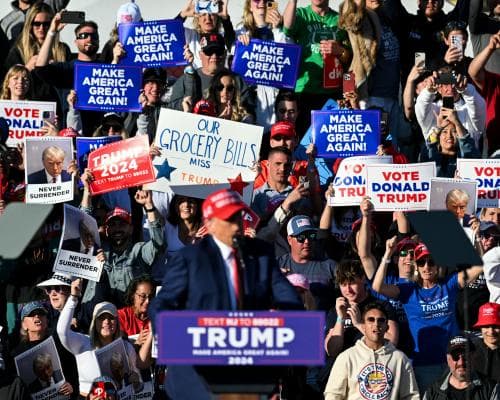
Trump’s working-class support is waning | Jared Abbott and Dustin Guastella
Talking Points:
-
Protagonist and Argument: The narrative centers on Trump’s dwindling support among working-class voters, as revealed by a survey conducted by Jared Abbott and Joan C. Williams. The findings indicate that about 20% of Trump’s 2024 voters are reconsidering their allegiance to the Republican Party, particularly among lower-income and less-educated demographics.
-
Implications for Political Landscape: This erosion of support poses a significant challenge for Republicans, as many of these disillusioned voters are not gravitating towards Democrats either, highlighting a gap in representation for their economic and social concerns.
-
Call for Populism: The authors argue that neither party effectively addresses the needs of working-class voters, suggesting that a genuine populist approach—focused on globalization, cost of living, and elite power—could reclaim this crucial voter base.
-
Strategic Takeaway: The survey serves as a wake-up call for political leaders, emphasizing the necessity for authentic engagement with working-class issues to harness the potential of this demographic, which remains politically volatile and largely undecided.
Stoic Response
Citizens of the Agora,
Today, I stand before you to address a pressing matter that weighs heavily upon our political landscape. Recent findings from a survey conducted by Jared Abbott and Joan C. Williams reveal a troubling trend: approximately 20% of Trump’s 2024 voters, particularly among the working class, are reconsidering their allegiance to the Republican Party. This shift is not merely a statistic; it represents the voices of our fellow citizens who feel overlooked and unheard. The erosion of support among lower-income and less-educated voters signals a deepening chasm in our political discourse, where neither party seems to grasp the urgent needs of those who toil daily to make ends meet.
This moment demands our attention, for it speaks to the cardinal virtue of justice. In a democracy, it is our duty to ensure that every voice is represented and that the concerns of the working class are not drowned out by the clamor of elite interests. The survey indicates that nearly 31% of the lowest-income Trump voters are wavering in their support, while only 3.4% of these disillusioned citizens plan to turn to the Democrats. This is a clarion call for authentic engagement—an opportunity for political leaders to rise above divisive rhetoric and genuinely address the economic and social concerns of the working class.
Moreover, we must embrace the virtue of courage. It takes bravery to challenge the status quo and advocate for a populist approach that prioritizes the needs of the many over the few. The disillusionment felt by these voters is not a rejection of democracy, but rather a plea for a new kind of leadership—one that recognizes the struggles of globalization, the rising cost of living, and the overpowering influence of elites. It is a call for a movement that champions the dignity of labor and the rights of all citizens to participate meaningfully in our democracy.
As we reflect on these findings, let us also remember the virtue of wisdom. The political landscape is shifting, and the potential for a new coalition is ripe for the taking. We must encourage our leaders to listen to the concerns of the working class, to engage in dialogue, and to foster a sense of belonging for all citizens. This is not just a political strategy; it is a moral imperative that will shape the future of our democracy.
I charge you, citizens of the Agora, to demand accountability from our leaders. Let us advocate for a political discourse that embraces the voices of the working class and seeks to uplift, rather than alienate. Together, let us forge a path toward a more inclusive and just society—one where every citizen feels valued and heard. The time for action is now; let us rise to the occasion!
Article Rewritten Through Stoic Lens
The Stoic Reflection on Political Allegiances
Understanding the Protagonist's Dilemma
In our study of the political landscape, we observe a significant shift among those who once rallied behind Trump. A recent survey reveals that approximately 20% of his 2024 supporters are now reconsidering their allegiance to the Republican Party. Here, we find an opportunity to practice the dichotomy of control: while we cannot control the decisions of others, we can control our responses to these changes.
Discipline in Observation: Recognize that the wavering of support is not a reflection of your worth or beliefs but an external event that demands our disciplined judgment. Reflect on what this means for your own values and actions.
Implications for the Political Landscape
The erosion of support among working-class voters presents a challenge not just for Republicans, but for all involved in the political discourse. Many of these disillusioned individuals are not gravitating toward Democrats, revealing a gap in representation for their economic and social concerns.
Right Action in Engagement: Here lies an opportunity for us to engage authentically with those around us. Rather than lamenting the state of politics, let us strive to understand the concerns of others. In doing so, we practice the Stoic virtue of compassion, recognizing that while we cannot dictate the political climate, we can choose to listen and learn.
The Call for Populism
The authors of the survey argue that neither major party adequately addresses the needs of working-class voters. A genuine populist approach, focused on globalization, cost of living, and elite power, could reclaim this crucial voter base.
Judgment in Leadership: This is a moment to reflect on our own leadership, whether in politics or personal life. Are we addressing the needs of those we serve? The Stoic principle of service reminds us that true leadership involves understanding and acting upon the needs of others, even when we feel powerless to change the larger system.
Strategic Takeaway for Authentic Engagement
The survey serves as a wake-up call for political leaders, emphasizing the necessity for authentic engagement with working-class issues. The potential of this demographic remains politically volatile and largely undecided.
Opportunity in Uncertainty: Embrace the uncertainty of political allegiance as a chance to cultivate your own character. Rather than seeking to control the outcome, focus on your own actions and intentions. Engage with those around you, fostering dialogue and understanding. This is where true virtue lies—acting rightly in the face of external chaos.
Conclusion: The Stoic Path Forward
In summary, as we navigate the complexities of political allegiance and societal change, let us remember that while we cannot control the actions of others, we can control our own responses. Each moment of uncertainty is an opportunity to practice discipline, judgment, and right action.
Let us strive to embody the Stoic virtues, engaging authentically with those around us, and fostering a dialogue that transcends mere political allegiance. In doing so, we not only strengthen our own character but also contribute to a more thoughtful and compassionate society.
Source Body Text
A new survey offers some novel insight into Trump’s corroding coalition. The survey, which I (Abbott) conducted with the scholar and author Joan C Williams, sampled about 1,940 Trump voters and captured the attitudes of the broad coalition that brought Trump to the White House in 2024. Respondents were asked if they intended to vote Republican in the 2028 presidential election and, in particular, their views on immigration – Trump’s strongest issue. The results paint a bleak picture for Republicans (but not necessarily a rosy one for the Democrats). The survey finds that approximately 20% of 2024 Trump voters may not vote Republican in 2028, and that almost 57% of voters who switched from Biden in 2020 to Trump in 2024 are considering abandoning the Republican party in 2028. Many among the much-talked-about group of voters that gave him the edge he needed to win the popular vote – working-class, blue-collar voters and lower-income moderates – are now on the fence. The bulk of the now-uncertain Trump voters come from the lower end of the class hierarchy. About 31% of the lowest-income 2024 Trump voters are wavering in their support. Compare that to just 12.7% of those earning more than $200,000. We see a weaker, though still clear, pattern when it comes to education. While 31.8% of Trump voters without a high school diploma and 20% with less than a college education are wavering, that number drops to 17.6% among those with at least a four-year college degree. Put simply, Trump’s coalition is most stable at the top and most fragile at the bottom. It’s not hard to see why. These working-class voters (many of them self-identified moderates, former Democrats, and even some self-described liberals) took a gamble on Trump hoping he would deliver them from an economic squeeze and restore some sense of social peace. One year on, he has not done so, and worse than that, he’s introduced a lot more chaos. Take immigration, Trump’s signature issue. Many blue-collar voters were frustrated by the Biden administration’s handling of the border – and not without reason. There is good evidence that the surge of immigration under Biden’s watch tempered wage growth among workers in construction, manufacturing, and other labor-intensive sectors. At the same time, few workers who voted for Trump out of frustration with Biden and the Democrats thought they were signing up for masked ICE agents abducting peaceable residents without any semblance of due process or gunning down law-abiding American citizens in the streets. To wit, our new survey results show that while only 13.5% of wavering Trump voters say they prefer Joe Biden’s immigration policies over Trump’s, a whopping 50% of these voters think Trump has gone too far on immigration, while just 31.4% believe he has not. Here is a great example of the way that neither party’s preferred policy position really speaks to the needs and interests of many working-class voters. And it’s one reason why, despite the bad news for Trump, the math doesn’t add up to good results for Democrats. Indeed, though about 20% of Trump’s 2024 supporters, concentrated among his working-class voters, are now having second thoughts, the vast majority of those haven’t been won over by the Democrats either. Just 3.4% of Trump 2024 waverers plan to vote blue in 2028, while the lion’s share are undecided, thinking of a third party, or just planning to sit it out altogether. Here is a wake-up call. Trump’s working-class base is eroding, but they won’t be won over by smug I-told-you-so’s and the bad, old liberal habit of talking down to voters, of scoffing at their values, or denying their economic concerns. Only a real full-throated populism, one that takes seriously these voters’ concerns about globalization, the cost of living and the corrosive power of the elite, can win them back. Trump’s coalition is there for the taking, for any populist brave enough to listen to the working class. Jared Abbott is the director of the Center for Working-Class Politics. Dustin Guastella is a research associate at the Center for Working Class Politics and the director of operations for Teamsters Local 623