
April 6, 2026
Don’t believe Trump’s claims about making life more affordable | Steven Greenhouse
Talking Points: "Don’t Believe Trump’s Claims About Making Life More Affordable" | Steven Greenhouse
-
Protagonist and Argument: In his critique, Steven Greenhouse dismantles Donald Trump's claims of improving affordability for Americans, labeling them as exaggerated and misleading. Greenhouse argues that Trump's initiatives, such as the TrumpRX program and housing policies, have minimal impact on the affordability crisis, which he recognizes as a significant concern.
-
Evidence and Analysis: Greenhouse highlights specific examples, such as the limited scope of TrumpRX in reducing prescription drug prices and the ineffectiveness of Trump's executive order on housing, which fails to address the real issue of a housing shortage. He emphasizes that Trump's rhetoric often overshadows the reality of rising costs in essential areas like food, healthcare, and housing.
-
Implications: The implications of Greenhouse's analysis suggest that Trump's approach prioritizes political gain over substantive solutions, potentially misleading Americans during a critical affordability crisis. This raises concerns about the effectiveness of his policies and the potential for further economic strain on working families.
-
Call to Action: Greenhouse urges Americans to critically evaluate Trump's claims and recognize the gap between political rhetoric and tangible outcomes, advocating for a more informed electorate that demands genuine solutions to affordability challenges.
Stoic Response
Stoic Meditation for Dawn Practice
As dawn breaks, let us reflect on the nature of truth and the importance of discernment in our lives. Steven Greenhouse's critique of Donald Trump's claims regarding affordability serves as a poignant reminder of the need for clarity in our understanding of reality.
Author's Claim Restated
Greenhouse argues that Trump's assertions of making life more affordable for Americans are exaggerated and misleading. He emphasizes that initiatives like the TrumpRX program and housing policies have minimal impact on the real affordability crisis facing many families.
Weighing Against Nature and Logos
In the realm of Stoicism, we are taught to align our thoughts with nature and reason (logos). Greenhouse's critique aligns with this principle. He writes, “Trump’s much-ballyhooed efforts to fight inflation are essentially diddlysquat.” This statement highlights the dissonance between political rhetoric and the actual impact of policies. Nature reveals the truth: rising costs in essential areas such as healthcare and housing cannot be ignored, regardless of persuasive claims.
Actionable Reflections
-
Seek Clarity: In our daily lives, strive to discern truth from rhetoric. Just as Greenhouse urges Americans to critically evaluate claims, we too should question the narratives presented to us, whether in politics or personal interactions.
-
Focus on Substance: Prioritize actions and policies that have tangible benefits over those that are merely performative. Assess whether the initiatives in your life—be they personal, professional, or societal—truly address the underlying issues you face.
-
Cultivate Awareness: Remain vigilant about the broader context of issues like affordability. Understand that superficial solutions often fail to address deeper systemic problems. Reflect on your own circumstances and identify areas where genuine change is needed.
-
Engage in Dialogue: Encourage open discussions with others about affordability and related issues. Share insights and foster a culture of informed dialogue, rather than accepting claims at face value.
-
Practice Gratitude: Amidst the challenges of rising costs, take a moment each day to appreciate what you have. Cultivating gratitude can help shift your perspective and foster resilience in the face of adversity.
Conclusion
As the sun rises, let us commit to living with awareness and integrity. Embrace the Stoic principle of aligning with nature and reason, and remain steadfast in your pursuit of truth. In doing so, we contribute to a more informed and resilient community, capable of navigating the complexities of our world.
Article Rewritten Through Stoic Lens
A Stoic Reflection on Claims of Affordability
Protagonist and Argument
In the discourse surrounding the affordability crisis, we find ourselves confronted with claims made by Donald Trump, which merit examination through a lens of virtue and reason. Steven Greenhouse presents a critique of these assertions, suggesting they are overstated and may not align with the reality of the situation. It is essential to recognize that the pursuit of affordability is a significant concern, one that requires our attention and rational assessment rather than emotional reaction.
Evidence and Analysis
Greenhouse provides a rational analysis of Trump's initiatives, such as the TrumpRX program and various housing policies. He notes that these efforts have limited efficacy in addressing the underlying issues of affordability. For instance, the TrumpRX program, which claims to provide low-cost prescription drugs, covers only a fraction of available medications and does not effectively lower prices for the majority of Americans. This highlights a critical Stoic principle: we must discern between what is within our control and what is not. The reality of rising costs in essential areas—food, healthcare, and housing—remains largely outside the influence of political rhetoric.
Moreover, Trump's claims regarding housing affordability, such as prohibiting Wall Street firms from purchasing single-family homes, do not address the root cause of the housing shortage. The Stoic perspective encourages us to focus on actionable solutions rather than superficial measures that do not produce meaningful change.
Implications
The implications of Greenhouse's analysis suggest that Trump's approach may prioritize political expediency over genuine solutions. This raises a vital question: how do we cultivate wisdom in our evaluations of leadership? It is imperative to approach such claims with a discerning mind, recognizing that the gap between rhetoric and reality can lead to misguided beliefs. As Stoics, we must strive for justice and temperance in our judgments, understanding that the effectiveness of policies should be measured by their true impact rather than their presentation.
Call to Action
In light of these observations, we are called to engage in critical reflection. It is our responsibility as citizens to evaluate the claims made by those in power, seeking clarity and truth. We must demand transparency and substantive solutions to the affordability challenges we face. By fostering a well-informed electorate, we can contribute to a society that values wisdom, courage, and justice.
In conclusion, while the claims surrounding affordability may be compelling, it is essential to maintain a Stoic perspective: focus on what we can control, seek virtue in our assessments, and strive for genuine solutions that benefit all.
Source Body Text
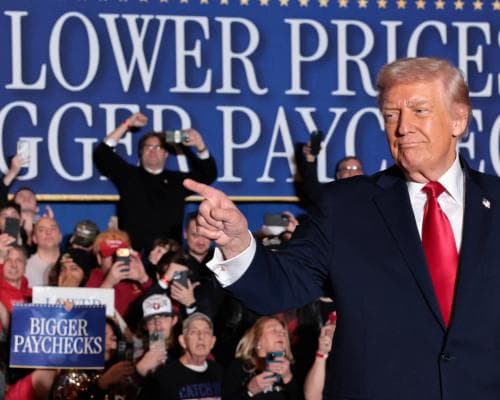
In recent months, Donald Trump has made some absurd comments about inflation, saying the affordability crisis is “a hoax” and “I won affordability,” a clumsy, questionable claim meaning that he somehow conquered inflation. Trump recognizes that affordability is a huge issue, and with his war against Iran proving to be a big political loser, he seems eager to score some political points by telling Americans that he’s moving boldly to cut living costs. But as with everything Trump says, people shouldn’t be tricked by his slick salesmanship. Trump has boasted about cutting prescription drug prices, housing prices, food prices and gasoline prices. All that might be great public relations for Trump, but it’s grossly exaggerated nonsense. Trump’s much-ballyhooed efforts to fight inflation are essentially diddlysquat. Many of them are mini efforts that have had mini effects in reducing prices. They’re as meaningful as a degree from Trump University. Trump often boasts that his egomaniacally named TrumpRX program will be a boon for Americans by supposedly bringing “the world’s lowest prices” for prescription drugs. But as of this weekend, TrumpRX covered only 61 of the country’s several thousand prescription medications – a drop in the ocean of high-priced prescription drugs. What’s more, Trump is flat-out wrong when he says TrumpRX is offering the world’s lowest drug prices. TrumpRX sells a medium dose of Wegovy, a weight-loss drug, for $349, while that same dose sells for $163 in Japan and $198 in Germany. According to a New York Times analysis, Xigduo, a drug for diabetes, is $116 cheaper in Germany than on TrumpRX; Xeljanz, a drug for auto-immune diseases, is $1,653 cheaper there. The TrumpRX website is one big, glossy, government-paid advertisement for Trump and his ego, but for the vast majority of Americans, it will do nothing to cut their drug prices. TrumpRX is designed to help uninsured, cash-paying patients, but not the 85% of Americans who have prescription drug insurance coverage. With many Americans complaining about housing costs, Trump has trumpeted that he’s helping hold down rents with his executive order that prohibits Wall Street firms from buying single-family homes. But with Wall Street firms and other institutional investors owning only about 2% of the country’s single-family homes, housing experts say this effort will do little or nothing to reduce housing prices or rents. The overriding cause for high housing prices and rents isn’t Wall Street, but a severe shortage of housing units. Zillow says there is a shortage of 4.7m housing units nationwide. Making matters worse, Trump’s war in Iran has caused mortgage interest rates to jump sharply. It’s important to remember that for a smooth-talking demagogue like Trump, the goal isn’t so much to accomplish good things, but to make Americans believe he is accomplishing good things. From the moment Trump returned to the White House, he boasted he was cutting gasoline prices, largely by tossing out environmental protections and letting fossil fuel companies “drill, baby, drill”. But ever since Trump began bombing Iran, gas prices have soared, with a gallon of regular jumping to $4.10 on average as of Saturday, a 37% jump from $2.98 before the war started. Candidate Trump promised to reduce food prices on day one, but, sorry folks, food prices have risen since Trump’s inauguration, although that hasn’t stopped him from bragging that he reduced food prices. He often boasts that eggs prices are way down (thanks not to Trump, but to a sharp decrease in avian flu). But food prices overall have risen, climbing 3.1% between February 2025 and February 2026, with coffee prices jumping by 18.4%, beef by 14.4% and fresh vegetables by 5.4%. Trump’s beloved tariffs have hiked prices on many food items and other things, indicating that he cares more about raising tariffs than about reducing prices. Even as Trump boasts that he “won affordability”, the Organization for Economic Cooperation and Development forecasts that inflation will climb above 4% in the US this year, largely because of Trump’s war against Iran, well above the 3% rate when Biden left office. Trump has absurdly claimed he “inherited the worst inflation” in history from Biden. Part of Trump’s boast about affordability is that he has put more money in people’s pockets. He brags about no taxes on overtime or Social Security. But those boasts are false. In his speech last month in Hebron, Kentucky, Trump said: “Every extra hour you work, your overtime pay is now 100% tax-free. You have no tax.” The truth is that every overtime hour people work, two-thirds of their pay is subject to federal income tax, while 100% is subject to federal social security and Medicare payroll taxes. Only the “half” in time-and-a-half overtime pay is free from federal income tax. If your base pay is $20 an hour and you receive $30 for each overtime hour, you must still pay income tax on your $20 an hour, but not on the $10 overtime premium. “No tax on overtime” is a slick, but false slogan. The White House says there is no tax on social security, but that, too, is bunk. The nonpartisan Tax Policy Center says that more than half of seniors receiving social security will still pay some income tax on their benefits. The center wrote that under Trump’s budget bill, “most would see their income taxes on Social Security benefits reduced, not eliminated.” While Trump insists there’s no tax on social security, his own Social Security Administration says that more than 10% of Americans will continue to pay taxes on their benefits – an estimate the Tax Policy Center says is far too low. To give credit where it’s due, Trump pushed for “no tax on tips”, and under last year’s new tax law, tips generally aren’t taxed. But that provision is very limited in that it benefits only the 1.7% of US workers employed in tipped jobs, meaning that more than 98% of workers don’t benefit. Trump also crows that Trump Accounts will be great for struggling families. In that program, the federal government makes a one-time, seed deposit of $1,000 when a child is born. The child’s family can deposit up to $5,000 per year into this tax-deferred account up to age 18. This is good news for wealthy families that can easily put $5,000 a year into these baby savings accounts, but for the millions of families that live paycheck to paycheck and can’t effort to make deposits beyond that initial $1,000, Trump Accounts will mean very little. While providing meager help for struggling families, this program will, just like 401ks and the mortgage interest deduction, disproportionately help wealthy Americans. Let’s not forget that Trump has taken specific actions that have made life less affordable for millions of Americans. He pressed Congress not to extend Obamacare subsidies, and as a result average healthcare premiums have soared by more than 20% for over 20 million Americans. As part of his new budget, Trump is pushing to end subsidies that help 6m low-income households pay their heating and cooling bills. While tens of millions of Americans struggle, Trump often seems focused on building his $400m gilded ballroom and more recently a glitzy sky-high presidential library/monument to himself in Miami. All these Trumpian efforts to supposedly cut prices and increase affordability sound nice. They have great PR value and aim to maximize political advantage to Trump, but most of these programs will do far less than advertised to help America’s working families. Many will have an itty-bitty effect, doing little or nothing for average families. Americans shouldn’t be fooled by Trump’s salesmanship. Steven Greenhouse is a journalist and author, focusing on labour and the workplace, as well as economic and legal issues