
April 16, 2026
Why were these two US immigration judges fired? | Seth Stern
In this report, Seth Stern discusses the recent firings of immigration judges Roopal Patel and Nina Froes by the Trump administration, which appears to be prioritizing political loyalty over constitutional rights. Both judges were dismissed for ruling in favor of noncitizens expressing critical views on U.S. policies, with Patel rejecting the notion that such expressions equate to supporting terrorism. The author concludes that this trend signals a dangerous shift in the judicial landscape, where immigration judges may be incentivized to suppress free speech and prioritize deportations over due process. Stern warns that this could set a precedent for broader abuses of power against dissenting voices in the future.
Stoic Response
Stoic Meditation for Dawn Practice
Author's Claim
In his report, Seth Stern argues that the recent firings of immigration judges Roopal Patel and Nina Froes highlight a troubling trend where political loyalty is prioritized over constitutional rights. This shift signals a potential erosion of free speech and due process in the judicial landscape, particularly for noncitizens. He states, "The trend signals a dangerous shift in the judicial landscape, where immigration judges may be incentivized to suppress free speech and prioritize deportations over due process."
Weighing Against Nature and Logos
From a Stoic perspective, nature and logos emphasize the importance of virtue, justice, and rationality. The actions taken by the Trump administration, as described by Stern, appear to contradict these principles. The Stoics believed that justice is a fundamental virtue, essential for the well-being of society. By firing judges for upholding constitutional rights, the administration undermines the very foundation of justice.
As Marcus Aurelius wrote, “The universe is change; our life is what our thoughts make it.” The current climate may seem chaotic, but it is our duty to maintain our integrity and act justly, regardless of external pressures.
Actionable Reflections
-
Seek Inner Virtue: Reflect on your own values and principles. In times of uncertainty, hold fast to your commitment to justice and fairness. Consider how you can embody these virtues in your daily life.
-
Practice Detachment: Recognize that while you may not have control over external events, you do have control over your responses. Cultivate a sense of detachment from the outcomes of political actions, focusing instead on your own moral compass.
-
Engage in Dialogue: Foster conversations about the importance of free speech and due process. Use your voice to advocate for those who may be silenced, understanding that speaking out is a form of exercising your own rights.
-
Reflect on the Bigger Picture: Consider the long-term implications of current events. How do they align with the principles of justice and virtue? Use this reflection to guide your actions and decisions.
-
Embrace Community: Connect with others who share your values. Together, you can support each other in advocating for justice and ensuring that the principles of due process are upheld.
Conclusion
As dawn breaks, let this meditation serve as a reminder to remain steadfast in your commitment to justice and virtue. The world may be fraught with challenges, but through rational thought and virtuous action, we can contribute to a more just society. Embrace the Stoic teachings, and let them guide you in navigating the complexities of our time.
Article Rewritten Through Stoic Lens
Reflections on the Nature of Justice and Authority
The Firing of Judges: A Lesson in Acceptance
In recent days, I have learned of the dismissal of Judges Roopal Patel and Nina Froes, who upheld the principles of justice amidst a tempest of political loyalty. These events remind me of the ever-turning wheel of fortune, where the virtuous may find themselves cast aside for their adherence to truth. In this, I find an opportunity to reflect on the nature of duty and the acceptance of what is beyond my control.
The Nature of Expression
Judge Patel’s refusal to equate dissent with terrorism speaks to the heart of our shared humanity. It is a reminder that to express a critical view is not to incite violence but to engage in the discourse that defines us as rational beings. In this world, where many may suffer for their beliefs, I must cultivate a spirit of understanding and compassion, recognizing that the path of virtue often leads through the valley of misunderstanding.
The Consequences of Authority
The actions of those in power, such as the administration’s prioritization of loyalty over constitutional rights, serve as a poignant reminder of the fragility of justice. It is easy to lament the state of affairs, yet I must instead focus on how I can embody virtue in my own life. The judges who remain, like Blake Doughty, may choose a path of expediency over integrity, but it is not for me to judge them harshly. Rather, I must strive to uphold the principles of fairness and equity in my own dealings.
The Illusion of Expertise
The reasoning that one must possess complete understanding to advocate for another is a dangerous fallacy. It reflects a misunderstanding of the essence of justice, which is not reserved for the learned alone but is a right of all. I must remind myself that wisdom often resides in the hearts of those who dare to question and challenge the status quo. In this, I find strength in my own beliefs and the courage to speak out against injustice.
The Nature of Power
The broader implications of these actions extend beyond individual cases. They serve as a cautionary tale of how power can corrupt and silence dissent. I recognize that the forces of authority may seek to suppress those who challenge their narrative, but I must remain steadfast in my commitment to truth. The history of governance teaches us that such powers, once granted, are rarely relinquished. Thus, I must remain vigilant, not only for myself but for those who may come after me.
Embracing the Present
As I reflect on these events, I am reminded of the importance of embracing the present moment. The world may be fraught with injustice, but I can choose how to respond. I will cultivate a spirit of resilience and compassion, seeking to uplift those who are silenced. In doing so, I align myself with the greater good, understanding that my actions, however small, contribute to the tapestry of justice.
Conclusion: A Call to Virtue
In the face of adversity, I am called to embody the virtues of courage, wisdom, and justice. The dismissals of Patel and Froes are but a chapter in a larger narrative, one that I can influence through my own choices. I will strive to be a beacon of hope and integrity, recognizing that true strength lies not in the power to silence others, but in the ability to uplift and advocate for the voiceless. Thus, I accept the unfolding of events with equanimity, knowing that my response is where my true power resides.
Source Body Text
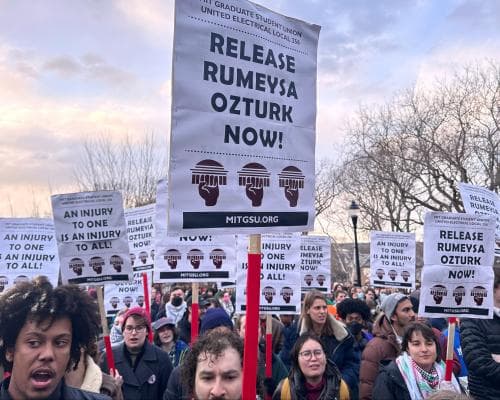
The Trump administration believes some noncitizens may not even have first amendment rights. And it’s turning that legal fantasy into a reality by making immigration judges choose between the constitution and their jobs. Last week, the judge who rejected the deportation of Rümeysa Öztürk, the Tufts doctoral student whose only offense was co-writing an op-ed critical of Israel, was fired after upholding the law. Judge Roopal Patel rejected the administration’s argument that expressing views shared by millions of Americans disturbed by the carnage in Gaza – sometimes including Donald Trump himself – equates to supporting terrorism and antisemitism. Also let go by the Department of Justice, which hires and fires immigration judges, was Judge Nina Froes. She terminated the removal case against Mohsen Mahdawi over his involvement in campus protests at Columbia. The secretary of state, Marco Rubio, perplexingly argued, in a memorandum supporting the removal, that Mahdawi’s antiwar activities interfered with the administration’s purported goal of ending the war in Gaza peacefully. But while Froes and Patel pack their bags, Blake Doughty, an immigration judge in Atlanta, remains on the bench. And his recent opinion ordering the deportation of Ya’akub Vijandre – a Daca recipient, Red Cross-trained first aid responder, activist and photojournalist – may have secured his seat on the bench for the foreseeable future. There’s precedent: the Louisiana immigration judge Jamee Comans was promoted to acting assistant director of the office of policy at the Executive Office for Immigration Review months after ordering the pro-Palestine activist Mahmoud Khalil removed. The constitutional cluelessness reflected by Doughty’s order is appalling. In other words, it’s the exact order the Trumps and Stephen Millers of the world probably wish Patel and Froes had written, and it’s the kind of legal analysis they hope to see from judges economically incentivized to deport journalists, writers and activists who exercise their free speech rights. Vijandre drew the administration’s ire through posts on social media expressing support for defendants known as the “Holy Land Five” and others convicted on terrorism-related charges. The Five were leaders of the Holy Land Foundation, which was the largest Muslim charity in the US before the government designated it a terrorist organization for giving money to organizations it claimed were tied to Hamas. There was no evidence the foundation’s money bankrolled terrorism or violence. Vijandre believes they were wrongly convicted and therefore has supported their legal defense. He has advocated for their right to due process and better prison conditions. Doughty found this amounted to material support for terrorism. It’s like claiming The Innocence Project supports murder by advocating for convicted murderers to be freed. In what universe is believing someone didn’t do what they’re accused of doing equivalent to supporting what they’re accused of? Doughty did not point to a single post by Vijandre that actually supported alleged terrorism. If he had, that wouldn’t have cured the constitutional issues with his order, but we don’t even need to go there, because he didn’t. Here’s Doughty’s convoluted reasoning in his own words: “Given the respondent’s acknowledged ignorance of the specific criminal convictions [of the Holy Land Five], the Immigration Court reasonably concludes respondent’s belief in their innocence is based on ideological affinity with HLF rather than a factual understanding of the criminal conduct.” Under this logic, the first amendment is only for subject matter experts. You can’t defend someone unless you have full command over the nuances of their case – and if you don’t, your advocacy only proves your extremism. But plenty of highly informed people have criticized the Holy Land Foundation prosecution. A 2022 letter calling on then president Joe Biden to pardon the Five was signed by more than 70 lawyers, activists, rights organizations and others. Human Rights Watch and Amnesty International have, like Vijandre, raised concerns about the treatment of Aafia Siddiqui, who was convicted in 2010 of attempted murder after allegedly attacking US officers in Afghanistan. That means agreement with the world’s leading human rights organizations is now evidence of support for terrorism. Of course, opinions not held by scores of scholars are also constitutionally protected, whether or not a judge agreed with them. But Judge Doughty’s order nonetheless dismisses Vijandre’s credibility and first amendment rights with condescending pseudo-psychological pronouncements that have no legal significance. “The respondent’s worldview is informed by extremist ideology to such an extent that he no longer has the ability to provide reliable or credible factual statements,” the ruling states matter-of-factly. Doughty goes on to opine, based on exactly nothing, that Vijandre is “so heavily influenced by fringe online elements” he lacks a “meaningful grasp of truth regarding terrorism”. The same judge who thinks Vijandre’s résumé doesn’t qualify him to have an opinion apparently sees himself as perfectly competent to serve as the arbiter of objective truth and conduct unlicensed psychoanalysis. I’d say he shouldn’t quit his day job, but he actually should. Doughty’s reasoning is even more dangerous under the broadened domestic terrorism guidelines of NSPM‑7, which, it seems, the Trump administration can’t wait to abuse. Will the next immigrant who questions, for example, the convictions of alleged members of so-called Antifa for wearing black or possessing zines be subject to deportation? How about someone who merely opposes Trump’s immigration enforcement actions, which, ICE agents have claimed, earns them a spot on a domestic terror watchlist? Or, under a future administration, how about someone who defends Trump’s pardons of convicted participants in the January 6 attack? There’s no reason to think the powers Trump claims to fight domestic terror won’t be used by other presidents, regardless of party. We saw a preview when the Obama administration adopted much of Bush’s global war on terror playbook for everything from mass surveillance to targeting journalists and whistleblowers to covert drone strikes in the Middle East. Those in charge rarely relinquish powers handed to them by their predecessors. And while social media was Vijandre’s medium, nothing in Doughty’s ruling exempts journalists, commentators or opinion writers from similar treatment. Öztürk, of course, was abducted by masked ICE goons over an op-ed, while journalists like Mario Guevara, who was deported to El Salvador, and more recently Estefany Rodríguez have allegedly been targeted due to their coverage of Trump’s immigration policies and protests against them. The British journalist Sami Hamdi was thrown in ICE jail amid a speaking tour. A recent email to law students at conservative Liberty University reportedly said that, in order to work for Trump’s justice department: “The two most important requirements are you MUST be aligned politically with President Trump and his administration and you must be willing to work hard … GPA is not a strong factor.” The administration has similarly lowered hiring standards for immigration judges specifically. It’s a hiring policy designed to recruit more judges like Doughty and fewer like Patel and Froes. And in case any of those law-over-loyalty judges slip through the cracks and acknowledge that immigrants are entitled to have opinions, now they’re on notice. Seth Stern is the chief of advocacy at Freedom of the Press Foundation (FPF) and a first amendment lawyer