
April 24, 2026
Trump cannot bear the judgments of Pope Leo | Sidney Blumenthal
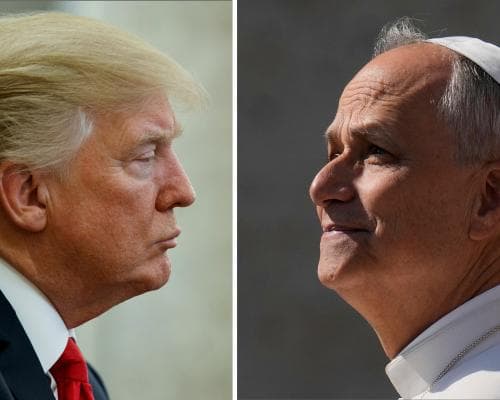
In "Trump cannot bear the judgments of Pope Leo," Sidney Blumenthal argues that Donald Trump's reaction to Pope Leo XIV's moral critiques reflects his fragile ego and authoritarian tendencies. The Pope's calls for peace and condemnation of Trump's policies, particularly regarding immigration and war, have incited Trump's ire, revealing his inability to tolerate dissent from a figure of moral authority. This conflict matters as it underscores the broader tensions between Trump's nativist agenda and the Catholic Church's historical role as an advocate for immigrants, highlighting the potential fractures within the GOP's coalition of evangelical and Catholic supporters.
Stoic Response
Reflecting on the Tension Between Authority and Ego
In the turmoil surrounding Donald Trump's reaction to Pope Leo XIV's moral critiques, we observe a profound tension: the clash between authority and fragile ego. As Blumenthal notes, Trump's inability to tolerate dissent, especially from a figure of moral stature like the Pope, reveals his deep-seated insecurity. This conflict serves as a reminder of the Stoic principle that we must focus on what lies within our control and accept what does not.
Recognize What You Can Control
The Stoics teach us that our responses to external events are within our control, while the events themselves are not. Trump's fury at Leo's moral stance illustrates a failure to recognize this distinction. Instead of seeking validation from external figures, we must look inward. Reflect on your values and principles, and understand that the opinions of others, even those in positions of authority, do not define your worth.
Cultivate Inner Strength
In the face of criticism or dissent, cultivate your inner strength. As Pope Leo stated, “True strength is shown in serving life.” Embrace this notion by focusing on how you can contribute positively to the world around you. Engage in acts of service, kindness, and understanding. This will not only fortify your character but also help you rise above the noise of external judgments.
Practice Acceptance
Acceptance is a core tenet of Stoicism. Recognize that external events, such as political criticism or moral condemnation, are beyond your control. Instead of reacting with anger or frustration, practice acceptance. Understand that dissent can be a catalyst for growth and reflection. Ask yourself: What can I learn from this situation? How can I improve myself in light of this feedback?
Act with Integrity
Finally, act with integrity and align your actions with your values. As Blumenthal highlights, Trump’s response to the Pope reveals a struggle for power rather than a commitment to moral principles. In contrast, strive to embody the values you hold dear, regardless of external pressures. Stand firm in your convictions, but do so with humility and respect for others, even those who may challenge you.
By following these Stoic principles, you can navigate the complexities of authority and ego with grace and resilience.
Article Rewritten Through Stoic Lens
Reflections on Authority and Virtue: A Stoic Perspective
Introduction
In the discourse surrounding the recent tensions between Donald Trump and Pope Leo XIV, we observe a manifestation of the Stoic principles of virtue, wisdom, courage, justice, and temperance. The reactions of individuals in positions of power often reveal their character, and it is through this lens that we must evaluate the unfolding events.
The Nature of Authority
The historical reference to Henry II and Thomas Becket illustrates a timeless struggle between temporal authority and moral guidance. The expectation of absolute loyalty from subordinates, as demonstrated by Henry II's knights, is a reflection of a fragile ego unable to tolerate dissent. In contrast, the Stoic philosopher recognizes that true authority lies not in coercion but in the ability to uphold virtue and wisdom.
The Role of Moral Critique
Pope Leo XIV's critiques of Trump's policies, particularly regarding immigration and warfare, serve as a reminder of the importance of moral accountability. The Stoic approach emphasizes that while one may not control the judgments of others, one can control their own responses. Trump's reaction—characterized by indignation and a sense of betrayal—highlights a failure to embrace the virtue of temperance. Instead of reflecting on the merits of the Pope's moral stance, he perceives it as a personal affront.
The Illusion of Control
Trump's assertion that the Pope was elected to counter his presidency reveals a profound misunderstanding of the nature of leadership. The Stoic teaches that we must distinguish between what is within our control—our thoughts, intentions, and actions—and what is not—the opinions and decisions of others. The Pope’s call for peace amidst conflict is a reminder that true strength is found in serving the greater good, rather than in the pursuit of personal power.
The Fragility of Ego
Trump's reaction to the Pope's condemnation is emblematic of a deeper fragility. In his insistence that he is fulfilling the will of the people, he overlooks the Stoic principle that virtue is not determined by popularity or success but by adherence to moral principles. His fury in response to the Pope’s moral authority reveals a lack of self-awareness and an inability to accept constructive criticism.
The Intersection of Politics and Faith
The relationship between Trump and his evangelical supporters illustrates the complexities of faith intertwined with political identity. The Stoic recognizes that true virtue transcends partisan divides and is rooted in justice. The conflation of political allegiance with religious devotion raises questions about the authenticity of one’s moral compass. The Stoic seeks to cultivate a sense of justice that is independent of external validation.
The Response to Conflict
In the face of conflict, the Stoic philosopher advocates for dialogue and understanding rather than retaliation. The Pope's emphasis on diplomacy and consensus stands in stark contrast to the militaristic rhetoric often espoused by Trump. The Stoic approach encourages us to engage with differing perspectives, recognizing that wisdom is often found in the humility to listen and learn.
Conclusion
The unfolding dynamics between Donald Trump and Pope Leo XIV serve as a rich tapestry for examining the Stoic virtues of wisdom, courage, justice, and temperance. As we navigate the complexities of authority and moral critique, let us strive to cultivate an inner strength that is rooted in virtue, recognizing that our true power lies not in domination but in the pursuit of a just and harmonious existence. In this pursuit, we must remember that while we cannot control the judgments of others, we can control our responses and our commitment to living a life of virtue.
Source Body Text
“Who will rid me of this meddlesome priest?” Henry II was reputed to have muttered. His knights heard his pointed remark as an order. They rode to confront Thomas Becket, the archbishop of Canterbury, who spoke too freely and critically about the king. When they failed to intimidate him into silence, they murdered him. Absolute rule demanded absolute fealty. The representative of the holy trinity could not be allowed to stand above the unitary executive in 1170. Donald Trump believed that the conclave of the college of cardinals elected Robert Prevost as Pope Leo XIV on 8 May 2025 for the gratification and exaltation of Donald Trump. “He wasn’t on any list to be Pope,” Trump posted on 12 April this year, “and was only put there by the Church because he was an American, and they thought that would be the best way to deal with President Donald J Trump. If I wasn’t in the White House, Leo wouldn’t be in the Vatican.” Leo wears the shoes of the fisherman, not the black Florsheim models that Trump insists his underlings wear. As the Iran war continued, the pope called for peace. Trump felt betrayed, aggrieved and victimized that the pope would not kneel at his throne. To his horror, Trump could not stop the moral censure of his policies from mass deportations to the Iran war. As Trump floundered in the strait of Hormuz, the pope’s condemnation was especially damning and humiliating. “Enough of the idolatry of self and money! Enough of the display of power! Enough of war!” said Leo on 11 April. “True strength is shown in serving life.” Leo’s condemnations fell upon Trump harder than courtroom verdicts. There was no higher appeal. Trump could not wield the pardon power on his own behalf. The threatened withdrawal of federal contracts or security clearances could not make Leo cower as if he were a law firm or university. Trump’s cancellation of a grant to a Catholic charity in Miami ministering to immigrant children only highlighted his cruelty. No tariff could leverage Leo. Unlike his predecessor Francis, he could not be dismissed as an out-of-touch alien. Leo, who holds a doctor of canon law degree from the Pontifical University of St Thomas Aquinas in Rome, is also Bob from the south side of Chicago, a White Sox fan. The most despised American in the world cannot bear the judgments of the most admired American in the world. Trump’s wounded pride has festered from envy into malice. Trump’s expectation of submission dashed, he flew into a fury, but his rage could not overawe Leo. He treated the pope like a politician who would crumble before his bluster. “Pope Leo is WEAK on Crime, and terrible for Foreign Policy,” he tweeted. Trump exposed his own irreparable fragility: “I don’t want a Pope who criticizes the President of the United States because I’m doing exactly what I was elected, IN A LANDSLIDE, to do, setting Record Low Numbers in Crime, and creating the Greatest Stock Market in History. Leo should be thankful because, as everyone knows, he was a shocking surprise.” Was the pope’s election rigged? Does he use an auto-pen? “I have no fear,” said Leo in a matter-of-fact tone that evoked Psalm 23: “I will fear no evil; for thou art with me.” On 12 April, Trump posted an image of himself as a Christlike figure in a white robe healing a sick man. He soon deleted the post. Excoriated for blasphemy and silliness, Trump tried to explain that he was not pictured as Christ but a doctor – surrounded by angels, a devil and a jet fighter perhaps to reference his stated intention to bomb “a whole civilization”, no less than “back to the Stone Ages”. “Trump is far too lightweight a figure to be the Antichrist foretold in the Bible. But what Trump is unambiguously doing is manifesting the spirit of Antichrist,” wrote Rod Dreher, a conservative writer who was instrumental in his religious conversion. Like Lucifer, the protagonist of John Milton’s Paradise Lost, refusing to accept his status below God, Trump rebels against Heaven itself. But as Dreher observes, Trump lacks the self-consciousness of Lucifer while inhabiting his destructive ire: “Which way I fly is Hell; myself am Hell,” says Lucifer. Or, as Dreher put it: “Batshit crazy.” Though notoriously illiterate about religion – Trump once cited “Two Corinthians” – he is keenly aware that he is venerated by white evangelical Christian nationalists. Despite his tribulations, white evangelicals remain among his strongest devotees. Christian nationalists pray at the altar of the church of Trump. Their relationship to Trump long ago melded partisan politics with a cult of personality to form a revised religious identity. In this theology, Trump is both king and Christ. At a White House prayer breakfast on 1 April, he told an assemblage of preachers: “On Palm Sunday, Jesus entered Jerusalem as crowds welcomed him with praise honoring him as king. They call me king now. Can you believe it?” Paula White-Cain, the chair of the White House faith office, likened Trump to the Maga Jesus: “You were betrayed and arrested and falsely accused. It’s a familiar pattern that our lord and savior showed us.” She had delivered the opening prayer at the January 6 rally at the White House to the mob carrying Christian nationalist banners before the attack on the Capitol, calling for “holy boldness”. Since the Reagan presidency, the alliance between evangelical Christians and conservative Catholics has been the essential coalition of the reframed Republican party. They were fastened tightly together by the abortion issue, the key element of the culture war. Their fusion was a carefully engineered political operation. Anti-Catholicism has always been at the center of American nativism. The Know Nothing party of the 1850s pledged to bar Catholics from holding public office. In 1960, John F Kennedy, under harsh attack as an unpatriotic papist, went into the lion’s den to address the Greater Houston Ministerial Association of Protestant pastors to assure them: “I believe in an America where the separation of church and state is absolute” and “where no public official either requests or accepts instructions on public policy from the Pope”. In 1982, religious right operatives overturned the fundamental theology of the Southern Baptist Convention, the largest evangelical group, on abortion to align it with conservative Catholicism. Previously, the SBC had approved resolutions upholding the right to abortion and against prayer in schools. Ed McAteer, a former Colgate Palmolive sales manager who founded the Religious Roundtable, explained to me for an article I wrote in the New Republic in 1984 how he closely coordinated with the Reagan White House to pack the SBC convention and pass the anti-abortion resolution. In 2022, the conservative majority on the supreme court, mostly conservative Catholics installed since Reagan, overturned Roe v Wade, eliminating the right to abortion at the federal level. The removal of abortion on the right as a national issue also had the effect of loosening the political adhesiveness behind the evangelical/Catholic fusion despite the growth of a rightwing Catholic infrastructure financed by reactionary billionaires. The ultimate fruition of the Reagan era project paradoxically set the stage for Trump’s war on Leo. Trump has pursued a nativist crusade to mass-deport immigrants, most of them Catholic. Since the first wave of immigration in the 19th century, the church in America has been an immigrant body. Trump’s deployment of ICE was an attack on the larger congregation. ICE, not abortion, became the crisis for the Catholic church. On 12 November 2025, the US Conference of Catholic Bishops issued a “Special Message”, its first in 12 years since it had criticized the Obama administration for providing women’s reproductive services. “We oppose the indiscriminate mass deportation of people,” read its statement. The bishops denounced “a climate of fear and anxiety around questions of profiling and immigration enforcement” and “the vilification of immigrants”. On 9 January of this year, Leo delivered a speech in the wake of Trump’s military operation in Venezuela and Russia’s continuing war on Ukraine. “A diplomacy that promotes dialogue and seeks consensus among all parties is being replaced by a diplomacy based on force,” he said. “War is back in vogue and a zeal for war is spreading. The principle established after the second world war, which prohibited nations from using force to violate the borders of others, has been completely undermined.” On 22 January, Elbridge Colby, undersecretary of war for policy, who is Catholic, summoned the cardinal Christophe Pierre, then the Vatican’s ambassador to the United States, to the Pentagon, where, according to a report, he lectured him on the strength of the US armed forces and instructed him he “had better take its side”. Colby reportedly reminded Leo’s emissary of the fate of the Avignon papacy, when Philip IV of France kidnapped Pope Boniface VIII from Rome in 1309, taking him to Avignon, where he promptly died apparently from abuse. (The administration and Vatican challenged the reporting on the meeting’s details.) But Colby did not silence the Pope. Once the Iran war was launched, Trump’s threats could not stifle him, either. On 15 April, the US bishops’ chair, Bishop James Massa, issued a “Clarification on Just War Theory”: “That is, to be a just war it must be a defense against another who actively wages war, which is what the Holy Father actually said: ‘He does not listen to the prayers of those who wage war.’” Trump assigned a new knight to joust against the Pope. JD Vance, who converted to Catholicism in 2019 but is nonetheless a leading apostle of the conservative faction that Leo is isolating, warned: “I think it’s very, very important for the pope to be careful when he talks about matters of theology.” Vance explained on: “It would be best for the Vatican to stick to matters of morality, to stick to matters of whatʼs going on in the Catholic church and let the president of the United States stick to dictating American public policy.” The novitiate sermonizing to the Pope was indulging in more than spiritual presumption. The vice-president confused his own administration’s policy. The day before he admonished the Pope, at a hearing of Trump’s Religious Liberty Commission, its chair, Dan Patrick, the lieutenant governor of Texas, declared that every school and business should post “that the separation of church and state is the biggest lie that’s been told in America since our founding”. But in seeking to undermine the Pope, Vance was performing his duty as defender of the faith for his master, who, like Milton’s Lucifer, is intolerant of any authority other than his own: “Better to reign in Hell than serve in Heaven.” Sidney Blumenthal, former senior adviser to Bill Clinton as well as Hillary Clinton, has published three books of a projected five-volume political life of Abraham Lincoln: A Self-Made Man, Wrestling With His Angel and All the Powers of Earth. He is a Guardian US columnist