
April 30, 2026
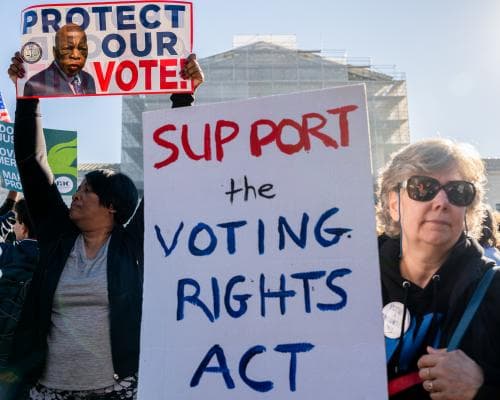
The supreme court’s voting rights decision is a death knell for American democracy | Moira Donegan
Talking Points: The Supreme Court’s Voting Rights Decision is a Death Knell for American Democracy
-
Protagonist and Argument: In her article, Moira Donegan argues that the Supreme Court's recent decision in Louisiana v. Callais marks the effective end of the Voting Rights Act (VRA) and, by extension, a significant retreat from true democracy in America. She asserts that the court's ruling dismantles essential protections against racial discrimination in voting, thereby undermining the democratic principle of equal participation.
-
Historical Context: Donegan contextualizes this decision within a broader historical narrative, stating that America has rarely been a true democracy, with the VRA representing a critical milestone in ensuring voting rights for all citizens, particularly Black Americans. The court’s actions, she argues, represent the culmination of a long-standing effort to weaken these protections, initiated with the 2013 Shelby County v. Holder ruling.
-
Implications: The implications of this decision are profound: it threatens to disenfranchise Black voters and facilitate Republican gains in upcoming elections through racially discriminatory redistricting. Donegan warns that this shift will lead to a significant loss of political power for minority communities, effectively reversing decades of progress made since the civil rights movement.
-
Legacy and Accountability: Finally, Donegan emphasizes that Chief Justice John Roberts’ legacy will be defined by this hostility towards multiracial democracy, revealing a deeper institutional crisis within the Supreme Court. She calls for a critical examination of the court's role in perpetuating systemic inequalities, urging the public to recognize the disingenuous nature of the court's rationale and its far-reaching consequences for American democracy.
Stoic Response
Stoic Meditation at Dawn: Reflecting on Democracy and Justice
As dawn breaks, we find ourselves in a moment of stillness, a time to reflect on the state of our world and our role within it. Today, we meditate on the recent Supreme Court decision discussed by Moira Donegan, which she argues signifies the death knell of American democracy.
Author's Claim
Donegan asserts that the Supreme Court's ruling in Louisiana v. Callais dismantles the Voting Rights Act (VRA), marking a significant retreat from true democracy. She emphasizes that this decision undermines the principle of equal participation, particularly for marginalized communities.
"The court’s ruling dismantles essential protections against racial discrimination in voting, thereby undermining the democratic principle of equal participation."
Weighing Against Nature and Logos
As Stoics, we seek to align our thoughts and actions with nature and the rational order of the universe (logos). Nature teaches us that justice is a fundamental principle, essential for harmony in society. The erosion of voting rights contradicts this principle, fostering division rather than unity.
In nature, every element has its role, just as every citizen has a voice in a democracy. The court's actions, as Donegan points out, threaten to disenfranchise a significant portion of the population, thereby disrupting the balance that is essential for a just society.
Actionable Reflections
-
Examine Your Role: Reflect on how you can contribute to the preservation of democratic values in your community. Are you informed about local voting rights issues? Consider engaging in discussions or advocacy efforts.
-
Promote Equality: Seek to understand the experiences of those who are marginalized. Empathy is a powerful tool for fostering justice. How can you amplify their voices in your circles?
-
Stay Informed: Knowledge is a form of power. Commit to staying updated on legislative changes and court decisions that affect voting rights. Share this knowledge with others to foster a more informed community.
-
Practice Resilience: In the face of injustice, cultivate inner strength. Remember that while we cannot control external events, we can control our responses. How will you maintain your integrity and commitment to justice, regardless of the challenges?
Conclusion
As the sun rises, let it illuminate our path toward justice and equality. Let us embody the Stoic principle of virtue, striving to act in accordance with nature and the rational order of the universe. In doing so, we honor the legacy of those who fought for voting rights and commit ourselves to the ongoing struggle for a truly democratic society.
Article Rewritten Through Stoic Lens
Reflections on the Supreme Court’s Decision
The Nature of Justice
In contemplating the recent ruling in Louisiana v. Callais, I find myself reflecting on the nature of justice and the impermanence of human institutions. The decision, which many perceive as a retreat from the principles of the Voting Rights Act, serves as a reminder that the path of democracy is fraught with challenges. It is not the first time that the ideals of equality and participation have been tested in our society.
Historical Lessons
The history of our republic reveals that true democracy has often been elusive. The Voting Rights Act was a beacon of progress, yet it is clear that the struggle for equitable representation is ongoing. The court's ruling, echoing the sentiments of past decisions, underscores the cyclical nature of justice. Just as the seasons change, so too do the tides of political power. Acceptance of this reality allows us to cultivate resilience in the face of adversity.
The Call for Virtue
While the implications of this decision may seem dire, I am reminded that every challenge presents an opportunity for virtue. The disenfranchisement of any group calls upon us to rise in solidarity and advocate for justice. We must not succumb to despair but rather seek to embody the principles we hold dear. It is in these moments of trial that our character is forged.
Legacy and Accountability
The legacy of Chief Justice John Roberts, as it stands now, may reflect a departure from the ideals of multiracial democracy. Yet, I find solace in the understanding that history is written not only by those in power but by the collective actions of the people. Accountability lies not solely with the court but with each of us. We must engage in critical reflection and active participation to ensure that the principles of justice endure.
Embracing the Order of Nature
In the grand tapestry of existence, the ebbs and flows of power are but threads woven into a larger narrative. The Supreme Court's decision may alter the landscape of American democracy, but it does not extinguish the spirit of those who seek justice. Nature has its order, and while we may not always understand it, we must accept it with grace. Let us strive to remain steadfast in our pursuit of virtue, even in the face of adversity.
Conclusion: The Path Ahead
As we navigate this new reality, let us remember that the essence of democracy lies not just in laws but in the hearts of individuals. Each act of kindness, each voice raised in advocacy, contributes to the greater good. The path ahead may be uncertain, but it is our duty to walk it with courage and integrity, ever mindful of the wisdom that emerges from our shared struggles.
Source Body Text
Is America a democracy? The term implies an equality of rights and dignity among citizens, a collective and uniform right of individuals to participate in self-government and to shape the laws that rule them. In that sense, the answer is no: though it has been a republic since its founding, America has only rarely been a true democracy, one where all citizens have the full right to vote and to have that vote counted. Political scientists such as the University of Notre Dame’s Christine Wolbrecht have argued that America wasn’t really a democracy, not in the meaningful sense of the term, until the passage of the Voting Rights Act, the law that formed the signature achievement of the civil rights movement and sought to end racial barriers to voting across the south when it was passed in 1965. If you accept that premise, you could say that the era of American democracy officially ended on Wednesday, when the supreme court finished its project of dismantling the VRA in its 6-3 decision in Louisiana v Callais. Whatever this country has become now, “democracy” does not describe it. The decision, authored by Samuel Alito and joined by the Republican appointees Clarence Thomas, John Roberts, Neil Gorsuch, Brett Kavanaugh and Amy Coney Barrett, completes an effort that the court began in 2013’s Shelby County v Holder, in which the justices struck down the VRA’s section 5. Section 5 had required federal oversight of voting laws and districts adopted by states with a history of racial discrimination in voting; its absence has already led to greater difficulty for minority voters in Republican-controlled states to elect the representatives of their choice – usually Democrats. In that 2013 decision – and in subsequent rulings that further weakened the Voting Rights Act over the intervening years – the court had claimed that section 5’s protections were no longer necessary to ensure minorities’ equal access to the franchise, because the law’s section 2, requiring that no state adopt a voting practice or district map that discriminated on the basis of race, was still standing. In his Callais opinion, seeking to preserve the pretext that the court was merely altering the application of the VRA’s section 2, rather than eliminating it entirely, Alito suggested that he was merely creating a new set of tests for the law. Do not believe this: section 2 is now effectively moot. The court has drawn new standards for plaintiffs to establish claims of illegal racial discrimination in voting that virtually no case will be able to meet. The Voting Right Act is dead. It is not an exaggeration to say that the changes that will result will likely represent the greatest withdrawal of voting power from Black Americans since the end of Reconstruction and the establishment of Jim Crow. It is difficult to say how many seats Democrats will lose in the coming Republican redistricting bonanza that the court’s decision will allow. A New York Times analysis found that the ruling would endanger about a dozen Democratic-leaning seats across the American south. A report by Fair Fight Action, the voting rights group led by the Georgia Democratic activist Stacey Abrams, says that Republicans could pick up as many as 27 seats. Some of these will be snatched up as early as the November 2026 primaries, with Republican-controlled states scrambling to eliminate majority-minority districts that had been previously mandated by what remained of the VRA. Others will shift to the Republicans over the course of the coming years, as statehouses redistrict ahead of the 2027 special elections and the 2028 cycle. That’s because according to the court, it is now acceptable for voting districts to have racially discriminatory impacts so long as they cannot be proved to have racially discriminatory intent. Alito’s opinion overturns the 1982 reauthorization of the Voting Rights Act, which specifically said that voting district maps needed to be drawn in a way that preserved the equitable representation of racial minorities – and that mere discriminatory impact was sufficient to render maps illegal, with no evidence of discriminatory intent required. Discarding congressional intent entirely, Alito claims that this provision is itself unconstitutional, because in order to ensure equal representation for Black voters, redistricting bodies have to consider race. This, the court contended, constitutes discrimination against non-Black voters. Instead, a facially race-neutral – but in effect racially discriminatory – new regime has been imposed. Now, under the court’s new regime, de facto racial gerrymandering will be blessed, under the new standard established by the court’s Republican justices, so long as it is presented with the fig leaf of having merely partisan intent. That racial gerrymanders can be disguised as partisan gerrymanders, because in many states there are deep partisan divisions between voters of different races, is the reality that allows this bad-faith pretext to be passed off to the American public in a vulgar display of cynical faux-neutrality. It is transparent, disingenuous sophistry to pretend that racial gerrymanders can be hidden behind mere partisanship, just as it is transparent, disingenuous sophistry to pretend that the 14th amendment, which was enacted in the aftermath of slavery, and the Voting Rights Act, which was enacted to end Jim Crow, were meant to prohibit any state acknowledgement of race at all, rather than to end the oppression of Black Americans by white ones. The court’s opinion makes these claims because they are transparent, disingenuous people, and because they think that the American people are stupid. But reality pays little heed to such word games: the reality is, now, that Black voters in the American south will be procedurally barred from electing candidates of their preference, and that Republicans will reap the rewards. Longtime court observers note that the elimination of the VRA has been a decades-long dream of the chief justice, John Roberts, a George W Bush appointee, who had written of his disdain for the law and his desire to see it eliminated as early as the 1980s, during his time in the White House counsel’s office in the Reagan administration. Roberts has often presented himself as an instutituonalist, more reasonable and less vulgar than colleagues to his right, like Alito or Thomas. But the elimination of the Voting Rights Act will be his true legacy, and it is this that he should be remembered for: a hostility to multiracial democracy that he valued more than his own intellectual honesty, more than his dignity, and much, much more than the integrity of his institution – a hated and discredited court which now lies in ruins at his feet. Moira Donegan is a Guardian US columnist