
May 5, 2026
Abortion pills are saving women’s lives. The right is trying to eliminate them | Moira Donegan
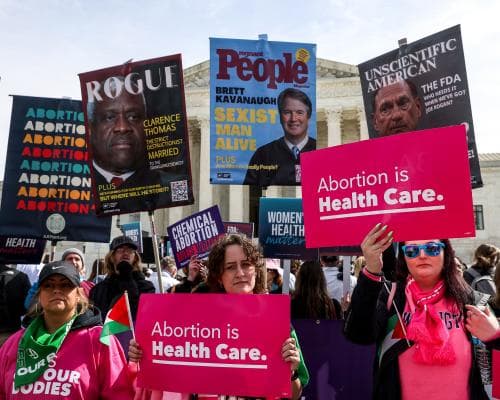
In her article, Moira Donegan discusses the aftermath of the Supreme Court's 2022 Dobbs decision, which overturned Roe v. Wade, leading to severe restrictions on abortion access across the U.S. She highlights the role of mifepristone, an abortion pill, in saving lives and maintaining some level of access for women in states with bans. Donegan concludes that while abortion pills have provided a crucial alternative, the ongoing efforts by the anti-choice movement to eliminate them threaten women's health and autonomy. The political landscape has largely moved on from the issue, but the fight for reproductive rights remains critical as the right seeks to impose further restrictions.
Stoic Response
Stoic Field Manual Entry: Navigating the Aftermath of the Dobbs Decision
What is Within Our Power
- Personal Agency: Recognize that while external circumstances (like the Supreme Court's decisions) may be beyond our control, our responses and choices remain in our hands.
- Advocacy: Engage in advocacy for reproductive rights, using our voices to influence public opinion and policy.
- Support Networks: Establish and strengthen support systems for those affected by restrictions on reproductive health.
What is Opinion
- Public Sentiment: Understand that societal views on abortion and women's rights are shaped by cultural narratives and can fluctuate.
- Political Landscape: Acknowledge that political parties may prioritize different issues, affecting the visibility and urgency of reproductive rights in public discourse.
- Misogyny's Role: Recognize that the invisibility of misogyny in political discussions can skew perceptions and diminish the urgency of women's rights.
What Action Virtue Demands
- Continuous Engagement: Maintain vigilance and actively participate in the ongoing struggle for reproductive rights, despite the shifting political landscape.
- Educate and Inform: Share knowledge about the importance of access to safe abortion methods, such as mifepristone, and the implications of their restriction.
- Empathy and Support: Foster compassion for those impacted by restrictive laws, ensuring they feel heard and supported in their struggles.
- Resilience: Embrace resilience in the face of setbacks, knowing that the fight for justice and equality is a long-term commitment.
Conclusion
In the wake of the Dobbs decision, it is crucial to focus on what we can control—our actions, our advocacy, and our support for one another. The Stoic path is not one of passivity but of purposeful engagement, ensuring that we uphold dignity, health, and autonomy for all women.
Article Rewritten Through Stoic Lens
A Stoic Perspective on the Aftermath of the Dobbs Decision
In the wake of the Supreme Court's 2022 Dobbs decision, which overturned Roe v. Wade, we find ourselves confronted with a profound test of virtue. The Stoic philosophy teaches us to respond to adversity with resilience and to cultivate our character in the face of challenges. As we navigate the complexities of reproductive rights, we must focus on the cardinal virtues: wisdom, courage, justice, and temperance.
Wisdom: Understanding the Landscape
The Dobbs decision, fulfilling a long-standing agenda of the American right, has led to severe restrictions on abortion access across the U.S. This event serves as a stark reminder of the fragility of rights and the importance of remaining vigilant. As Donegan notes, “popular will... had little bearing on abortion policy,” highlighting the need for informed engagement in civic life. Wisdom calls us to recognize the systemic issues at play and to understand that the fight for reproductive rights is far from over.
Courage: Facing Adversity
In the aftermath of the ruling, many women have found themselves in dire circumstances, forced to confront the reality of unwanted pregnancies. The courage to face such adversity is paramount. While some may view the situation as a catastrophe, Stoicism encourages us to maintain our composure and seek solutions. The introduction of mifepristone, an abortion pill, has provided a lifeline for many, allowing them to navigate these challenges with dignity. As Donegan points out, “mifepristone... has been available in the US for nearly 30 years,” demonstrating that even in dark times, there are paths to empowerment.
Justice: The Call for Equity
The ongoing efforts by the anti-choice movement to eliminate access to abortion pills represent a significant injustice. The language of new abortion bans often lacks exceptions for rape or incest, further compounding the suffering of women. This reality challenges us to advocate for justice, not only for ourselves but for all who are affected. As Donegan states, “the ferocity of the anti-choice movement’s misogyny has not been abated.” This situation calls for a collective response grounded in fairness and compassion, urging us to stand firm in our commitment to equity.
Temperance: Responding with Measured Action
In the face of political apathy, it is easy to succumb to frustration or despair. However, Stoicism teaches us to practice temperance, responding to challenges with measured action rather than outrage. The political landscape may have shifted, but the fight for reproductive rights remains critical. Donegan observes that “the American political conversation has moved on from abortion,” yet this should not deter us from our purpose. We must cultivate gratitude for the progress made, such as the successful voter referendums that protected the right to choose, while remaining unattached to outcomes that are beyond our control.
Conclusion: A Call to Virtue
The aftermath of the Dobbs decision serves as a crucible for virtue. Each conflict presents an opportunity for character development, urging us to embody wisdom, courage, justice, and temperance. As we navigate this complex landscape, let us remain steadfast in our commitment to advocate for reproductive rights, recognizing that our responses will shape the future. In the words of the Stoics, it is not the events themselves that disturb us, but our judgments about them. Let us choose to respond with virtue, striving for a world where justice prevails.
Source Body Text
An event that ruined lives, degraded the citizenship of hundreds of millions, and permanently lowered the status of American women came and went four years ago, and American politics seems to have largely moved on. When the supreme court overturned Roe v Wade in 2022’s Dobbs decision, it fulfilled a decades-long project of the American right and made real a nightmare for women’s health and equality that feminists had dreaded for a generation. In the months that followed, protests were sporadic and largely moot: popular will, it had long become clear, had little bearing on abortion policy. Women began giving birth to babies they did not want, and dropping out of school and work to care for them – wasting their talents and abandoning their dreams. A flurry of court cases negotiating the impact of the court’s ruling in states across the country made abortion legal, then illegal, then legal again, then illegal again, with women’s ability to control their own lives flickering on and off like a dying lightbulb. Clinics that had served communities for years shut their doors, the world they had helped to build now extinguished by the justices. The new abortion bans are written in such draconian and expansive language that there are often no exceptions for rape or incest and only narrow, inscrutable legal permission for the life of the mother. Because of these bans, women died. Their names blazed across the headlines for a few days, then faded. The fact is that just four years after Dobbs, abortion has receded from the headlines and from the attention of many American voters. Part of this is because of legal reality: voter referendums on abortion, in states where they were possible, were mostly successful in protecting the right to choose, and those campaigns raised money and awareness about the issue. But that strategy was quickly exhausted; just about every state where a referendum on abortion rights is legally possible has now had one. And it is partly due, too, to the peculiar discursive invisibility of misogyny in American political life. Though we have perhaps never seen a moment when male identity and male grievance have been wielded to greater political effect, feminism is at a comparative nadir. The country is used to seeing women be made to suffer because they are women. America saw the violence that Dobbs did to women’s dignity, dreams, and health, and it largely shrugged its shoulders. But if the post-Dobbs status quo has been largely accepted by the American public, it has still not satisfied the anti-choice movement, which continues its work to restrict abortion rights and access further, and which has powerful allies up and down the ranks of the federal judiciary. This much was clear in Louisiana v FDA, a lawsuit brought by the state of Louisiana seeking to curb access to the abortion drug mifepristone, in which the hard-right fifth circuit court of appeals temporarily banned the mailing or telehealth distribution of the drug nationwide over the weekend. The order required the pill to be dispensed only in person, everywhere in the country – a demand that would have upended the way abortions are accessed across the country. The fifth circuit’s order was a dramatic nationwide intervention, inflicted on the whole of the country without warning – an even more extreme move than a similar intervention that was made made by the extreme anti-choice federal judge Matthew Kacsmaryk in 2023. It was in effect for just a few days before the supreme court temporarily restored full access to the drug in a Monday morning ruling. Mifepristone, a drug that has been available in the US for nearly 30 years, is the reason why Dobbs has not resulted in mass deaths as women living in states with abortion bans turn to black and grey markets to access care. The pill, which cuts off the body’s supply of the pregnancy hormone progesterone and thereby stops the development of a fetus or embryo, is used in combination with misoprostol, a separate drug which induces contractions of the uterus. Together, the drugs induce abortion by ending a pregnancy and causing the contents of the uterus to be expelled through the vaginal canal. When properly used, the drugs are more than 90% effective during the first trimester, and they have a lower rate of serious complications than Tylenol; the drugs have the added benefit of allowing patients to take them on their own schedule, and miscarry in the comfort and privacy of their homes. The regimen now accounts for more than 60% of abortions in the United States. Many of those pill abortions are performed in Republican-controlled states where the procedure is banned. And this is another reason why abortion has not remained a hot-button political issue in the post-Dobbs era: abortions have remained largely accessible and safe, even in ban states, because of the ubiquitous access of pills. The medicines can be ordered online, from providers and pharmacies overseas or located in Democratically-controlled states, where abortion providers are often protected from out-of-state prosecution by shield laws. Then, the pills can be mailed–to Arkansas or Alabama, to Idaho or Texas or Missouri. In the pre-Roe era, when abortion pills were not yet available, women sought out black-market providers for surgical abortions, where they were subject to high rates of infection and perforation that could lead to infertility or death, as well as rampant sexual violence. Now, because of the pills, that doesn’t happen. Now, because of the pills, these women, even those living under abortion bans, can be safe. That is exactly what the anti-choice movement is looking to end. The supreme court’s intervention on Monday morning means that abortion pills remain available by mail for now; even absent the high court’s ruling, many providers would have switched to a misoprostol-only protocol, which is still largely effective, or would have continued shipping misoprostol through the mail across state lines. But other providers would have stopped mailing the pills; this is also true in Democratic-controlled states, without bans, where the order from the fifth circuit would have overhauled how overstretched clinics dealing with an influx of both local and out-of-state patients, use telehealth to meet demand. The American political conversation has moved on from abortion. Democrats don’t seem eager to make it a topic of debate in the 2026 midterms, perhaps sensing that the issue’s political utility has been exhausted; feminists, at a low point in their influence and power, seem out of ideas for how to expand or restore access. But the state-by-state patchwork of women’s rights remains an untenable reality, and the ferocity of the anti-choice movement’s misogyny has not been abated. The Supreme Court has kicked the can down the road, perhaps hoping to keep the issue’s salience to a minimum ahead of the elections. But this uneasy political settlement over abortion access will not last forever. The right will seek a nationwide ban; with the federal judiciary on their side, they already have what they need to get it. Moira Donegan is a Guardian US columnist