
May 10, 2026
The next Voting Rights Act must outlaw gerrymandering | Jamil Smith
Thesis: The next Voting Rights Act must include a comprehensive ban on gerrymandering to protect Black political power and ensure fair representation.
Stakes: As seen in Tennessee, gerrymandering not only undermines electoral fairness but also teaches communities that their political will can be rendered irrelevant, perpetuating systemic racism and disenfranchisement.
Takeaway: A new Voting Rights Act must establish a national standard against all forms of gerrymandering, empowering voters to reclaim democracy from the hands of partisan mapmakers and ensuring that every voice matters in the political arena.
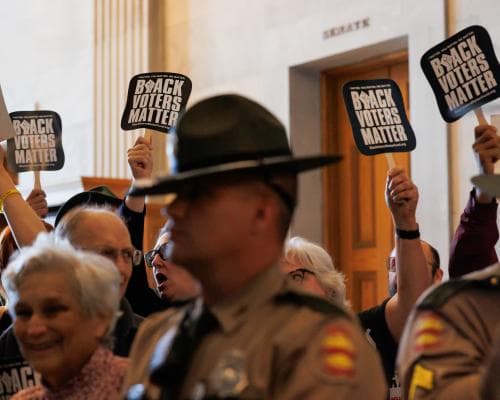
Stoic Response
Stoic Meditation for Dawn Practice
As the sun rises, illuminating the world anew, we reflect on the pressing need for a comprehensive Voting Rights Act that bans gerrymandering. This is not merely a political issue; it is a matter of justice, fairness, and the very essence of democracy.
Author's Claim Restated
The central thesis presented is that the next Voting Rights Act must include a comprehensive ban on gerrymandering to protect Black political power and ensure fair representation. This claim underscores the urgency of establishing a national standard to prevent manipulation of electoral maps, which has historically disenfranchised communities of color.
Weighing Against Nature and Logos
In nature, balance is essential. Just as ecosystems thrive when all elements coexist harmoniously, a democracy flourishes when every voice is heard and represented. The manipulation of electoral maps disrupts this balance, creating artificial barriers to representation. As the author notes, "Gerrymandering is a nuclear weapon for democracy," illustrating the destructive potential of such practices on our collective political landscape.
Logos, or reason, also supports this claim. The systematic disenfranchisement perpetuated by gerrymandering is not only unjust but also undermines the foundational principles of democracy. The author emphasizes that "powerlessness is not helplessness," reminding us that through collective action, we can reclaim our democratic rights.
Actionable Reflections
-
Recognize the Importance of Representation
As the dawn breaks, take a moment to appreciate the significance of every voice in our democracy. Reflect on how gerrymandering silences entire communities and consider how you can amplify those voices. -
Engage in Political Action
Commit to being an active participant in the political process. This can include registering to vote, educating others about the impact of gerrymandering, and advocating for a new Voting Rights Act. -
Foster Community Awareness
Initiate conversations within your community about the implications of gerrymandering. Create spaces for dialogue that empower individuals to understand their political power and the importance of fair representation. -
Support Grassroots Movements
Seek out and support organizations that are working to combat gerrymandering and promote voting rights. Your contributions—whether time, resources, or advocacy—can help build momentum for change. -
Practice Resilience
Understand that the path to justice and equality is fraught with challenges. Embrace the Stoic principle of resilience; recognize that while we may face setbacks, our commitment to fairness and representation must remain steadfast.
Conclusion
As the day begins, let us carry with us the resolve to advocate for a fairer democracy. The sun's light serves as a reminder that clarity and truth can prevail over darkness and deceit. By standing against gerrymandering and advocating for a comprehensive Voting Rights Act, we reclaim our power and ensure that every voice matters in the political arena.
Article Rewritten Through Stoic Lens
The Stoic Path to Electoral Justice
Understanding Control: The Map and the Mind
Students, consider the maps that guide us. They reveal our paths, but they can also dictate who holds power. In the realm of politics, we see how electoral maps can manipulate our perception of importance. Recognize that while we cannot control the actions of those who draw these maps, we can control our response. Focus on what is within your power: your judgment and your actions.
The Stakes of Gerrymandering: A Lesson in Resilience
In Tennessee, we witness a grave injustice. The division of Memphis, a majority-Black city, into fragmented districts serves as a stark reminder of how external forces can undermine our collective will. This teaches us that while we cannot prevent the actions of those who fear our power, we can cultivate resilience. Embrace the Stoic principle: external events do not define us; our response does.
The Call for a New Voting Rights Act: Acting with Purpose
The call for a new Voting Rights Act is not merely a political necessity; it is an opportunity for us to practice discipline and right action. Understand that while we may not control the legislative process, we can influence it through our engagement. Let this be a moment to act with integrity, advocating for a comprehensive ban on all forms of gerrymandering.
The Nature of Racism: A Shapeshifter to Confront
Racism, like a shapeshifter, adapts to evade our grasp. The old Voting Rights Act was a tool, but it was incomplete. Recognize that while we cannot change the past, we can learn from it. Use this knowledge to strengthen your resolve and advocate for a future where all forms of discrimination are addressed.
The Supreme Court's Role: Accepting What We Cannot Change
The recent rulings, such as Louisiana v. Callais, remind us of the limitations imposed by external authorities. While we cannot change the decisions of the Supreme Court, we can choose how we respond. Let us not be disheartened; instead, channel your energy into collective action and advocacy for reform.
The Dilemma of Counter-Gerrymandering: Choosing the Higher Path
Some may argue for counter-gerrymandering as a response to injustice. However, this only perpetuates a cycle of harm. Recognize that while you cannot control the actions of others, you can control your own choices. Choose the path of integrity: advocate for fairness and justice, even when it is difficult.
The Battlefield of Democracy: A Call to Arms
As we observe the ongoing struggle for fair representation, remember that every institution is affected by the fight against gerrymandering. While we cannot control the battlefield, we can choose to be warriors for justice. Engage in the process, support movements for reform, and be a voice for those who are silenced.
A New Movement: The Power of Collective Action
The need for a new Voting Rights Act is urgent. This is a call for collective action. While we may feel powerless against the forces of injustice, we are not helpless. Harness your agency: organize, educate, and mobilize. The Stoic way is to act with purpose, even in the face of adversity.
Conclusion: The Stoic Commitment to Justice
In our pursuit of electoral justice, let us remember the Stoic teachings: we cannot control external events, but we can control our responses. Embrace the principles of discipline, judgment, and right action. Together, we can reclaim democracy and ensure that every voice matters in the political arena.
Source Body Text
Maps can guide us home. They show us where we are, where we have been and where we might go. Electoral maps can do something even more sinister, though. They often tell us what and who is allowed to matter. They can decide, before a single ballot is cast, whether an entire voting bloc will become powerful or be buried by the design of a party that is indifferent – at best – to their needs and wants. Memphis is the latest warning. Tennessee’s largest majority-Black city can vote, organize, turn out, remember and resist – and still be cut into pieces by politicians who fear what that city might do with power. This week, Republicans carved up the Memphis-centered congressional district, dividing its only majority-Black district into three Republican-leaning seats while weakening voter-notice requirements in the process. Gerrymandering, at its most brutal, does more than help one party win. It teaches a community that even overwhelming local political will can be made irrelevant by a map. The United States may be celebrating 250 years since the Declaration of Independence, but anything resembling a multiracial democracy here is barely older than the Voting Rights Act. The effectively erstwhile Voting Rights Act of 1965 (VRA) was enormously consequential, addressing ballot access, voter registration and the brute mechanics of disfranchisement. It addressed racial vote dilution. It was born from the knowledge that the US, left to itself, would not protect Black political power. It was also incomplete. Racism remains a shapeshifter, and the old, now-disempowered VRA was not built to combat all of its forms. It was certainly not built for our full modern machinery of electoral mapmaking: the data analyst, the algorithm, the partisan alibi, the lawmaker who knows how to make racial harm speak the language of party politics. So when the six supreme court conservatives issued the Louisiana v Callais ruling – weakening the VRA section that, for decades, helped prevent states from drawing maps that diluted Black political power – what we lost was not abstract. We lost one of the only federal tools we had against one of the most effective weapons in US politics. The trap is almost elegant in its cruelty. If a state draws a map that dilutes Black political power, it can insist that it was not targeting Black voters because they are Black. It was merely targeting Democrats. Since Chief Justice John Roberts’ supreme court announced in 2019’s Rucho v Common Cause that partisan gerrymandering claims lie beyond the reach of federal courts, the mapmaker’s excuse becomes a shield – one strengthened, in the Callais ruling, with misleading data. The Guardian reported on Friday that Justice Samuel Alito’s majority opinion lifted its central evidentiary claim about Black turnout almost word-for-word from a justice department amicus brief, propped up with cherrypicked numbers from the Obama elections of 2008 and 2012. The ruling that gutted the VRA was built on numbers that did not survive contact with reality. This is the moment to be honest about what has to come next. If and when Democrats regain control of Congress, they must pass a new Voting Rights Act immediately. (Trump may not sign it, but the legislative process alone signals the urgency.) In that new bill, whenever it arrives, there must be a federal ban on gerrymandering in congressional districts. Not racial gerrymandering alone. Partisan gerrymandering, as well – by either party, in any state, under one national standard. End it all. That would be extremely difficult, I agree. Congress would have to bar not only the maps Republicans are now racing to redraw across the south, but also the responsive maps Democrats have drawn or tried to draw in California, Illinois, New York and Virginia – where, on Friday morning, the state supreme court struck down a voter-approved Democratic redistricting plan on procedural grounds, nullifying a measure voters had approved just two weeks earlier. A genuine ban means giving up the gerrymander we like along with the one we hate. It means trusting our policies, our candidates and our voters – regardless of party – more than our cartographers. I am willing to make that trade. Every American voter should be. There is a part of me that understands the argument for counter-gerrymandering. If Republicans rig maps, why should Democrats be asked to lose nobly on fair ones? Why should a party committed, at least in theory, to multiracial democracy disarm while its opponents carve up the south? But that is the logic of an arms race. It does not end with democracy defended. It ends with democracy mutilated by both sides, each claiming the other made it necessary. Gerrymandering is a nuclear weapon for democracy. The danger is not only that your enemies may use it. The danger is that, once they do, your allies will insist they too need to use it to survive. That is how democracy stops being a contest among voters and becomes one among mapmakers. This past week alone tells the story. Callais is one cut. Mississippi preparing a redistricting vote in the old capitol building, the same place where the state voted to secede from the Union in 1861 and ratified its Jim Crow constitution in 1890, is another. Louisiana postponing its congressional primary after the ruling is another. Tennessee enacting the first post-Callais map is another. Then came Virginia. On Wednesday, the FBI searched the office of the state senator L Louise Lucas, an 82-year-old great-grandmother, the president pro tempore of the state senate and a leader of Virginia’s redistricting fight. The investigation may be legitimate; Lucas has not been charged, and the probe reportedly predates the redistricting fight. But in the current climate, even law enforcement is understood through the map wars. Two days later, Virginia’s supreme court struck down the newly approved Democratic redistricting plan, wiping out a ballot measure voters had approved on 21 April. The ruling turned on procedure, not the shape of the districts. It does not belong in the same category as a raid, nor does it prove intimidation. It does, however, reveal the larger truth: once gerrymandering becomes a live weapon, every institution around it starts to look like part of the battlefield. A new Voting Rights Act has to do what the old one could not. It must end the legal fiction that gerrymandering is merely a state-court problem. It must restore preclearance, so states with records of discrimination cannot change election rules first and answer questions later. It must require independent redistricting commissions – or, where that is politically impossible, a uniform federal standard for compactness, contiguity, and transparency that contains explicit requirements for racial fairness and partisan symmetry. It must prohibit states from laundering racial vote dilution through partisan language. Last but not least, it must bar noncompliant maps from being used in future federal elections, including maps already drawn this decade. Any reform that leaves today’s damaged maps in place would only freeze the battlefield exactly as the mapmakers designed it. I know some Democrats likely will disagree – the fear of losing responsive maps is real. After Callais, they’re wrong. This is simultaneous disarmament: one national standard, every congressional map, every state required to submit to the same democratic rule. Whether we get to that reform depends on November. Trump is sinking in the polls, and the midterms could deliver a House majority willing to begin this work. The south will be the test. The cuts are coming faster there, because they always do. Black voters in Mississippi, Louisiana, Tennessee and elsewhere are again being asked to prove that their power can survive the ingenuity of those determined to contain it. There may be outcomes that Americans are powerless to stop. The supreme court has made that much plain. But powerlessness is not helplessness. Voters cannot reverse Callais by themselves. They can elect a Congress with a mandate to answer it. Civil-rights legislation did not pass in the 60s because white people in power finally became generous. It passed because Black Americans and their allies applied the necessary pressure until Congress finally erected some bulwarks against racism. All of the demonstrating and dying forced the federal government to constrain states that had proven they could not be trusted to protect Black political power. Now we need a new movement for a new Voting Rights Act. That requires voters, not spectators. Registration drives in places where the cutting is sharpest. Turnout numbers that make the line itself a story. Persistence in the face of opposition. Punishing voter suppression after the damage is done is no longer sufficient. We must prevent it outright. To do that, we have to take the tools of racism out of the hands of its practitioners. That includes taking the gerrymandering weapon away from everyone. A party unwilling to do that is not defending democracy. It is merely managing its decline. Jamil Smith is a Guardian US columnist