
May 12, 2026
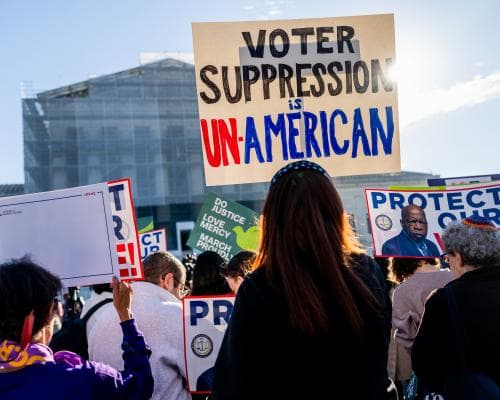
The supreme court’s takedown of American democracy is complete | Austin Sarat
The Supreme Court's recent decision to dismantle Section 2 of the Voting Rights Act marks a significant setback for American democracy, as it limits protections against racial discrimination in voting. This ruling follows a series of decisions that have favored corporate influence in politics and allowed partisan gerrymandering, undermining the principle of fair representation. The implications are profound, particularly for minority voters, as it makes it increasingly difficult to challenge discriminatory practices. The article emphasizes the urgent need for civic engagement and legislative action to protect democratic institutions and ensure equitable voting rights.
Stoic Response
Correspondence to a Roman Magistrate
I. The Weight of History
Honorable Magistrate,
In the spirit of our forebears, I must draw your attention to a grave matter that echoes through the annals of our republic. As the historian Henry Steele Commager warned, “Judicial review is wrong in theory and dangerous in practice.” This sentiment reverberates with the recent decision to dismantle Section 2 of the Voting Rights Act, a pivotal safeguard against racial discrimination in voting. The implications of this ruling are profound, particularly for the marginalized, who find their voices increasingly stifled.
II. The Moral Stakes
The recent actions of the Supreme Court serve not merely as a legal precedent but as a clarion call to all citizens. The erosion of protections against racial discrimination in voting is not an isolated incident; it is part of a broader pattern undermining the very foundations of democracy. As noted, “The only reliable way to preserve and improve US democracy is to act democratically.” This truth compels us to recognize that our civic engagement is paramount in the face of such adversity.
III. A Call to Action
The stakes are high, and the time for action is now. The court’s ruling is a devastating blow to our democratic ideals, particularly for those whose rights have been historically marginalized. Senator Raphael Warnock aptly stated that the court’s attack is “nothing less than a massive and devastating blow.” In this moment, we must rally our collective strength and seek to protect our democratic institutions through active participation in the electoral process.
IV. Practical Maxims for Civic Engagement
- Engage Actively: Let your voice be heard at the ballot box; every vote matters.
- Educate Others: Share knowledge of our rights and the importance of equitable representation.
- Demand Accountability: Pressure your representatives to uphold and protect voting rights.
- Stand United: Join movements that advocate for democracy and fight against disenfranchisement.
In unity and resolve, we can strive to safeguard the principles that bind us as citizens of this great republic. Let us not falter in our duty to uphold justice and equity for all.
Article Rewritten Through Stoic Lens
Reflections on the Supreme Court's Decision: A Stoic Perspective
Introduction
In examining the recent decision by the Supreme Court to dismantle Section 2 of the Voting Rights Act, we must approach this event with a rational mind, recognizing the inherent nature of the judicial process and its implications for our society. The Stoic philosophy teaches us to focus on what is within our control and to accept what is not. This decision, while significant, should not lead us to despair but rather to a deeper understanding of our responsibilities as citizens.
The Nature of Judicial Review
Historian Henry Steele Commager's assertion that the Supreme Court has never been a steadfast ally of democracy prompts us to reflect on the role of judicial review. While some may view this as a failure of the system, it is essential to recognize that the court operates within the framework established by the Constitution. The Stoic perspective encourages us to accept that the actions of the court, whether favorable or unfavorable, are beyond our control. Instead, we must focus on our own responses and actions.
Understanding the Ruling
The Supreme Court's ruling on April 29, 2026, which effectively dismantles protections against racial discrimination in voting, is a manifestation of the ongoing struggle between power and justice. Section 2 of the Voting Rights Act aimed to safeguard the rights of minority voters. However, the court's interpretation highlights a broader issue: the limitations of legal frameworks in ensuring justice.
While the ruling may appear unjust, we must assess its implications rationally. The court's decision reflects a particular interpretation of constitutional law, one that emphasizes states' rights over federal oversight. This presents an opportunity for us to engage with the democratic process, advocating for laws that promote equity and justice.
Historical Context and Cause and Effect
The decisions leading up to this ruling, including the Citizens United case and the invalidation of key provisions of the Voting Rights Act, reveal a pattern of judicial interpretation that favors corporate influence and partisan interests. Understanding this trajectory allows us to recognize the cause and effect at play. The Stoic approach encourages us to analyze these developments without assigning blame, focusing instead on how we can respond constructively.
Civic Engagement and Responsibility
Commager's insight that the preservation of democracy relies on active participation is particularly relevant. The Stoic philosopher recognizes that while we cannot control the actions of the court, we can control our engagement in the democratic process. This is a call to action for all citizens: to vote, to advocate for equitable policies, and to hold our representatives accountable.
The Path Forward
In the face of adversity, we must cultivate virtue, wisdom, courage, justice, and temperance. The recent ruling should not deter us from striving for a more just society. Instead, it should galvanize our efforts to engage in civic discourse and legislative advocacy. We must remember that our actions, grounded in Stoic principles, can influence the trajectory of our democracy.
Conclusion
The Supreme Court's decision serves as a reminder of the complexities of governance and the importance of civic engagement. While we may not control the decisions of the judiciary, we possess the power to shape the future through our actions. Let us embrace the Stoic ideal of focusing on what we can control and strive for a society that reflects our highest values of justice and equity. In doing so, we honor the legacy of those who fought for the rights we now seek to protect.
Source Body Text
Writing in 1943, the historian Henry Steele Commager delivered both a stern history lesson and a warning about the United States supreme court. The court, he said, had never been a friend to US democracy, and it never would be. For anyone committed to the advancement of majority rule, he added, judicial review “is wrong in theory and dangerous in practice”. The danger that Commager noted was on full display on 29 April 2026, when the supreme court eviscerated section 2 of the 1965 Voting Rights Act. As the Department of Justice explains, section 2 “prohibits voting practices or procedures that discriminate on the basis of race, color, or membership in one of the language minority groups … or procedure that results in the denial or abridgement of the right of any citizen to vote on account of race, color, or membership in a language minority group”. But the Voting Rights Act decision is only the latest in a string of decisions in which the conservative-dominated supreme court has used its version of constitutional interpretation to wage war on constitutional democracy. Those decisions have opened the floodgates to the corrupting influence of money in politics, removed the federal government from the business of ensuring that states do not draw legislative districts in ways that disadvantage minority voters, and given the green light to partisan gerrymandering. As we try to come to terms with what the court did to section 2, we need to keep those other decisions in mind. They show what Commager long ago observed: that the only reliable way to preserve and improve US democracy is to act democratically by winning at the ballot box and prevailing in the legislative process. That lesson should inspire a massive turnout in the November election and a mass movement to pressure Congress to take steps to protect and reinvigorate democratic institutions and practices in this country. Before saying more about the court’s gutting of section 2, let’s recall the recent supreme court cases that undermined the pillars of US democracy. In 2010, the court took a truly significant step in that direction when it handed down its ruling in Citizens United v Federal Election Commission. That case arose, as the Brennan Center for Justice notes, “when a conservative nonprofit organization challenged campaign finance rules that stopped it from promoting and airing a film criticizing then presidential candidate Hillary Clinton”. The court used the case to deliver the death knell to almost all campaign finance restrictions. In a 5-4 ruling, the court struck down “century-old prohibitions on corporate ‘independent’ spending – money that doesn’t go directly to a candidate or party”. The majority held that under the first amendment, “corporate funding of independent political broadcasts in candidate elections cannot be limited … [and] that political speech is indispensable to a democracy, which is no less true because the speech comes from a corporation”. As the Brennan Center observes: “The justices who decided Citizens United held that independent spending could not pose a substantial risk of corruption … [and] that existing transparency rules would require all the new spending they were permitting to be fully transparent.” Both assumptions, it adds, “have proven to be incorrect”, with Super Pacs playing key roles in recent presidential campaigns and even leading voter outreach operations. In 2013, the court took the next step in its campaign against democracy, declaring two key provisions of the Voting Rights Act unconstitutional. One of them, section 4, contained a formula for determining which states had to obtain preclearance from the justice department before making any changes to their voting laws. The other, section 5, described the pre-clearance requirements. Writing for the majority, chief justice John Roberts found that the Voting Rights Act was “no longer responsive to the current conditions” in the voting districts to which they were applied. He argued that sections 4 and 5 “represent an unconstitutional violation of the power to regulate elections that the Constitution reserves for the states”. The result was a rash of new efforts to make voting burdensome for the very groups whose voting rights had been protected by the pre-clearance requirements of sections 4 and 5. Step 3 in the court’s effort to turn the constitution into a weapon against democracy came in 2019, when it said that states were free to engage in partisan gerrymandering and to draw legislative districts with the express purpose of giving electoral advantages to the party in power. Here again, Roberts led the way, turning to history to argue that, “aware of electoral districting problems”, the Framers “chose a characteristic approach, assigning the issue to the state legislatures, expressly checked and balanced by the Federal Congress”, with no “suggestion that the federal courts had a role to play”. The court, as the attorney Emmet Bonderant argues, disregarded “thirty years of [its own] precedent” and reached a result that allows politicians to pick their voters and limits the ability of voters to pick those whom they prefer to represent them. It also allowed state legislatures to engage in racial gerrymandering if they claim it is motivated by partisan, not racial, considerations. So it should not have been surprising that the court would do what it did on 29 April, when it made it almost impossible for anyone to prove that race plays a role in redistricting decisions. The court found that the only way to do so is to provide convincing evidence that the legislatures intended to discriminate when they made those decisions – and it disregarded a clear congressional statement to the contrary. In 1982, Congress enacted legislation to make clear that “a plaintiff could establish a violation of the section if the evidence established that … [a] standard, practice, or procedure being challenged had the result of denying a racial or language minority an equal opportunity to participate in the political process”. The court swept aside what Congress did and decided that section 2 protected minority voters only from what justice Samuel Alito called “present-day intentional racial discrimination regarding voting” and nothing more. Reacting to Alito’s reasoning, Georgia senator Raphael Warnock said that the court’s attack on section 2 of the Voting Rights Act “is nothing less than a massive and devastating blow – not only to our democracy, but particularly to people of color in the South … This question about intent is … misleading, and it ignores our history.” In the end, the court may have ignored our history, but we should not ignore its history. Commager would not have been surprised by what has unfolded since 2010, but he would have warned Americans against despair. He would want us to get busy trying to save what is left of our democracy by using our votes and our voices. There is no time to waste. Austin Sarat, associate dean of the faculty and William Nelson Cromwell professor of jurisprudence and political science at Amherst College, is the author of Gruesome Spectacles: Botched Executions and America’s Death Penalty