
June 3, 2026
Thank God for Pope Leo. He’s the leader our world desperately needs | Arwa Mahdawi
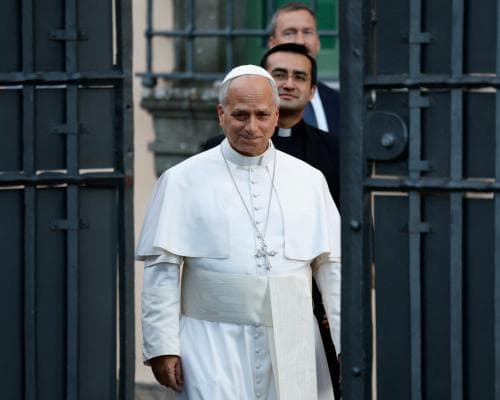
In her article, Arwa Mahdawi reflects on the decline of idealism in Silicon Valley and the rise of moral clarity in the Vatican, particularly under Pope Leo XIV, who succeeded Pope Francis. She contrasts the once-idealistic tech leaders with the current climate of greed and cruelty, exemplified by figures like Donald Trump and Elon Musk. Mahdawi concludes that Pope Leo's advocacy for the vulnerable and his warnings about the dangers of unregulated AI make him a crucial voice in today's morally ambiguous world. Ultimately, she argues that the pope's leadership offers a much-needed counterbalance to the prevailing negativity in politics and technology.
Stoic Response
Stoic Meditation for Dawn Practice
Author's Claim
In her article, Arwa Mahdawi asserts that the decline of idealism in Silicon Valley has paved the way for a resurgence of moral clarity in the Vatican under Pope Leo XIV. She contrasts the greed and cruelty exemplified by figures like Donald Trump and Elon Musk with the pope's advocacy for the vulnerable and his warnings about the dangers of unregulated AI. Mahdawi concludes that Pope Leo's leadership provides a necessary counterbalance to the negativity prevalent in today's political and technological landscape.
Weighing Against Nature and Logos
Nature teaches us that true leadership is rooted in virtue, compassion, and a commitment to the common good. Logos, the rational principle that governs the universe, suggests that actions should align with truth and justice. Mahdawi's claim resonates with this understanding, as she highlights how the pope's moral clarity stands in stark contrast to the self-serving behaviors of tech leaders and politicians.
As she paraphrases, “Indifference to the truth leads, slowly but surely, to a descent into totalitarianism.” This reminds us that the pursuit of truth is fundamental to a just society. In a world where moral ambiguity thrives, the pope's voice serves as a beacon, urging us to seek clarity and act with integrity.
Actionable Reflections
-
Seek Truth: In your daily interactions, strive to discern truth from falsehood. Question information critically and engage in discussions that elevate understanding rather than perpetuate ignorance.
-
Cultivate Compassion: Reflect on how your actions impact others. Consider ways to advocate for the vulnerable in your community, whether through volunteering, supporting ethical businesses, or speaking out against injustice.
-
Practice Courage: Like Pope Leo XIV, be willing to stand against prevailing negativity. Whether in your workplace or social circles, don’t shy away from expressing your values, even if it feels uncomfortable.
-
Limit Exposure to Negativity: Be mindful of the media you consume. Choose sources that promote constructive dialogue and truth rather than sensationalism and division.
-
Daily Reflection: At dawn, take a moment to meditate on your intentions for the day. Ask yourself how you can embody the virtues of compassion and integrity in your actions, and commit to being a force for good in a complex world.
Conclusion
As we rise with the dawn, let us embrace the opportunity to align ourselves with the virtues of truth, compassion, and courage. In a world often overshadowed by greed and cruelty, we can choose to be the light that counters darkness, embodying the moral clarity that Mahdawi celebrates in Pope Leo XIV.
Article Rewritten Through Stoic Lens
The Decline of Idealism and the Rise of Moral Clarity: A Stoic Reflection
The Illusion of Idealism in Silicon Valley
In the early 2000s, Silicon Valley presented itself as a bastion of idealism, with tech leaders proclaiming their intent to improve the world. Google's motto, “Don’t be evil,” and Facebook's mission to foster openness and connection were assertions of virtue. However, upon closer examination, such declarations often reflected more aspiration than reality. The decline of this idealism became evident with the Cambridge Analytica scandal in 2018, revealing the fragility of these claims.
It is essential to recognize that the actions of these individuals and corporations are not inherently evil, but rather a reflection of their choices and the environment in which they operate. The Stoic perspective teaches us to focus on what is within our control—our own actions and responses—rather than lamenting the decline of ideals that were never fully realized.
The Shift in Moral Standards
The current climate, characterized by the normalization of greed and cruelty, exemplified by figures such as Donald Trump and Elon Musk, invites us to reflect on the nature of virtue. The Stoic philosopher understands that external circumstances often reveal the character of individuals. The shift from idealism to a more pragmatic acceptance of greed is a testament to the choices made by these leaders.
Elon Musk's transformation from an innovator to a controversial figure illustrates the Stoic principle that our perceptions of others can lead us astray. It is not the external labels we assign that define a person, but their actions and intentions.
The Vatican as a Beacon of Moral Clarity
In contrast, the Vatican, under the leadership of Pope Leo XIV, emerges as a voice of moral clarity in a landscape muddied by self-interest. The Stoic approach encourages us to examine the actions of Pope Francis and his successor, who have advocated for the vulnerable and spoken against injustice. Their commitment to justice and compassion serves as a reminder of the virtues we should strive to embody.
Pope Francis, despite his imperfections, demonstrated courage by addressing issues such as climate justice and the treatment of marginalized communities. His acknowledgment of the suffering in Gaza and condemnation of violence reflects a commitment to justice that transcends political boundaries.
The Nature of Truth and Pragmatism
Pope Leo XIV's encyclical, Magnifica Humanity, warns of the dangers posed by unregulated AI and the erosion of truth. The Stoic understanding of truth is vital; it is the foundation upon which rational thought and virtuous action rest. The encyclical highlights the importance of maintaining a commitment to truth, as indifference to it can lead to moral decay.
The current landscape, where pragmatism often overshadows ethical considerations, presents a challenge. The Stoic perspective reminds us that while we cannot control the actions of others, we can choose to uphold our own principles. The indifference exhibited by many leaders, who prioritize convenience over moral clarity, underscores the necessity of individual courage in the face of adversity.
The Role of Leadership in Times of Crisis
In a world where moral clarity is often obscured, the leadership of Pope Leo XIV serves as a reminder of the importance of virtue. While he is not without flaws, his willingness to confront power and advocate for justice exemplifies the Stoic ideal of courage. The Stoics teach us that true leadership is characterized by the pursuit of virtue, even in the face of opposition.
As we navigate a landscape fraught with challenges, let us reflect on our own capacity for virtue, wisdom, courage, justice, and temperance. The actions of others may be beyond our control, but we can choose to embody the principles that lead to a more just and compassionate world.
Conclusion: The Path Forward
In conclusion, the decline of idealism in Silicon Valley and the rise of moral clarity in the Vatican provide a contrasting lens through which to examine our current state. The Stoic philosophy encourages us to focus on our own actions, cultivate virtue, and remain steadfast in our commitment to justice. As we confront the complexities of our world, let us strive to be leaders in our own right, embodying the principles that elevate humanity above the chaos of greed and cruelty.
Source Body Text
Do you remember the early 2000s, when Silicon Valley buzzed with idealism and tech bros told us they were going to save the world? “Don’t be evil” was Google’s unofficial motto; its 2004 IPO prospectus declared that doing “good things for the world” was more important than “short term gains”. Mark Zuckerberg similarly wrote in Facebook’s 2012 IPO letter that the social network was “built to accomplish a social mission – to make the world more open and connected”. As was obvious to anyone paying attention, this was all performative bullshit. Nevertheless, it’s hard not to feel nostalgic about that period of time – which came to a definitive end in 2018, with the Cambridge Analytica scandal. By and large, billionaires and CEOs still cared what the hoi polloi thought of them. They were self-aware enough to realize that, even with all their billions, there’s a lot more of us than there are of them. Now, however, there has been a seismic vibe shift. Donald Trump has made cruelty cool, and normalized greed and corruption. Tech titans, meanwhile, have lined up to kiss the ring – and extract as much money from his administration as they can. Elon Musk has gone from quirky rocketman to rightwing agitator. Zuckerberg is in his macho era, urging companies to unleash their “masculine energy” and saying he regrets apologizing so much in the past. As for the mantra “don’t be evil”? Ha. Now tech companies are unapologetically fueling unimaginable evil. Project Nimbus, for example, a $1.2bn contract awarded by Israel to Google and Amazon, has been accused of playing a role in the ongoing genocide in Gaza. Sergey Brin, Google’s co-founder, meanwhile, has said using the term genocide in connection to Gaza, which scores of leading human rights organizations and scholars do, is “offensive”. Amid this vibe shift, something odd has happened: the Vatican City has replaced Silicon Valley as ground zero for disruptive thinking. The Catholic church, dripping with gold, burdened by a sordid history of sexual abuse and cover-ups, is becoming a beacon of light in a very dark world. Even for nonbelievers like me, the pope has become a reassuring – and all too rare – voice of moral clarity. Pope Francis, who died last year, started this transformation. He wasn’t exactly an unproblematic LGBTQ+ ally, but he maintained that people shouldn’t be marginalized for their sexual orientation and called laws criminalizing homosexuality “unjust”. He was vocal about caring for immigrants, spoke out about climate justice and criticized the Trump administration’s mass deportations. He told churches in South Sudan that they could not remain neutral amid injustice. And he condemned Israel’s assault on Gaza. “This is not war. This is terrorism,” he said in November 2023. One of his last requests was that his popemobile be turned into a health clinic for the children of Gaza. Israel, of course, has still not allowed it in. When Pope Leo XIV succeeded Francis, many wondered whether he would continue to advocate for the most vulnerable. To the Trump administration’s chagrin, he has. Leo has spoken out against the war on Iran, and Maga’s use of religious justifications for it. He has reminded the world that “the people of Gaza are still not receiving humanitarian aid”, which is a fact that most world leaders seem keen to ignore. He has rattled Trump and his supporters so much that the president accused him of being “WEAK on crime” and Fox News’s Sean Hannity wondered on-air whether the pope had “even read the Bible”. Now, Leo is becoming a thorn in Silicon Valley’s side. On 25 May, the pope released his first encyclical, which is an official statement outlining the church’s stance on an important topic. Titled Magnifica Humanity: On Safeguarding the Human Person in the Time of Artificial Intelligence, it warns about the dangers of unregulated AI, noting that “the growing dominance of a technocratic paradigm” risks “reducing creation to an object of exploitation and human beings to mere cogs in a system driven toward ever greater efficiency”. The encyclical is very long (more than 40,000 words) and full of interesting nuggets. But here’s one of the sections I think is most crucial: “The search for truth is an essential element of democracy … When questions about what is true lose their appeal, and a pragmatism takes hold that is content with what appears useful or effective, then democratic life is weakened … Indifference to the truth leads, slowly but surely, to a descent into totalitarianism. As the philosopher Hannah Arendt wrote, the ideal subjects of such regimes are not so much those who are ideologically convinced, but rather ‘people for whom the distinction between fact and fiction (ie, the reality of experience) and the distinction between true and false (ie, the standards of thought) no longer exist’.” Social media, which has been used for good as well as evil, should not be blamed for all our woes. But it seems quite clear that the moral rot eating away at the world set in as social media enveloped the planet, turning us all into data points that could be manipulated. A fact is a fragile thing and, in her essay Truth and Politics, Arendt warned that a flood of lies undermines our sense of reality. AI, of course, is already supercharging this – eroding our critical thinking, casting doubt on everything, collapsing the distinction between fact and fiction. This is why the Trump administration loves AI so much: it helps make the rich richer, and the rest of us more compliant. Leo’s note about a dangerous “pragmatism” taking hold is also important. The world seems to be run by the gleefully evil and the pathetically pragmatic. On the one hand, you have people like Stephen Miller, Donald Trump, Benjamin Netanyahu: people who revel in cruelty. Then, just as bad, albeit not as brazen, are the people who are just going along with it all, because it’s easier that way. In a January piece in the Wall Street Journal, of all places, former US treasury secretary Robert E Rubin lamented the fact that business leaders are quiet about Trump’s trampling of democracy. “In my experience, many leaders harbor deep concerns about Mr Trump’s lawlessness, weaponization of the government, and interference in markets,” Rubin wrote. “They refrain from public criticism not because they find nothing to criticize but because they’re intimidated.” We are ruled by cretins and cowards. From our universities to our courts, our institutions have not met the present moment with courage. Thank God then for the pope. He is still a mere mortal, he is not perfect, but he is proving to be a much-needed force for good. He is speaking truth to a higher power. Arwa Mahdawi is a Guardian US columnist and the author of Strong Female Lead