
July 19, 2026
Trump is invoking foreign election interference to justify his own | Jamil Smith
Talking Points: "Trump is Invoking Foreign Election Interference to Justify His Own" by Jamil Smith
-
Protagonist and Argument: Jamil Smith critiques Donald Trump’s manipulation of foreign election interference narratives to undermine the legitimacy of elections, particularly targeting jurisdictions like Fulton County, Georgia, where Black voter turnout significantly contributed to his 2020 defeat. Smith argues that Trump’s rhetoric not only distorts facts but also weaponizes federal oversight against marginalized communities.
-
Evidence and Contradictions: Smith highlights that Trump’s claims about foreign interference lack credible evidence, as intelligence assessments have consistently shown no foreign actor changed votes in U.S. elections. Instead, Trump’s narrative serves as a pretext for federal intervention, creating a climate of suspicion around voters, especially those from communities of color.
-
Implications for Democracy: The implications of Trump’s actions are profound; by labeling voters as suspects rather than participants, he threatens the integrity of future elections and perpetuates systemic racism. His administration's efforts to impose stricter voting regulations under the guise of security could disenfranchise vulnerable populations and undermine democratic processes.
-
Broader Context: Smith’s analysis situates Trump’s rhetoric within a larger strategy to delegitimize electoral outcomes that do not favor him, framing his grievances as a broader assault on democratic norms. This narrative not only affects immediate electoral integrity but also sets a dangerous precedent for future governance and civil rights.
Stoic Response
Stoic Field Manual Entry: Navigating Political Narratives
What is Within Our Power
- Understanding Our Reactions: We can choose how to respond to political rhetoric. Recognize that external narratives do not dictate our internal peace.
- Maintaining Integrity: Uphold personal and communal values in discussions about democracy and justice, regardless of external influences.
- Engaging with Evidence: Seek truth through credible sources, distinguishing between opinion and fact. Our ability to discern is a powerful tool.
What is Opinion
- Perceptions of Legitimacy: Opinions about election integrity, such as Trump's claims of foreign interference, are subjective and often driven by emotion rather than evidence.
- Narratives of Fear: The framing of voters as suspects rather than participants reflects a perspective that can be challenged through rational discourse and evidence.
- Political Grievances: The belief that elections are rigged or manipulated is often rooted in personal bias rather than objective reality.
What Action Virtue Demands
- Promote Truth and Transparency: Advocate for factual discourse in political discussions, emphasizing the importance of evidence over sensationalism.
- Empower Marginalized Communities: Support initiatives that protect the voting rights of all citizens, especially those disproportionately affected by unjust scrutiny.
- Foster Civic Responsibility: Engage in the democratic process by voting, educating others, and standing against divisive rhetoric that undermines community trust.
Key Takeaways from Jamil Smith’s Analysis
- Critique of Manipulation: Smith argues that Trump’s rhetoric distorts facts to undermine electoral legitimacy, particularly targeting communities of color.
- Evidence of Integrity: Intelligence assessments consistently show no foreign interference that altered election outcomes, challenging the validity of Trump's claims.
- Threats to Democracy: Trump's actions create a climate of suspicion that jeopardizes future elections and perpetuates systemic racism, necessitating a collective response to uphold democratic values.
Conclusion
In the face of political manipulation and divisive narratives, we must remain steadfast in our pursuit of truth, justice, and community empowerment. By focusing on what is within our power, we can navigate these challenges with Stoic resilience and virtue.
Article Rewritten Through Stoic Lens
A Stoic Reflection on Political Conflict: The Case of Trump and Election Integrity
In the realm of political discourse, we encounter a profound test of virtue, particularly when faced with the rhetoric surrounding election integrity. Jamil Smith’s critique of Donald Trump’s manipulation of foreign election interference narratives serves as a reminder of the importance of measured responses, character development, and the cultivation of virtue in the face of adversity.
Wisdom: Understanding the Nature of Claims
Smith highlights Trump’s claims about foreign interference as lacking credible evidence. The intelligence assessments consistently affirm that no foreign actor altered votes in U.S. elections. This discrepancy between rhetoric and reality invites us to exercise wisdom.
“Factcheckers agreed he proved nothing.”
In our pursuit of truth, we must discern the difference between genuine concerns and unfounded fears. The Stoic principle of focusing on what is within our control becomes paramount here: we cannot control the actions of others but can choose our responses to them.
Justice: The Implications for Democracy
The implications of Trump’s rhetoric extend beyond individual claims; they threaten the very fabric of democracy. By labeling voters as suspects rather than participants, he undermines the integrity of future elections and perpetuates systemic racism.
“His administration's efforts to impose stricter voting regulations under the guise of security could disenfranchise vulnerable populations.”
In the Stoic tradition, justice is about fairness and equity. We must strive to protect the rights of all individuals, especially marginalized communities, recognizing that the true measure of a society is how it treats its most vulnerable members.
Courage: Confronting Manipulation
Smith’s analysis situates Trump’s rhetoric within a broader strategy to delegitimize electoral outcomes unfavorable to him. This manipulation of facts serves as a test of courage for those who stand against it.
“Trump’s falsehoods made targets of Ruby Freeman and Shaye Moss, two Black women who counted ballots.”
In confronting such challenges, we must summon the courage to speak truth to power, to defend the integrity of our democratic processes, and to support those unjustly targeted. It is through these acts of courage that we develop our character and contribute to the greater good.
Temperance: Gratitude Amidst Conflict
As we navigate these turbulent waters, it is essential to practice temperance—maintaining a balanced perspective. While the political landscape may evoke feelings of outrage, we must cultivate gratitude for the democratic processes that allow us to engage in discourse.
“The Save Act is the architecture for taking it national.”
In recognizing the opportunities for gratitude, we detach ourselves from the outcomes, focusing instead on our commitment to virtue. Successes in promoting justice and integrity should be celebrated, not as personal victories, but as collective steps toward a more equitable society.
Conclusion: A Call to Virtue
In the face of political conflict, we are reminded that our responses define our character. The challenges presented by figures like Trump are not merely obstacles but tests of our wisdom, justice, courage, and temperance. As we engage in this discourse, let us strive to respond with measured resolve, cultivating our virtues and contributing to a democratic society that honors the dignity of all its participants.
In the words of Marcus Aurelius, “You have power over your mind—not outside events. Realize this, and you will find strength.” Let us embody this strength as we navigate the complexities of our political landscape.
Source Body Text
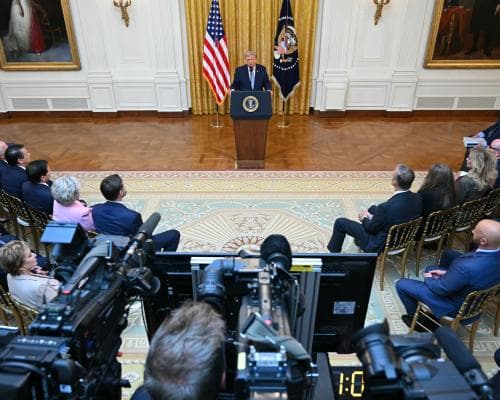
There is a version of this country in which Donald Trump tells Americans the truth he has been handed: that their elections are secure. Once, he apparently wanted to. The Atlantic reported after Thursday night’s address that a February 2020 election-security briefing pleased Trump so much he wanted to announce the news himself. The press conference never happened. The election did, and Trump lost it. More than six years later, he mocked the assurances he once wanted his name on, describing a system “so broken and so vulnerable that no one can possibly defend it”. The evidence hadn’t changed. Its usefulness had. Trump is dangerous twice over: in what he does and what he tells us to fear while doing it. Factcheckers agreed he proved nothing. Failing as evidence, his address succeeded as permission – for federal intervention already under way in Fulton county. In his speech, Trump assembled old intelligence, vulnerabilities and lies into a conspiracy: 220 million US voter records in Chinese hands, “extremely exposed” voting machines, 278,000 supposed noncitizens on the rolls and a deep-state burial of proof. Yet some documents he released contradicted him. A 2021 intelligence-community assessment distinguished foreign influence from interference with registration, ballot casting, tabulation or results, and found no indication that any foreign actor attempted the latter. A newly released document judged tabulation systems difficult to manipulate at election-changing scale; a report on Venezuelan voting never confirmed large-scale electronic fraud even there. The files instead documented a Russian influence campaign intended to defeat Joe Biden: allegations related to the Ukrainian gas company Burisma spread through American intermediaries, plans for a corruption scandal and fraud narratives involving mail ballots. Trump omitted the foreign influence that aided him and inflated vulnerabilities into interference that did not occur. Trump gave Bill Pulte – the loyalist installed as acting intelligence chief to investigate supposedly “rigged” elections – broad declassification authority. The conservative media figure John Solomon helped search government files for the speech. Yet after millions of documents were reviewed, a White House official told the Atlantic that no evidence showed a foreign power changed votes; Solomon conceded the same for 2020, 2022 and 2024. The speech named Michigan, but omitted Georgia. In January, FBI agents seized roughly 700 boxes of 2020 election materials from Fulton county, including about 150,000 mail ballots, 116,000 cast for Biden. The bureau redirected 260 analysts nationwide to work on an investigation into that year’s election. One day before Trump’s speech, ProPublica reported that the FBI had explored using artificial intelligence to re-examine ballot-envelope signatures, possibly against only one registration signature. Whoever builds such a system decides how much natural variation counts as suspicion. The predicate was never sound. The allegations behind the seizure had been found false; Georgia’s ballots were counted three times, once by hand. Yet an FBI source told ProPublica the hunt would continue “whether they find anything or not”. Signature-matching errors fall hardest on voters of color and other vulnerable groups. This is what Trump’s own interference means. He cannot alter a completed count. He can use federal power to place voters, workers and institutions under permanent suspicion, weakening the legitimacy of the next count before it begins. Fulton county was no random choice. Georgia is where Black opposition to Trump became governing power. Black voters made up about 29% of the 2020 electorate; nearly nine in 10 supported Biden. Fulton gave Biden an advantage approaching 243,000 votes in a state he won by 11,779. That coalition then elected Raphael Warnock and Jon Ossoff, transferring the Senate to Democrats. Trump’s falsehoods made targets of Ruby Freeman and Shaye Moss, two Black women who counted ballots; the federal project now extends suspicion to their county. Trump carried Georgia in 2024. That victory did not end his pursuit of Fulton. The racism of this project requires no window into his heart. It is visible in the jurisdiction selected, the method applied and the voters who will bear its errors. The president’s grievance is 2020, but his government is targeting 2026. His justice department has lost its first 15 district-court attempts to obtain states’ unredacted voter rolls, containing driver’s license numbers and partial social security numbers – more sensitive information than Trump showed China possessing. Having failed in court and struggled in Congress, he propagandized on television. His intelligence office identified voting-machine vulnerabilities but found no hacking. The White House shelved its report as the safe installation window closed, then emptied the agency supporting voting-system certification. The day before the speech, House Republicans attached Trump’s Safeguard American Voter Eligibility Act, or Save America Act, to a state department spending bill and passed it, 217–209. The bill would impose new identification requirements on mail voting, require documentary proof of citizenship to register and compel every state to send its complete federal voter list to the Department of Homeland Security within 30 days. Trump neither declared an emergency nor claimed control over state elections. But he ordered DHS to direct states to remove alleged noncitizens, and by Friday enforcement had arrived. A week earlier, the Department of Justice had warned election officials nationwide of criminal liability for knowingly retaining noncitizens or facilitating their votes. On Friday, the DHS secretary, Markwayne Mullin, claimed that a database known as Systematic Alien Verification for Entitlements had identified more than 250,000 potential noncitizens registered in California, New Jersey, Nevada and Pennsylvania. His department offered no evidence and gave those four states two weeks to confirm cooperation. Mullin separately threatened election officials nationwide with criminal charges if they refused to run their rolls through the database. The database can misidentify naturalized citizens; last month, a federal judge blocked the revamped system from checking voter rolls, finding it less accurate and a threat to privacy and voting rights. The speech failed to prove an emergency. Yet within a day, Trump’s government was acting as though it had. Fulton was the laboratory. The Save Act is the architecture for taking it national. Trump can neither erase his loss nor the Black political power essential to it. So he no longer treats the people who defeated him as voters. He treats them as suspects. To this president, any election he loses is a crime scene. Jamil Smith is a Guardian US columnist