
August 4, 2026
We are US civil rights lawyers. Trump’s policies have driven us to seek justice internationally | Thomas Becker and Antonio Romanucci
Executive Summary
Civil rights lawyers Thomas Becker and Antonio Romanucci highlight the alarming trend of diminishing accountability within the U.S. legal system due to the Trump administration's aggressive policies against dissent and judicial independence. Key data points include a thematic hearing requested at the Inter-American Commission on Human Rights, addressing the violent suppression of protests against federal immigration policies, which underscores the need for international scrutiny of U.S. actions. As domestic avenues for justice narrow, the authors advocate for leveraging international human rights mechanisms to safeguard democratic principles and protect the rights of protesters and marginalized communities. The upcoming hearing in Washington, D.C., represents a critical opportunity to address these issues on a global stage.
Stoic Response
Citizens of the Agora,
Today, we stand at a crossroads, a moment in our shared history that demands our attention and action. As we gather in this sacred space, let us reflect on the cardinal virtues that guide our collective journey: wisdom, courage, justice, and temperance. These virtues are not merely abstract ideals; they are the bedrock of our democracy and the framework through which we must navigate the troubling landscape of our current political climate.
Recent revelations from civil rights lawyers Thomas Becker and Antonio Romanucci paint a stark picture of diminishing accountability within our legal system. Their call for a thematic hearing at the Inter-American Commission on Human Rights highlights an alarming trend: the violent suppression of protests against federal immigration policies. This is not just a legal issue; it is a moral one. We must remember that the freedom to assemble and to speak out is a cornerstone of our democracy. When this freedom is under siege, we all suffer the consequences.
Consider this: the IACHR, a body that has historically held authoritarian regimes accountable, will convene in Washington, D.C. on August 4th to address these very issues. This is a rare opportunity for us to shine a light on the injustices that have been allowed to fester under the current administration. The testimonies of those who have suffered — from families torn apart to peaceful protesters injured — will reverberate in the halls of international scrutiny. We must not turn away; we must listen, learn, and act.
As citizens, we are called to embody courage in the face of injustice. Let us not be complacent while our fellow Americans are met with violence for exercising their rights. The time has come for us to engage, to advocate for those who have been silenced, and to demand accountability from our leaders. We must leverage our voices and our actions to ensure that the principles of justice and human dignity are upheld.
I charge each of you, as guardians of our democracy, to stand firm in your convictions. Attend the hearing, spread the word, and ignite conversations in your communities. Let us be the torchbearers of justice, ensuring that the ideals of freedom and equality are not just words on a page, but lived realities for all. Together, we can reclaim our democracy and restore the accountability that is essential for its survival. Thank you.
Article Rewritten Through Stoic Lens
Journal Entry: Reflections on Justice and the Nature of Governance
The Nature of Justice
Today, I reflect upon the state of our legal system, a construct designed to uphold virtue and safeguard the rights of the people. Yet, I observe a troubling trend: the diminishing accountability within our courts, particularly in the face of aggressive governance that seeks to silence dissent. Such occurrences remind me that justice is not merely a function of law but an expression of our collective virtue.
Acceptance of the Present
In the tumultuous times we find ourselves, it is essential to accept the nature of the order around us. The actions of those in power, particularly the recent maneuvers by the Trump administration, reveal a willingness to undermine judicial independence. Yet, I must remind myself that the universe unfolds as it should, and from this chaos, opportunities for virtue arise.
The Call for International Scrutiny
As we witness the violent suppression of protests against federal immigration policies, I am reminded of the interconnectedness of humanity. The request for a thematic hearing at the Inter-American Commission on Human Rights serves as a beacon of hope. Here lies an opportunity to hold our own government accountable on a global stage, a chance to ensure that the principles of democracy endure even when domestic avenues seem to narrow.
The Role of the Individual
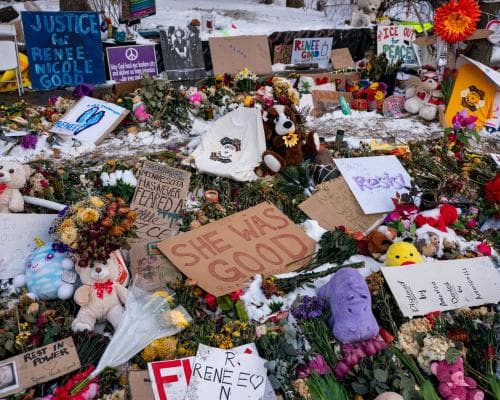
The stories of individuals like Renee Good and the Rev. David Black remind us that the struggle for justice is often borne by the courageous few. Their suffering, while tragic, serves as a call to action for all who value freedom of assembly and speech. These rights are not merely privileges but the very foundation of a functioning democracy. In their defense, we cultivate our own virtue.
The Wisdom of Historical Precedent
History teaches us that authoritarianism often begins with the erosion of dissent. As the United States faces scrutiny from international bodies, we must recognize that such oversight is not a sign of weakness but a necessary safeguard against tyranny. The words of the United Nations high commissioner resonate deeply: the mistreatment of migrants is not merely a political issue but a moral failing that reflects our shared humanity.
A Call to Virtue
In the face of adversity, let us not succumb to despair. Instead, let us embrace the opportunity to advocate for those whose voices have been silenced. The upcoming hearing is not just a moment of accountability; it is a chance to reaffirm our commitment to justice and the rights of all individuals. As we engage in this struggle, we must remember that virtue is not merely a response to injustice but a proactive pursuit of the common good.
Conclusion: The Path Forward
As I close this reflection, I am reminded that the path to justice is fraught with challenges. Yet, it is through these challenges that we cultivate resilience and fortitude. Let us stand firm in our convictions, advocating for the rights of the marginalized and ensuring that the principles of democracy endure. In doing so, we honor the legacy of those who have fought before us and pave the way for a more just future.
Source Body Text
We are constitutional law, civil rights, and human rights scholars and practitioners who have spent decades litigating government abuse cases in the United States. Despite the US legal system’s flaws, our work – from securing a record civil settlement for George Floyd’s family to holding Bolivia’s ex-president accountable in US federal court for the massacre of Indigenous protesters – has demonstrated that US courts can reign in state power and provide a path to accountability. But this pathway is narrowing. As Donald Trump attacks the courts, weaponizes the Department of Justice, and targets attorneys who challenge his administration, we have been forced to seek justice beyond our borders. Earlier this year, we requested a thematic hearing at the Inter-American Commission on Human Rights (IACHR) on the United States’s violent suppression of protests against federal immigration policies. Never before had the commission granted such a hearing, but the extraordinary nature of the Trump administration’s actions – including allegations of excessive and lethal force against peaceful protesters, attacks on journalists and legal observers, and racial profiling and surveillance – warrants international scrutiny. On 4 August, the commission will hold that hearing. The IACHR is unfamiliar to most Americans. Together with the Inter-American Court of Human Rights, the commission is the bedrock of the hemisphere’s human rights system. For decades, it has served as a safeguard against authoritarianism and State repression in the region, providing an avenue for victims when domestic institutions have failed. While the United States claims it is not bound by the Inter-American System’s norms, it remains subject to the commission’s oversight under the American Declaration of the Rights and Duties of Man. Condemnation by the commission has directly led to policy changes by countries, including the United States. The IACHR typically convenes sessions of hearings three times per year, rotating the location between countries in the region. Fittingly, ours will be held in Washington DC, just two blocks from the White House. Among those participating will be counsel for the family of Renee Good, who was shot and killed in her car by an ICE agent during a Minneapolis demonstration. Following the tragic killing of Good, the then Department of Homeland Security secretary, Kristi Noem, characterized Good’s actions as “domestic terrorism”. Good’s counsel will also speak on behalf of the dozens of victims in Chicago he represents injured at protests and denied basic rights in detention – including access to food, medicine, and lawyers. Also testifying will be the Rev David Black, who was shot in the head with a pepper ball by a federal agent at a protest outside Chicago. In response, Gregory Bovino, who was serving as US Customs and Border’s “commander-at-large”, said the shooting “was absolutely in line with policy, and I applaud [the agents]”. Renee Good and the Rev Black are only two of the hundreds of protesters and bystanders who have been injured amid demonstrations against Trump’s remarkably cruel immigration policies. On his inauguration day, Trump signed a series of xenophobic executive orders, including the “Protecting the American People Against Invasion” order. Within days, he deployed federal agents to carry out paramilitary-style raids across US cities. Families have been torn apart and thrown into detention centers or sent to third countries. Everyday Americans watched agents abduct, beat and shoot unarmed migrants. Only weeks ago, separate violent ICE operations resulted in three more deaths. The international community has sharply criticized the United States’ treatment of immigrants. United Nations high commissioner Volker Türk said he was “astounded by the now-routine abuse and denigration of migrants and refugees”, while the United Nations committee on the elimination of racial discrimination expressed alarm over what it called the “systematic use of racial profiling” by ICE and “[r]acist hate speech by political leaders, including the President”. Such condemnation is entirely justified, but even those who support the administration’s immigration agenda should be deeply concerned by attacks on those who protest it. Today’s target may be anti-ICE protesters. Tomorrow it could be advocates for climate justice, gun rights, abortion or labor rights. Freedom of assembly and freedom of speech are cornerstones of any functioning democracy. When they are under attack, other freedoms quickly fall. The upcoming hearing before the commission is both extraordinary and symbolic. A body that has historically held the hemisphere’s most authoritarian governments to account will now scrutinize the United States. As the Trump administration weakens domestic checks on power, international oversight has become not only relevant. It may be our last chance to stop the backsliding that threatens our democracy. Thomas Becker serves as the legal and policy director at the University Network for Human Rights and teaches human rights at Columbia Law School Antonio Romanucci is a founding partner at Romanucci & Blandin, LLC and serves as counsel for Renee Good’s family