
August 17, 2026
Trump’s tough-guy image has been undone by his own actions | Mohamad Bazzi
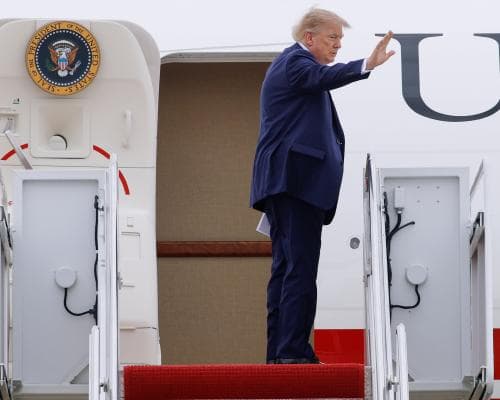
Donald Trump's carefully crafted tough-guy persona is being undermined by recent revelations about his handling of a potential Iranian assassination attempt. Following a NATO summit, Trump was secretly flown out of Turkey on a military aircraft, using a ruse that involved him boarding Air Force One for the cameras, which has drawn criticism for its portrayal of weakness. This incident highlights the disconnect between Trump's bravado and the reality of his precarious position, especially as his aggressive war against Iran has led to a resilient adversary and significant geopolitical turmoil. The fallout from this situation may not only damage Trump's image but also impact his political legacy amid ongoing challenges in the Middle East.
Stoic Response
Addressing Students in the Stoa
Greetings, students. As we gather in this sacred space of reflection and learning, let us turn our minds toward the nature of judgment and the discipline of our desires, impulses, and assent.
The Headline Issue
We find ourselves in a world where appearances often eclipse reality, as seen in the recent events surrounding a prominent figure whose carefully crafted persona of strength is now under scrutiny. This serves as a profound lesson for us all.
Challenge Unhealthy Judgments
-
Examine the Facade:
- Recognize that bravado can mask vulnerability.
- Understand that strength is not merely the absence of fear, but the mastery of it.
-
Seek Inner Truth:
- Ask yourself: What is truly strong? Is it the loud proclamation of power or the quiet resolve to act with virtue?
- Reflect on how external judgments can cloud our perception of ourselves and others.
-
Avoid Comparisons:
- Refrain from measuring your worth against the false metrics of public personas.
- Cultivate your own virtues rather than chasing the shadows of another's image.
Anchor Advice in Discipline
To navigate the tumult of external circumstances and internal desires, we must practice discipline in three key areas:
-
Desire:
- Cultivate desires aligned with virtue and wisdom.
- Seek what is within your control and let go of the rest.
-
Impulse:
- Pause before acting; consider the implications of your actions.
- Respond with thoughtfulness, not reaction.
-
Assent:
- Question your initial judgments. Do they serve you or lead you astray?
- Only grant assent to thoughts that promote your inner peace and clarity.
Imperatives for Reflection
-
Practice Self-Examination:
- Regularly reflect on your motivations and desires. What drives you?
-
Embrace Humility:
- Recognize that true strength lies in humility, not in the loudest voice.
-
Commit to Growth:
- Use challenges as opportunities for personal growth and understanding.
In closing, remember that the essence of a true philosopher lies not in the outward display of power, but in the steadfastness of character. Let us strive to embody this truth in our daily lives.
Article Rewritten Through Stoic Lens
A Stoic Perspective on Recent Events Surrounding Donald Trump
In the realm of politics, character is often tested through adversity. The recent revelations regarding Donald Trump’s handling of a potential Iranian assassination attempt serve as a poignant reminder of this principle. Rather than succumbing to outrage or celebration, we must approach these events with a measured response, focusing on the lessons they impart about virtue, wisdom, courage, and temperance.
Wisdom: The Nature of Strength
For decades, Donald Trump has meticulously crafted an image of strength and dominance, a persona that resonated with many. As a brash New York real estate mogul and reality TV star, he often proclaimed, “You’re fired!” to assert his authority. However, wisdom teaches us that true strength lies not in bravado but in the ability to navigate complex situations with clarity and foresight.
Recent events, particularly Trump’s secret military flight out of Turkey following a NATO summit, reveal a stark contrast to his cultivated image. The elaborate ruse—boarding Air Force One for the cameras only to be whisked away in an airport catering truck—highlights a disconnect between his public persona and the reality of his precarious position. This incident serves as a reminder that wisdom often requires humility and the acknowledgment of one’s vulnerabilities.
Courage: Facing Adversity
The challenges Trump faces, particularly in his aggressive stance against Iran, are tests of courage. His decision to engage in military action against Iran was rooted in a belief in American strength. Yet, as the situation has unfolded, it has become clear that courage is not merely about aggression but also about the willingness to confront the consequences of one’s actions.
Trump’s admission that he switched planes due to concerns for his safety underscores the importance of prudence in leadership. “I go by Secret Service and the military,” he stated, attributing the decision to his protective detail. This acknowledgment of vulnerability is a crucial aspect of courage; it is not a sign of weakness but rather an understanding of one’s limitations.
Temperance: The Balance of Power
The fallout from Trump’s military actions in Iran illustrates the necessity of temperance in governance. His initial goals—to dismantle Iran’s military capabilities and instigate regime change—have led to significant geopolitical turmoil. The Iranian response has shown resilience, adapting quickly to the loss of leadership and leveraging its strategic position in the Strait of Hormuz to disrupt global oil supplies.
In the pursuit of power, one must exercise restraint and recognize the potential for unintended consequences. The current state of affairs serves as a reminder that the exercise of power should be tempered with foresight and respect for the complexities of international relations.
Gratitude: Acknowledging Opportunities for Growth
Amidst the turmoil, there are opportunities for gratitude. The challenges Trump faces may serve as catalysts for personal and political growth. Each setback can be viewed as a chance to reflect on one’s values and to cultivate a character that aligns with the virtues of wisdom, courage, and temperance.
As Iranian officials and state media revel in the media attention surrounding Trump’s secretive maneuvers, it is essential to approach this moment with a sense of detachment. The pursuit of power should not define one’s identity; rather, it is the character developed through adversity that ultimately shapes one’s legacy.
Conclusion: The Legacy of Character
In the end, the true measure of a leader lies not in their public image but in their capacity for virtue. The recent revelations regarding Donald Trump’s actions serve as a reminder that conflicts are tests of character, and successes should be met with gratitude rather than attachment. As we reflect on these events, let us strive to embody the cardinal virtues, recognizing that our responses to adversity define us far more than our triumphs.
Source Body Text
For decades, Donald Trump cultivated a public image based on strength and dominance. He was a brash New York real estate mogul; a reality TV star who deployed his signature phrase: “You’re fired!” to eliminate contestants from The Apprentice; and eventually US president and undisputed leader of the Republican party. In recent months, Trump has taken his boastfulness to an extreme, reportedly telling confidants that he’s “the most powerful person to ever live” and comparing himself with some of history’s most feared leaders, including Genghis Khan, Napoleon, Hitler, Stalin and Mao. But recent revelations have threatened to shatter Trump’s image as a strongman: the US president departed on a secret military flight out of Turkey after attending a Nato summit, while the White House told the public he was flying onboard Air Force One. The operation involved an elaborate ruse in which Trump boarded his jumbo jet in view of TV cameras, and then was hustled out by the Secret Service through an airport catering truck. Trump was taken to an alternate military aircraft, which flew him to Britain – all unbeknown to journalists and several White House staff members who stayed on Air Force One and thought they were on the same plane as the president. The embarrassing necessity was a result of Trump’s unnecessary war against Iran. US officials used such levels of subterfuge because they were worried about an Iranian assassination attempt against Trump, according to reports in the Washington Post and New York Times. On 11 August, Trump confirmed that he had secretly switched planes in Turkey, and attributed the decision to his protective detail and military advisers. “I go by Secret Service and the military,” Trump told reporters who asked why US officials had used such an intricate ploy and kept the public in the dark about it until the story was leaked. “They wanted me to go on a different flight, a different plane. Equal safety. But they wanted me to do it, so I do it. I do what they say.” Trump tried to evade criticism that the decision left several cabinet members and senior White House officials – including Marco Rubio, the secretary of state; Scott Bessent, the treasury secretary; Stephen Miller, Trump’s top domestic adviser; and Steven Cheung, the White House communications director – on Air Force One to serve as decoys, along with other Trump staffers and journalists. To deflect more questions, Trump claimed, without providing evidence, that the secret military plane he flew on was actually at “greater risk” than the Air Force One jet that the world saw him board after the Nato summit. “I think it was at greater risk because that would be the plane I think that they would be more likely to go for,” he said. It’s easy to see why Trump and his administration did not want to publicly share details of the ruse after the danger had passed, as past presidents had done when they used subterfuge to visit war zones and other hazardous locations. The image of Trump hiding in an airport catering container to avoid a potential Iranian assassination attempt is a stark contrast to the tough guy brand he spent years cultivating. It’s also an antithesis to the image Trump projected after he survived an assassination attempt at a presidential campaign rally in Butler, Pennsylvania, in July 2024. In a series of photos captured by news photographers at the scene, Trump raised his fist in the air and mouthed the words: “Fight, fight, fight” to supporters as he was rushed off stage by Secret Service agents, bleeding from his ear. One image in particular, showing a bloodied Trump pumping his fist with a US flag in the background, became iconic – and his campaign quickly tried to monetize it by using the photo on the cover of a book and to sell $299 Trump-branded sneakers. Beyond the dueling imagery, the fact that Trump took refuge in a catering truck has deeper political implications. It encapsulates Trump’s failure in his war on Iran: a president who constantly boasts about US military prowess and tries to project personal strength instead appears weak in front of the world as he hides from the consequences of his own actions. Nearly six months ago, Trump launched his reckless war against Iran as an act of imperial hubris – and a culmination of a series of lawless acts since he returned to office in 2025. With little resistance from the Republican-controlled Congress or the US supreme court, Trump was able to gut government agencies, use federal law enforcement to target his political enemies, appoint his loyalists as top prosecutors, deploy national guard troops into US cities, and weaken decades-old anti-corruption laws designed to constrain presidential power after the Watergate scandal. He also steamrolled over Congress and its authority to declare war. In late February, when the US and Israel launched a series of devastating airstrikes against Iran, Trump had expansive goals: to destroy Tehran’s military capabilities and nuclear program, and to topple Iran’s theocratic regime by decimating its leadership and instigating a popular uprising. In the war’s early days, the US and Israel assassinated more than 30 senior Iranian military and political officials, including the supreme leader, Ayatollah Ali Khamenei. But the Iranian system proved resilient and it quickly replaced those officials, partly by appointing Khamenei’s son, Mojtaba, as the new supreme leader, to ensure continuity. Iran also turned its proximity to the strait of Hormuz, a vital waterway through which more than a fifth of the world’s oil supply passed each day, into an effective economic weapon. Tehran closed the passageway at the start of the war, increasing energy prices and disrupting the global economy. Since then, Trump has struggled to reach a deal with Iran to reopen the strait of Hormuz and prevent the war from spiraling into a regional conflict that could cause severe economic damage. For months, Trump has tried to negotiate a face-saving agreement that would allow him to declare victory and shift US public attention away from the war before midterm elections in November that could see Republicans lose control of Congress. Iran’s leaders and Trump both say they don’t trust the other side to abide by any agreement – and a memorandum of understanding reached in mid-June, which included reopening the strait of Hormuz and lifting a US naval blockade against Iranian ships in the region, has collapsed. Since then, tit-for-tat attacks by Iran and the US have rekindled fears of another all-out war. Not surprisingly, Iranian officials and state media are reveling in the extensive media attention over Trump secretly switching planes in Turkey – and especially the detail about him being ushered into an airport catering truck. A presenter on Iranian state TV called it a “scandal stemming from fear of Iran’s military power”, and described the incident as a source of “humiliation” for the US president. It will take time for Trump to undo the damage this ruse has done to his self-proclaimed image as a strong and dominant world leader. More importantly, his disastrous decision to launch a war against Iran will shape his legacy long after he leaves office. Mohamad Bazzi is a Guardian US columnist. He is also director of the Center for Near Eastern Studies and a journalism professor at New York University