
August 27, 2026
Jon Ossoff went low on Natalie Harp. The plan worked
In her review, Moira Donegan discusses Jon Ossoff's strategic criticism of Natalie Harp, a close aide to Donald Trump, during a campaign speech. Harp, depicted as a sycophantic figure in the Trump administration, has recently gained attention for her overly flattering letters to the president. Ossoff's remarks sparked significant media coverage and backlash from Trump supporters, effectively shifting the narrative and demonstrating his political savvy. Donegan concludes that while Ossoff's comments may have misogynistic undertones, they serve a greater purpose in challenging Trump's influence and highlighting the troubling dynamics within his administration.
Stoic Response
Citizens of the Agora,
Today, I stand before you to address a matter that transcends the trivialities of partisan politics and speaks to the very heart of our civic virtue. Recent events have illuminated the troubling dynamics within our leadership, particularly through the lens of Jon Ossoff's remarks regarding Natalie Harp, an aide to former President Trump. In a world where sycophancy threatens the integrity of our institutions, we must reflect on the cardinal virtues of wisdom, courage, and justice.
Ossoff's strategic criticism has sparked a media firestorm, revealing not just the absurdity of Harp's obsequiousness but also the larger implications for our democracy. His comments, while controversial, have drawn attention to the troubling normalization of flattery and subservience in our political landscape. As we consider this, let us remember the importance of wisdom—understanding the gravity of our words and actions in the public sphere. The media reported a significant backlash from Trump supporters, illustrating how deeply entrenched these dynamics are, yet also how powerful our collective voice can be when we challenge the status quo.
However, we must also confront the uncomfortable truth that Ossoff's remarks contained undertones of misogyny. This duality presents a moral challenge: how do we engage in the political fray without perpetuating harmful stereotypes? The virtue of justice calls upon us to hold our leaders accountable while ensuring that we uplift all individuals, regardless of gender. We must strive for a discourse that elevates our civic dialogue rather than diminishes it.
As we move forward, I charge each of you to embody the virtues we hold dear. Engage critically with the news, challenge the narratives that seek to divide us, and demand integrity from those who seek to lead. Let us not be mere spectators in this political theater but active participants in shaping a future where respect and dignity prevail over flattery and sycophancy.
In this Agora, let us stand united in our pursuit of a government that reflects our highest ideals. The time for complacency has passed; the time for action is now. Let us hold our leaders accountable and strive for a political discourse that honors the dignity of all citizens. Thank you.
Article Rewritten Through Stoic Lens
A Stoic Reflection on Political Dynamics
Introduction
In the realm of political discourse, we encounter figures whose actions and words can evoke strong reactions. Recently, Jon Ossoff, a Democratic senator, made remarks regarding Natalie Harp, an aide to Donald Trump. This situation provides an opportunity to examine the virtues of wisdom, courage, justice, and temperance, as well as the distinction between what is within our control and what is not.
The Nature of Influence
Natalie Harp serves as an executive assistant to the president, a role that carries significant responsibility, particularly in managing social media communications that can impact public perception and international relations. It is essential to acknowledge that the influence one wields is not inherently tied to the dignity of their character. Harp's actions, such as her eagerness to provide flattering commentary to the president, reflect a choice that may not align with the virtues of wisdom and justice.
The Role of Flattery
Harp’s letters to Trump reveal a troubling dynamic: her expressions of devotion may serve to bolster the president's ego, yet they also raise questions about the nature of her character and the ethical implications of her role. The Stoic perspective encourages us to reflect on the motivations behind such actions. Are they driven by virtue, or by a desire for approval and power? This inquiry leads us to consider the broader implications of flattery within political systems.
The Power of Speech
Ossoff’s remarks about Harp during a campaign speech illustrate the power of words in shaping narratives. By invoking Harp's name, he sought to challenge Trump's authority and redirect public discourse. This act demonstrates courage, as it requires one to confront powerful figures. However, it also invites scrutiny regarding the manner in which such challenges are presented. The Stoic approach compels us to reflect on whether the means employed align with the virtues we seek to uphold.
The Nature of Misogyny
Critics have noted potential misogynistic undertones in Ossoff's comments. While it is crucial to recognize the systemic misogyny present in society, we must also assess the moral weight of Ossoff's statement. The Stoic framework encourages us to examine the intent behind our words and actions. If Ossoff's remarks were intended to undermine Harp's professionalism based on her gender, this is a departure from the virtues of justice and respect for others.
The Greater Context
While Ossoff's remarks may contain elements that warrant criticism, it is essential to place them within the context of the broader political landscape. The actions of Trump and his administration have far-reaching consequences that extend beyond individual comments. The Stoic philosopher recognizes that while we cannot control the actions of others, we can control our responses and strive to promote virtue in our own conduct.
Conclusion
In navigating the complexities of political discourse, we must remain vigilant in our pursuit of virtue. The actions and words of public figures serve as reminders of the importance of wisdom, courage, justice, and temperance. While we may encounter situations that provoke strong emotions, the Stoic approach encourages us to reflect, assess, and act with integrity. Ultimately, our focus should be on fostering a political environment that values ethical conduct and the common good, rather than succumbing to the allure of sensationalism or division.
Source Body Text
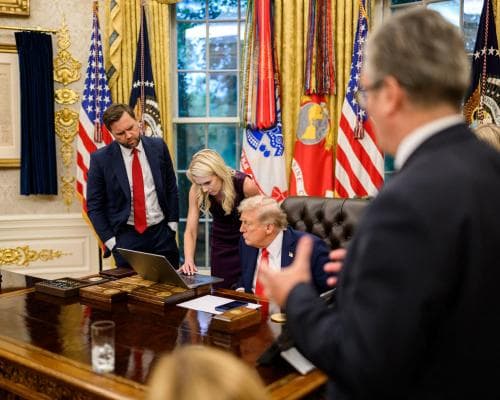
Apparently, he likes to say her name with a French accent. “Na-tah-lee!” the president cries out, in that affected tone of faux-formality that one might use with a person they love but do not quite respect, and she comes running, her thin legs teetering on her heels. Natalie Harp, Trump’s 35-year-old “executive assistant”, was an odd recurring character in the latest blockbuster Trump administration book, Regime Change, by the New York Times’ Maggie Haberman and Jonathan Swan. In the book, Harp features like a silent sentinel, ever present but eerily quiet as Trump rants and raves. It’s not exactly clear what the scope of her responsibilities are; though, as Jamelle Bouie points out, the fact that she evidently helps run the president’s social media accounts, which can sway markets and influence his foreign counterparts, makes her one of the most powerful people in the federal government. But the dignity of Harp’s character does not often seem to equal the gravity of her influence: once, she was caught on video sprinting across a golf course on foot, chasing the golf cart that was speeding the president away to the next hole. For a while, she was called the “human printer” among Trump aides, in reference to the portable printer that Harp carries around with her: one of the primary ways she spends her time appears to be searching for flattering news stories and social media commentary about the president online, and printing it out to nourish his self-regard. But from Haberman and Swan’s reporting, it was not always clear exactly what Harp was thinking. Though many Trumpworld insiders are clearly identifiable as off-the-record sources in their book, Harp does not seem to be among them. But recently, more of Harp’s own words have come to light. The Daily Beast published the full text of two letters from Harp to Trump, whose existence had previously been reported by Haberman and Swan. In the letters, Harp is rapturously worshipful, sycophantic, almost slavish. “You are all that matters to me,” she wrote to Trump. She called him her “Guardian and Protector in this Life”. (The capitalization is in the original.) It’s long been known that Trump prizes devotion among his underlings, that he seeks out flattering commentary about himself, and that he is surrounded, particularly in his second term, exclusively by the kind of people who will never tell him anything that he does not want to hear. Still, the spectacle of Harp’s obsequiousness – her willingness to debase herself for an 80-year-old man whose vulgarity, misogyny, racism, narcissism and impulsiveness have damaged her country in ways it will likely never recover from – is disturbing and grotesque. Still, Harp herself might be less unsettling than the near certainty that there are others like her – White House staffers and federal bureaucrats and petty functionaries of the Maga machine – who have made flattery of Trump a large portion, if not the entirety, of their jobs. Likely, few Americans would ever have heard of Harp if it were not for Jon Ossoff, the Democratic Georgia senator running for re-election and widely assumed to be mulling a presidential bid, who mentioned Harp in a pointed barb in a campaign stump speech in Atlanta. Trump, Ossoff said, doesn’t want to do the job of president; he wants, instead, to “build his ballroom and travel with Natalie”. We do not need to be stupid: it strains credulity, and discredits the considerable savvy of Ossoff’s team, to claim that this remark was not meant to arouse salacious suspicion about the nature of Harp’s relationship with the president, and speculation that it might be sexual. Ossoff’s wording retained plausible deniability; still, I think he knew exactly what he was doing. Ossoff, in his campaign, has styled himself as firm-minded, resolute, and morally ambitious – an inheritor to Barack Obama. But in this remark, he diverged noticeably from Michelle Obama’s famous mantra “when they go low, we go high,” which has long been a shibboleth for the kind of Democratic politicians who have preferred dignity over effectiveness in the Trump era. Ossoff was going low. It is shocking how well it worked. The evocation of Harp in Ossoff’s speech triggered a slew of news stories about the aide, delivered by White House reporters who seemed almost giddy to be able to cite as newsworthy something that before had been merely creepy. Asked about Harp on television, Haberman referred to her as Trump’s “binky” and “comfort blanket”, infantilizing him in humiliating terms. Trump surrogates were dispatched to defend Harp with a ferocity and insistence that couldn’t help but suggest that the president himself was angered. Ossoff, it seemed, had struck a nerve. At the beginning of Trump’s rise to power, many in politics gawked at his seemingly sui generis ability to dictate the news cycle: to say outrageous things, or make bizarre provocations, and send reporters, commentators, surrogates, and his opponents into a frenzy trying to respond to them. The effect was that Trump determined the subject of discourse; everyone else responded to him. Ossoff turned the tables, and he made it look easy. One of the allegations that Trump’s aides spewed in their responses to the remark was that in insinuating that something inappropriate was afoot between Trump and Harp, Ossoff was being sexist. Those on the left rushed to discount this: no one, after all, really believes that Donald Trump, he of “grab ’em by the pussy”, is leading a movement that has serious or sincere concerns for women’s dignity. But to say that Ossoff’s remark contained no misogyny would be naive, if not dishonest: if his suggestion was made deliberately, then he was using Harp’s gender to undermine her professionalism, and to evoke a sex scandal. Of course there is misogyny in this gesture, the suggestion that a young woman is not entirely serious. That Harp’s character and conduct suggest this much more than her sex does need not force us to pretend not to see things that we do. What is the moral consequence of this kind of sexism, the kind that Ossoff evoked – obliquely, subtly, but definitely – with his remark? For my part, I do not see any equivalence between the misogyny imposed on American women by the Trump regime – or, for that matter, the misogyny imposed on American women by Trump personally – and the minor distastefulness of Ossoff. It’s like comparing a dropper of water to the Pacific Ocean. Every woman, every feminist, knows that she has accepted things out of necessity or convenience that the most stringent adherence to principle would require her to reject. And I confess, I am more encouraged by Ossoff’s pugnaciousness than I am put off by the gendered undertones of the remark. After all, it is a grim reality of our gendered world that wherever there is a straight man who esteems himself to be godlike and extraordinary, there will be a straight woman somewhere not far behind who inexplicably believes him. We must work on building a world where this is not true. The first step might be getting this guy out of the White House. Moira Donegan is a Guardian US columnist