
September 11, 2026
Trump’s clash with Canada is his latest imperialistic embarrassment | Sidney Blumenthal
Executive Summary
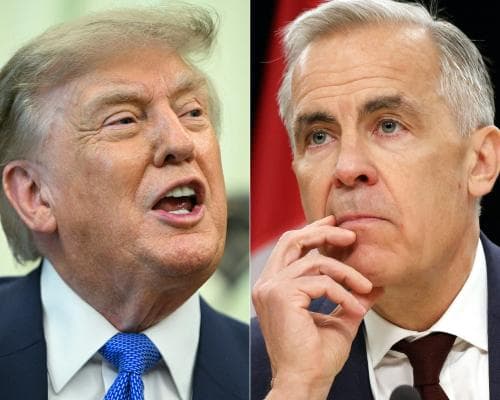
The article critiques former President Trump's approach to foreign relations, particularly his confrontational stance towards Canada, which is characterized as a form of imperialism. Key data highlights the economic repercussions of Trump's tariffs on Canada, notably affecting Michigan, where over 38% of exports go to Canada, resulting in significant job losses and increased household costs. The resolution suggests that Canada, under Prime Minister Mark Carney, is firmly resisting Trump's attempts to undermine its sovereignty, emphasizing the need for equal negotiations and a return to cooperative trade practices.
Stoic Response
Citizens of the Agora, gather round! Today, we stand at a crossroads, a moment where our collective wisdom must shine through the fog of discord and division. Recent events in our foreign relations, particularly concerning our neighbor to the north—Canada—demand our attention and reflection. Former President Trump’s confrontational approach, laden with imperialistic overtones, threatens not only their sovereignty but also the stability of our own economy. His tariffs have already cost Michigan alone an estimated $35 billion, jeopardizing 260,000 jobs and imposing an average burden of $5,619 on households. This is not merely a matter of policy; it is a matter of virtue.
Let us consider the cardinal virtues: wisdom, courage, temperance, and justice. Wisdom teaches us to seek the truth, to understand the complexities of our relationships with other nations. Courage compels us to stand against tyranny, whether it be in the form of economic bullying or the undermining of sovereignty. Temperance reminds us that our actions have consequences, and justice demands that we treat our neighbors as equals, not subjects to be dominated. Prime Minister Mark Carney of Canada has made it clear: “We will not sign an agreement that sacrifices our basic sovereignty.” His words echo the call for justice and respect in international dealings.
Yet, we must not be passive observers in this unfolding drama. The economic repercussions of Trump's tariffs extend far beyond the borders of Michigan. They reverberate through our entire nation, undermining the very fabric of cooperative trade that has been painstakingly woven since the end of the last great war. We must ask ourselves: Is this the legacy we wish to leave for future generations? A legacy of division, conflict, and economic strife? Or shall we strive for a future built on mutual respect, understanding, and collaboration?
I charge you, citizens, to rise up with courage and wisdom. Advocate for policies that prioritize cooperation over confrontation, that foster equitable negotiations rather than imperialistic demands. Engage in discussions, educate your peers, and hold our leaders accountable. Let us not allow the specter of imperialism to cloud our judgment or dictate our actions.
In the spirit of justice and solidarity, let us unite in our commitment to a brighter future. A future where we treat our neighbors not as adversaries but as partners, where we build bridges instead of walls. The time for action is now—let us reclaim our sovereignty, our dignity, and our shared humanity!
Article Rewritten Through Stoic Lens
Journal Entry: Reflections on the Nature of Power and Sovereignty
The Nature of Confrontation
In observing the actions of leaders, I am reminded of the transient nature of power. The former President, in his dealings with Canada, has exhibited a confrontational spirit, one that seeks to dominate rather than collaborate. This imperialistic approach, akin to the folly of those who believe they can bend the will of nations to their desires, serves as a reminder that true strength lies in mutual respect and understanding.
Acceptance of Nature's Order
The economic repercussions of his tariffs on Canada, particularly in Michigan, reveal the interconnectedness of our fates. More than 38% of Michigan’s exports flow to Canada, a testament to the bonds we forge through trade. When one seeks to impose their will through force, they inevitably harm not only the other but also themselves. Nature’s order teaches us that cooperation yields greater prosperity than conflict.
The Call for Virtue
Prime Minister Mark Carney's resolute stance against intimidation embodies the virtue of sovereignty. He asserts that Canada is an independent nation, deserving of respect, and will not be coerced into submission. This is a noble defense of one’s principles, and it invites reflection on our own commitments to honor and integrity in our dealings with others.
The Illusion of Control
The former President’s attempts to brandish power through ultimatums and executive orders reflect a misunderstanding of governance. His desire to rename Lake Ontario to “Lake America” and his theatrical displays reveal a fixation on image over substance. True leadership does not seek to dominate through spectacle but rather to inspire through wisdom and humility.
The Cycle of Resistance
As resistance mounts, so too does the pressure to exert greater force. This cycle is perilous, for it leads to a diminishing of one’s power and a fracturing of relationships. The more one clings to the illusion of control, the more they risk losing the very influence they seek to maintain. In this, we find a lesson: to govern wisely is to understand the limits of one’s authority and to respect the autonomy of others.
The Path to Cooperation
Carney’s assertion that “if Washington wants to trade, they must come to the table as equals” is a profound reminder of the need for balance in relationships. In the pursuit of mutual benefit, we must abandon the notion of superiority and embrace the dignity of all parties involved. This is the essence of virtuous negotiation.
Reflection on the Pursuit of Wealth
The former President’s fixation on acquiring resources, whether in Venezuela or Greenland, mirrors the folly of those who seek wealth without regard for the consequences. True prosperity is not found in plunder but in the cultivation of relationships grounded in trust and respect. The pursuit of wealth must be tempered by a commitment to the greater good.
Conclusion: Embracing Wisdom
In these turbulent times, let us strive to embody the principles of wisdom, humility, and cooperation. The actions of leaders may provoke anxiety, but we must accept the unfolding of events as part of nature's order. In doing so, we can transform challenges into opportunities for virtue, fostering a world where all nations can thrive in harmony.
Source Body Text
Trumpism is the lowest stage of imperialism. “We’re not going to invade Greenland. We’re going to buy it,” Donald Trump reportedly told the annual black-tie dinner on 1 February of the private Alfalfa Club, an assemblage of prominent Washington figures, a number of whom he had publicly humiliated, and others he was investigating or suing. “It’s never been my intention to make Greenland the 51st state. I want to make Canada the 51st state. Greenland will be the 52nd state. Venezuela can be 53rd.” The room greeted several of his remarks with dead silence. His cosplay as the Pirate King was not received as a good-humored takeoff from a Gilbert and Sullivan opera. He went on. “So many people in the room I hate,” he said in a display of honesty. “Most of you I like,” he claimed. Then, at his peak euphoria, he flew off to Mar-a-Lago to plan his attack on Iran, which took place 27 days later. Trump’s imperialism of piracy and plunder is less of a system even than that of the earliest imperialism of 17th-century privateers raiding the Spanish Main, the divine right of kings, and monarchs dividing up the spoils as favors to create their lords and earls. His schemes of aggrandizement operating by threat and force are justified by no larger rationale, nothing as exalted as “the white man’s burden”, marauding wherever and however he can to seize resources. Describing his actions as some version of colonialism grants him a more orderly and coherent method than he possesses. His pillaging bears not the slightest resemblance to the highly organized administration of Queen Victoria’s British empire. Trump’s predation is calculated to wreck the long-established arrangements of international trade, law and cooperation created after the second world war and the fall of colonial empires, whose guidelines he sees as obstructing his own profit and power. Obsessed with his fortune hunting, he couldn’t care less about the political consequences for ill-fated Republican candidates in the midterm elections who must face the music for the harm he is doing to their states. They are the least of his collateral damage. Mark Carney, the Canadian prime minister, offered the most succinct critique of Trump’s intent to usurp the sovereignty of countries in order to make them turn over their wealth to him. Carney said: “Canada is a sovereign, independent nation. We are not a target to be bullied, nor are we a client state to be subordinated … We will not sign an agreement that sacrifices our basic sovereignty, undermines our legal system, or cedes control over our foreign trade to Washington.” He called Trump’s demands a “last-minute power play intended to reduce Canada to an economic subsidiary”. Trump’s ultimatum abrogated the legal foundation of the US-Mexico-Canada Agreement, which he himself had signed in 2020. He had previously demeaned Carney as the “governor” of Canada. Now, adopting his characteristic pose as victim, Trump claimed Canada had been “ripping off the United States for years” and were among “worst” nations to “deal with”.. “They feel entitled and will be entitled no longer … It’s time to teach Canada you can’t do this anymore…. Someone should get these clowns to fall in line.” Carney replied that Canada was “at war” and would adopt “counter-measures”, tariffs of its own. “America,” he said, “has changed … If Washington wants to trade, they must come to the table as equals.” Trump’s answer was to issue an executive order renaming Lake Ontario as “Lake America”, the reflexive branding of the real estate operator. The White House put out AI-generated videos of Trump kicking over a sign reading “Lake Ontario” and replacing it with a new one, “Lake America”, and another with a squadron of ducks all with Trump’s hairdo and armed with machine guns patrolling the shore of “Lake America” to the theme music of Hawaii Five-O. The implied invocation of the Marx brothers’ farce of the ludicrous country of Freedonia nonsensically going to war, Duck Soup, seems lost on the busy beavers of Trump’s slop. Trump’s method has been consistent since he leveraged a mineral resource deal out of Ukraine in April 2025 at a weak point in its conflict with Russia. Rather than pressure Putin, Trump’s agents disguised as diplomats, his son-in-law Jared Kushner and real estate pal Steve Witkoff, the Rosencrantz and Guildenstern of Trump’s imperialism, stand by to negotiate post-sanctions deals on his behalf. Venezuela became Trump’s template for his piratical adventures. After swooping in on 3 January to capture its strongman, Nicolás Maduro, Trump promised a transition to democratic elections and that the US would play a custodial role over Venezuelan oil for the benefit of its people. Not long after Trump grabbed Maduro, he declared he needed to acquire Greenland and threatened a tariff war against Denmark and European allies to “get Greenland, including right, title and ownership”. “We probably won’t get anything unless I decide to use excessive strength and force, where we would be frankly unstoppable. But I won’t do that,” Trump said, adding, “I don’t have to use force,” and “I don’t want to use force.” He relented momentarily on 21 January after he claimed he had reached a “framework” agreement to negotiate over natural resources, though he subsequently sent preposterous agents into Greenland to stir up a quixotic annexation movement to no avail. A month later, he bombed Iran. Trump stated that his true inspiration for the Iran war was the Venezuelan model in a post on 11 June: “At some point in the not too distant future, we will … assume total control of their Oil and Gas Markets, much like we have with Venezuela, which is working out brilliantly for both Venezuela and the United States of America.” On 31 August, Trump announced that the US would take a stake in 17 oilfields in partnership with North American Blue Energy Partners, controlled by a Venezuelan oilman, Alejandro Betancourt. Betancourt was briefly detained in Britain, which was reportedly linked to a Swiss warrant on suspicion of money laundering. Betancourt has denied any wrongdoing and has not been charged with any offenses. The Swiss warrant was withdrawn in May and he became a Trump associate. The Trump administration has already claimed to have received proceeds of $500m from oil sales, initially deposited in an account in Qatar. When the congressman Sean Casten of Illinois and the senator Chris Van Hollen of Maryland wrote a letter requesting information, the administration shifted the money to an opaque account managed by the treasury department. In an article published in June by the Council on Foreign Relations, “The U.S. Took Over Venezuela’s Oil Industry. Where Has All the Money Gone?”, Roxana Vigil, a former treasury department expert, observed that in dealing with the “same corrupt regime, different leader … the Trump administration has provided almost no information on the system it has established to sell Venezuelan oil, collect the revenue, and use the funds”. The countries whose sovereignty, self-interest and rule of law Trump has struck include the United States. His assault on Canada has sent a shock through the whole US economy. The state most affected economically, Michigan, shares with Canada one of the most integrated industrial relationships in the world. More than 38% of Michigan’s exports go to Canada, the Detroit-Windsor corridor handles 25% of all US-Canada trade, and Trump’s tariffs immediately threaten 260,000 jobs with an immensely damaging multiplier effect. As of March, his tariffs had already caused estimated losses of $35bn to automakers. The average cost per Michigan household is estimated to be $5,619 in added expenses due to tariff-induced price increases. Trump’s tariffs have effectively hamstrung the Republican candidate for the Senate in Michigan, Mike Rogers, leaving him with the Hobson’s choice of either inciting Trump’s rage or submitting to his whim. Rogers has decided to take the latter course. He has called Trump’s economic policies “masterful”. When JD Vance came to the state, Rogers praised the administration. “The impact you have had on our state is phenomenal,” he said. Rogers hurls language about “extremism” against the Democratic candidate Abdul El-Sayed that substitutes for discussing Trump’s economic fiasco. Rogers is performing the kind of self-abasing fealty to Trump that Trump wishes he would receive from Carney. If only Rogers were the prime minister of Canada, there would be no trouble about “independence”. Vladimir Lenin, in his 1917 tract, Imperialism: The Highest Stage of Capitalism, argued in his dogmatic and overdetermined style that imperialism at the turn of the 20th century represented the integration of monopoly, finance and industrial capital, with the great powers dividing the world into colonies, and their conflict precipitating the first world war. In Trump’s imaginarium, he views himself as omnipotent and omniscient. When the world isn’t pliable, he must resort to greater force to reassure himself that the world acknowledges his self-image. The more he meets resistance to his fixed idea, the more pressure he must exert. He finds himself in a vicious cycle. His power hemorrhages, US power dissipates and he spins in a whirlpool. Trump’s Venezuelan paradigm, whose conditions cannot be replicated, have quickly descended into questionable business deals. Failed from the start of his Iran war, his pursuit of “total control” recedes over the horizon. His clash with Canada has been confronted with Carney’s fierce defiance. Trump’s quest for a new field to conquer has landed him in yet another quagmire. “When the Americans stop doing memes, stop throwing shade, stop trying to be tough, and start being serious about having those discussions, we can have those discussions,” said Carney. In the meantime, Trump’s outlandish exhibitions of triumphalism in the face of rejection and defeat echo the Marx Brothers more than they echo Marx and Lenin: “Hail Freedonia!” Sidney Blumenthal, former senior adviser to President Bill Clinton and Hillary Clinton, has published three books of a projected five-volume political life of Abraham Lincoln: A Self-Made Man, Wrestling With His Angel and All the Powers of Earth. He is a Guardian US columnist and co-host of the Court of History podcast