
October 12, 2026
Marco Rubio is promoting troubling ideas about ‘Western civilization’ | Ted Widmer
Talking Points: Marco Rubio's Troubling Vision of 'Western Civilization'
-
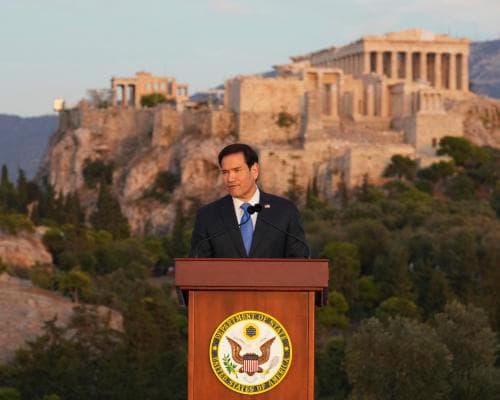
Protagonist and Argument: In his recent speech in Athens, U.S. Secretary of State Marco Rubio evokes a nostalgic vision of 'Western civilization,' arguing that the U.S. and Europe must reclaim the values of exploration and conquest to avoid decline. However, this perspective is rooted in a problematic interpretation of history, emphasizing a narrative of dominance rather than the democratic ideals that shaped the founding of the United States.
-
Historical Misinterpretations: Rubio's rhetoric suggests that history is defined by "great men" and conquest, echoing sentiments from figures like Hitler, while neglecting the contributions of diverse cultures that have shaped Western thought. This oversimplification risks alienating allies and ignoring the complexities of global interdependence.
-
Implications for Policy and Ideals: By failing to articulate a vision that includes democratic values and human rights, Rubio's speech reflects a retreat from the Enlightenment principles that inspired America's founders. This approach not only lacks substantive policy proposals but also undermines the intellectual legacy of American democracy, potentially leading to a more isolationist and exploitative foreign policy.
-
Conclusion: Ultimately, Rubio's speech serves as a hollow photo op rather than a meaningful call to action, revealing a troubling tendency to romanticize conquest while sidelining the essential democratic ideals that could guide a more equitable and collaborative future for the West.
Stoic Response
Citizens of the Agora,
Today, we gather in the spirit of inquiry and virtue, reflecting on the recent speech delivered by U.S. Secretary of State Marco Rubio in Athens. While he stood beneath the Acropolis, invoking a nostalgic vision of 'Western civilization,' we must critically assess the implications of his words. Rubio's portrayal of history as a tale of conquest and dominance, reminiscent of figures like Hitler, risks alienating allies and overlooks the rich tapestry of contributions from diverse cultures that have shaped our shared ideals. This narrow interpretation contradicts the very essence of democracy and the Enlightenment principles that inspired our founders.
Rubio's rhetoric suggests that we must return to an era defined by "great men" and their conquests. Yet, let us remember the wisdom of Aristotle, who taught us that virtue lies not in the pursuit of glory but in the pursuit of the common good. The statistics reveal a troubling reality: recent cuts to scientific research and education threaten our capacity for innovation and understanding. A former director of the White House Office of Science and Technology Policy warned that these actions could lead us away from a golden age and toward a regression in our intellectual pursuits. Are we to embrace a future defined by isolationism and exploitation, or shall we strive for a collaborative world built on mutual respect and shared values?
As we reflect on our own history, let us recall the words of Thomas Jefferson, who emphasized equality and the rights of all citizens. The ideals of democracy, human rights, and intellectual excellence must guide our actions, not the romanticization of conquest. We must not forget that true strength lies in our ability to uplift one another, to foster understanding and cooperation across borders. This is the legacy we should aspire to uphold, not a hollow narrative of dominance.
Therefore, I charge each of you to engage in thoughtful discourse and to challenge narratives that seek to divide us. Let us advocate for policies that reflect our highest ideals, ensuring that we remain a beacon of democracy and human rights in an increasingly complex world. Together, we can reclaim the narrative of Western civilization as one rooted in collaboration, enlightenment, and the pursuit of justice for all.
Stand with me, citizens, as we forge a path toward a future that honors our shared humanity and the virtues that define us. Let us not be mere spectators in this arena of history, but active participants in shaping a world that reflects our noblest aspirations.
Article Rewritten Through Stoic Lens
A Stoic Reflection on Marco Rubio's Vision of 'Western Civilization'
In the realm of public discourse, the recent speech delivered by U.S. Secretary of State Marco Rubio in Athens presents an opportunity to examine the cardinal virtues of wisdom, courage, justice, and temperance. Rather than succumbing to outrage or blind celebration, we can approach this moment as a test of character and an invitation to cultivate virtue.
Wisdom: A Call for Historical Clarity
Rubio's invocation of 'Western civilization' is steeped in nostalgia, urging a return to values of exploration and conquest. Yet, this perspective risks oversimplifying a complex history. As Stoics, we recognize the importance of understanding the past not through the lens of 'great men' but through the collective contributions of diverse cultures.
"Citizens of the same republic ought to have equal rights." — Cicero
This quote from Cicero underscores the democratic ideals that inspired the founders of the United States. Rubio's speech, however, leans toward a narrative of dominance that neglects these foundational principles. Wisdom compels us to acknowledge the interconnectedness of cultures and the lessons they offer, rather than romanticizing conquest.
Courage: Facing the Challenges of Today
Rubio's rhetoric suggests that the West must reclaim its historical prowess to avoid decline. However, true courage lies not in the glorification of past conquests but in confronting contemporary challenges with integrity and humility.
"There never yet was a democracy that did not commit suicide." — John Adams
This acknowledgment of potential decline serves as a reminder that the path forward requires not just boldness but also a commitment to democratic ideals and human rights. The Stoic approach encourages us to face adversity with resilience, recognizing that our character is forged in the crucible of conflict.
Justice: The Pursuit of Equitable Ideals
The absence of substantive policy proposals in Rubio's speech reveals a troubling retreat from the principles of justice that should guide our actions. Instead of advocating for a collaborative future, his vision risks alienating allies and perpetuating a narrative of exploitation.
"We shall pay any price, bear any burden... to assure the survival and success of liberty." — John F. Kennedy
Kennedy's commitment to justice and human rights stands in stark contrast to Rubio's focus on dominance. As Stoics, we must strive for a vision that uplifts the dignity of all people, recognizing that true strength lies in collaboration and mutual respect.
Temperance: Gratitude Without Attachment
While Rubio's speech may evoke a sense of nostalgia for a 'golden age,' we must approach such sentiments with temperance. Successes in history should inspire gratitude, not attachment to a bygone era.
"We believe that Europe can awaken from its long slumber and rekindle the fire that was here millennia ago."
This olive branch, while hopeful, also highlights the uphill battle that lies ahead. A temperate response acknowledges the beauty of the past while remaining grounded in the present, focusing on actionable ideals rather than romanticized visions.
Conclusion: A Call for Measured Reflection
Ultimately, Rubio's speech serves as a reminder of the complexities of our historical narrative and the virtues we must cultivate in response to contemporary challenges. Rather than allowing ourselves to be swept away by nostalgia or outrage, we are called to embody wisdom, courage, justice, and temperance.
In this way, we can navigate the tumultuous waters of modern discourse, using each conflict as a test of our character and each success as an opportunity for gratitude, free from the shackles of attachment. As Stoics, let us strive for a future that honors the democratic ideals of our past while fostering a more equitable and collaborative world.
Source Body Text
They had obviously worked hard on the backdrop – and it was magnificent. On 7 October, the US secretary of state, Marco Rubio, delivered a major speech in Athens, outdoors, with the Acropolis behind him. The sun was setting, bathing the ancient scene, including the Parthenon, in the light of the golden hour. The golden hour, but yet not quite the golden age. This was not Pericles defending democracy. Instead, Rubio offered a haunting vision of the choices facing the west, arguing that the US and Europe must rediscover the values of exploration and conquest that once drove centuries of expansion, or face decline and irrelevance. For long stretches, it was an exercise in nostalgia, lamenting the decline of western civilization as if this were a seminar at Hillsdale College or the Claremont Institute. In fact, a freshman seminar would have been able to puncture most of the speech’s assumptions. It’s true that the founders read deeply in the literature of ancient Greece and Rome, but they went there to justify their hope to build a democracy of equals – not a civilization of conquest. Thomas Jefferson, the author of the Declaration of Independence, admitted his debt to Cicero, who wrote: “Citizens of the same republic ought to have equal rights.” Abraham Lincoln considered the Greek mathematician Euclid a major influence, precisely because he defined equality as an inviolable concept. And what exactly is “the west”? We have a vague idea, but the question becomes complicated in the details. Is Vladimir Putin invited to this party? Russians also feel that their history stems from Greece and Rome. How about Adolf Hitler? Few leaders loved Rome and Greece more, as he made clear at the 1936 Berlin Olympics. In Mein Kampf, he celebrated the “higher culture” that arose from “the hardships of the Persian War”, in lines that might easily have fit into Rubio’s speech. Then there is the problem that a great deal of knowledge flowed into Greece and Rome from other places – eastern, not western. Writing comes from ancient Sumer, in what is now Iraq. Much mathematical thinking comes from the Arabs (a young Pythagoras probably traveled through the Levant). Even as the Persians and Greeks fought, they also influenced each other. Rubio seemed to enjoy retelling the story of a small band of Greek fighters, defending the Acropolis from Persian invaders. But that seemed theatrical during a week in which the war against Iran is not going well – with the USS Abraham Lincoln limping into San Diego, 12 B-1 bombers hastily evacuated from a base in England, from fear of a drone attack, and a rise in Iranian attacks on shipping. The price of oil remains sky-high. This is not a war that the speech’s heroes – Alexander the Great, Julius Caesar, Charlemagne and Hernán Cortés – would rush to claim as a conqueror’s legacy. To be fair, there was some elegant writing in the speech, displaying actual historical knowledge (for example, that the authors of the Federalist Papers cited Plutarch more than any other author). But again and again, Rubio wandered back to a precarious theme, that history is decided by “great men” who defy adversity and conquer lesser peoples. He almost seemed to be writing out text for a video game (Super Mario?), offering “an arena for great men to test and prove themselves”, where they can show off “fierce individuality and relentless ambition; daring exploration and invention; a yearning for discovery, for adventure, risk and glory”. To be fair, there have been many speeches in this vein, about striving for greatness and avoiding the fatal weaknesses that cause empires to vanish. Decline was much on the mind of the founders; John Adams wrote that “there never yet was a democracy that did not commit suicide”. Later presidents sounded similar themes. In 1910, Theodore Roosevelt described the virtues of the “Man in the Arena”, “whose face is marred by dust and sweat and blood; who strives valiantly; who errs, who comes short again and again, because there is no effort without error and shortcoming; but who does actually strive to do the deeds”. Similarly, John F Kennedy promised that “we shall pay any price, bear any burden, meet any hardship, support any friend, oppose any foe to assure the survival and the success of liberty” in his 1961 inaugural address. But in each case, they also paused to define the democratic ideals they believed in, and Kennedy went out of his way to mention human rights and the aspirations of the vast parts of the world that are not the west. Also, Roosevelt and Kennedy were legitimate military heroes, with the authority to discuss the waging of war and the even more important waging of peace. They were deeply read historians, too, who used the bully pulpit to celebrate intellectual excellence. The chief monument to Kennedy, of course, is the Kennedy Center, currently shuttered, its fate uncertain. It’s a short distance from Rubio’s state department, which added to the hollowness of his claim that a great nation, like the Greeks, pursues achievement “in philosophy and poetry, in sculpture and drama”. Given extensive cuts to scientific research, particularly climate science, it also sounded a false note to argue that Americans, like the Greeks, are consumed by “an insatiable curiosity about the world and the principles by which it operates, a hunger to know the mysteries of nature and grasp the secrets of the cosmos”. On the second day of the administration, the United States pulled out of the World Health Organization, and nearly every day brings another story about funding cuts for research. A former director of the White House office of science and technology policy, Arati Prabhakar, has argued that these cuts are leading us less to the “golden age” than to the stone age. Rubio’s speech was not quite as dismissive of Europe as a previous one he gave, in February, warning of “civilizational erasure”. At the foot of the Acropolis, he extended an olive branch, saying: “We believe that Europe can awaken from its long slumber and rekindle the fire that was here millennia ago.” But still, as he stood below the Parthenon, he seemed to be pointing out a path that will be difficult and mostly uphill for the US’s allies. In sum, it was a beautiful photo op. But at the end of the day, that’s all it was. There were no new policies advanced, and no ideals expressed, beyond the right to exploit resources and dominate others. This was a long distance from the Enlightenment that inspired Jefferson and the other founders. Instead, it provided more evidence of a moment that is darkening, despite Rubio’s efforts to capture the fading light of a sunset on the Acropolis. Ted Widmer, a former White House speechwriter, is the editor of American Speeches, and the recently published The Living Declaration: A Biography of America’s Founding Text, both published by the Library of America