
October 23, 2026
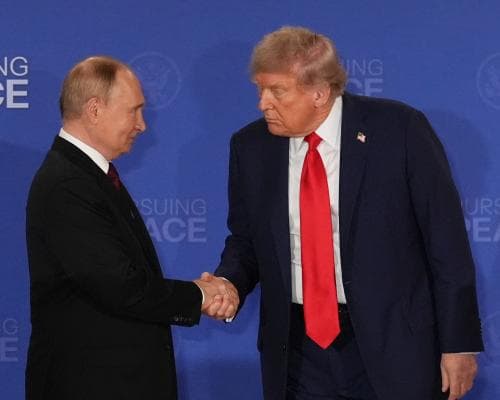
The Trump-Putin love story’s next chapter: selling out Ukraine | Sidney Blumenthal
In a provocative exploration of Donald Trump's relationship with Vladimir Putin, Sidney Blumenthal argues that Trump’s ambitions could lead to a dangerous compromise for Ukraine, reminiscent of the Munich Agreement that betrayed Czechoslovakia. Blumenthal suggests that Trump’s desire for personal gain and admiration from the Russian leader drives him to scapegoat Ukrainian President Volodymyr Zelenskyy, framing him as the obstacle to peace. As Trump maneuvers to align with Putin, the implications for U.S. foreign policy and support for Ukraine grow increasingly dire, raising alarms about a potential sellout of democratic values. This analysis underscores the troubling intersection of Trump’s political survival and his long-standing admiration for authoritarianism.
Stoic Response
Address to Students in the Stoa
Greetings, seekers of wisdom,
Today, let us delve into the nature of judgment and desire, particularly in the context of the unfolding political drama surrounding figures such as Donald Trump and Vladimir Putin.
Recognize the Headline Issue
- Ambition vs. Ethics: Observe how ambition can cloud judgment, leading to dangerous compromises.
- Scapegoating: Understand the tendency to blame others for one’s failures, as seen in the framing of Ukrainian President Zelenskyy.
Challenge Unhealthy Judgments
- Question Your Assumptions: Do not accept at face value the narratives spun by those in power. Reflect deeply on their motives.
- Seek Clarity: In the words of Socrates, “The unexamined life is not worth living.” Scrutinize the intentions behind political maneuvers.
Anchor Your Advice in Discipline
-
Desire:
- Cultivate Healthy Desires: Strive for what is virtuous, not what is merely advantageous.
- Align Desires with Values: Ensure your aspirations promote justice and integrity.
-
Impulse:
- Exercise Restraint: Before acting on impulse, pause and reflect. Ask yourself: Does this align with my principles?
- Practice Mindfulness: Be aware of the emotional triggers that lead to rash decisions.
-
Assent:
- Critically Assess Information: Do not grant your assent to ideas without thorough examination.
- Embrace Rational Discourse: Engage in discussions that challenge your views, fostering growth and understanding.
Imperatives for Action
- Reflect Often: Make time for self-examination. What drives your judgments?
- Engage Wisely: Choose your discussions and debates carefully. Surround yourself with those who challenge your thinking positively.
- Act with Integrity: In all dealings, whether personal or political, let your actions reflect your highest values.
In closing, remember that the path of virtue is often steep and fraught with challenges. Yet, it is through discipline in desire, impulse, and assent that we may navigate the complexities of our world with wisdom and courage.
Let us strive together for clarity and integrity in our judgments.
Farewell, Seekers of Wisdom
May your journey be guided by reason and virtue.
Article Rewritten Through Stoic Lens
The Dichotomy of Control: A Stoic Reflection on Current Events
Dear students, let us gather our thoughts and consider the unfolding events in the world, particularly the relationship between Donald Trump and Vladimir Putin. In every situation, we must remember the Stoic principle of the dichotomy of control: what is within our control and what is not.
The Nature of Ambition
Trump's ambitions, as noted, could lead to a dangerous compromise for Ukraine. Here, we must recognize that while we cannot control the ambitions of others, we can control our judgment of them. Reflect on how ambition can become a double-edged sword. It can drive one to greatness or lead to betrayal. Let us practice discernment and not allow ourselves to be swayed by the allure of power without virtue.
The Scapegoat of Zelenskyy
In his rhetoric, Trump scapegoats Ukrainian President Zelenskyy, casting him as an obstacle to peace. This serves as a reminder that we often project our fears and failures onto others. We must examine our own lives: are we blaming external circumstances for our challenges? The Stoic way is to take responsibility for our actions and decisions, recognizing that our responses are within our control.
Historical Parallels: Lessons from Munich
The reference to the Munich Agreement is poignant. Chamberlain’s actions were rooted in a desire for peace, yet they led to betrayal. History teaches us that the desire for peace must be coupled with wisdom and integrity. We cannot control the past, but we can learn from it. Let us strive to act with moral clarity, ensuring that our pursuit of peace does not come at the expense of justice.
Political Maneuvering and Its Consequences
Trump’s political maneuvers, driven by a need for personal gain, illustrate the fragility of democratic values. While we cannot control the actions of political leaders, we can control our engagement with the political process. Let us remain vigilant and advocate for principles that uphold justice and integrity, rather than succumbing to apathy or despair.
The Illusion of Strength
Trump’s admiration for Putin, whom he perceives as an unconstrained strongman, reveals a misunderstanding of true strength. Strength lies not in domination but in virtue and self-discipline. We must remind ourselves that true power comes from within and is demonstrated through our character and choices.
The Role of External Influences
As we observe the interplay of various actors in this geopolitical drama, we must remember that external influences are often beyond our control. However, our reactions to these influences are always within our power. Practice resilience and focus on what you can influence—your thoughts, your actions, and your responses.
Maintaining Integrity Amidst Chaos
The chaos surrounding these events can lead to despair. Yet, as Stoics, we must cultivate inner peace and integrity. The actions of others do not define us; rather, our responses to those actions do. Let us commit to acting with honor, regardless of the tumult around us.
Conclusion: The Path Forward
In conclusion, let us take these reflections to heart. The world may present us with challenges we cannot control, but our responses are always ours to govern. Embrace the Stoic principles of discipline, judgment, and right action. In doing so, we not only navigate the complexities of the external world but also cultivate a life of virtue and purpose.
Remember, the essence of Stoicism lies not in the events that unfold around us, but in our steadfast commitment to live a life guided by wisdom and virtue.
Source Body Text
If Donald Trump could, he would fly to Munich to sign away Ukraine to Vladimir Putin, and return to wave the document as “peace in our time”, hoping to claim at least the second Fifa peace prize. Whatever the complicated motives of Neville Chamberlain, his well-grounded fear after the carnage of a world war of another apocalypse and his wishful thinking that Hitler would be satiated after carving up Czechoslovakia, Chamberlain had not sent his son-in-law and former golf partner and real estate partner in advance to cut back-end deals with the Nazis to profit for his family and cronies. Though Chamberlain is judged as grievously misguided in history, Winston Churchill eulogized his “perfect sincerity according to his lights” and declared his mistaken gesture as rooted in the “noble and benevolent instincts of the human heart”. Putin has proposed a meeting with Trump and Xi Jinping to settle the Ukraine war on Russian terms without the presence of the troublesome Ukrainian president, Volodymyr Zelenskyy. The Wall Street Journal described such a meeting as “unprecedented”. As a historical matter, that would be untrue. The Czechs were not present at Munich when their country was delivered to Hitler. Part of Trump’s urgent reason for selling out Ukraine is to cast blame before the midterm elections for the inflation wrought by his tariffs and Iran war. Panicked by plunging polls, he has ramped up his rhetoric against Zelenskyy as the alleged source of the crisis that Trump himself has created. Portraying Zelenskyy as the villain, Trump projects himself, as usual, as the victim. His perceived political need and irreducible pathological neediness dovetail with his longtime admiration of Putin as the unconstrained strongman he has always wished to be. Since Trump’s first visit to Moscow in 1987, he has dreamed of the bonanza of Russian deals to be lavished on him from Putin. Upon his return, he paid for full-page ads in major newspapers calling for the US to stop funding the defense of countries capable of defending themselves and to cease defending the flow of oil through the Gulf. “The world is laughing at America’s politicians as we protect ships we don’t own, carrying oil we don’t need, destined for allies who won’t help,” the ad said. From the start, the ideology has been a token of his greed, decades before he hawked his “America First Collection” of digital tokens. Putin has been the unwavering object of his aspiration, one of the few people he has not betrayed or sought to humiliate, but to whom he bends his knee. “Together,” tweeted Kirill Dmitriev, Putin’s head of the Russian sovereign wealth fund, over a graphic showing the Russian bear and the American eagle on the same side poised to fight against the British lion and a shattered European Union flag. He was celebrating on 16 October what he conceived as the new axis against the western allies the same day that Trump waived sanctions against Russia under the Lindsey Graham Act. Graham, who died in Washington just hours upon returning from a visit of support to Ukraine, was hailed as Trump’s closest friend in the Congress, which passed the bill overwhelmingly, Democrats and Republicans in rare unity. Graham’s sister, Darline Graham Nordone, whom Trump imposed on the South Carolina governor to be appointed as the martyr’s replacement, was prominently made the marquee sponsor, lending the novice senator a credential. In a Republican primary debate, she said: “National security is not my thing.” When Trump tossed aside the Graham Act without bothering to consult her, she was left to sputter an ineffectual objection, leaving her vulnerable in an unexpectedly close race. Her prospect and dignity were shards of Trump’s collateral damage. Trump vehemently blamed Zelenskyy for supposedly prolonging the war, called him “not a good guy for us to deal with”, and said that the Ukrainian drone attacks on Russian refineries were a “disgrace” and had “better damn well stop”, and that Ukraine needed a “new leader who can make a deal”. After an hour-and-a-half phone call with Putin on his 74th birthday, so friendly that neither wanted to hang up the phone first, according to Yuri Ushakov, Putin’s aide, Trump announced his sweetheart deal for 300,000 metric tons of diesel from Russia, followed in November by 500,000 and an additional million. For this, Trump waived sanctions. The stunt gives Putin hard cash to continue operating his war machine, while the diesel will be statistically insignificant to the price in the US market. The US consumes 300,000 tons within 14 hours. Zelenskyy called this a “happy birthday gift to Putin”. The effect of Trump’s transaction could not help struggling American consumers, but is a practical help to sustain Putin’s aggression. Trump’s giveaway was followed by the sudden restriction of Ukrainian access to the Starshield network, managed by Elon Musk for the Pentagon, that is indispensable to Ukraine’s defense. For a week, in an Abbott and Costello routine of “who’s on first”, Musk blamed the Pentagon, while Trump claimed to be out of the loop. “It wasn’t me and I don’t think it was Elon,” he said. Ukraine’s frontline communications were immediately degraded. The outage directly preceded barrages of Russian missile strikes that knocked out energy infrastructure and left 600,000 Ukrainians without power. Slowly, after outraged reaction from the Europeans and Congress, connectivity was mostly but not completely restored. Musk, whose businesses are dependent on federal contracts, is the largest donor to the Republican campaigns in the midterm elections, spending $366m so far, exceeding the $276m he spent to elect Trump in 2024. The diesel deal was a successful ploy as part of Putin’s larger scheme to leverage Russian energy assets as bait to Trump in order to end US support for Ukraine. In early September, Putin pitched Trump’s self-interested envoys, Jared Kushner and Steve Witkoff, on the vast international assets of Lukoil, Russia’s second-largest oil company, requiring a treasury department waiver, thereby opening the door for a host of shadow agreements. The Abu Dhabi royal family and the Qatari Al-Khayyat brothers would hold a large part of the equity, the New York Times reported. The Qatari investors are simultaneously partnered with Kushner on his luxury real estate project in Albania, which has provoked a popular uprising called “the Flamingo revolution”. Another partner in the Lukoil consortium, Todd Boehly, CEO of Eldridge Industries, a holding company, and co-owner of the Los Angeles Dodgers and Lakers, has donated $2m to Trump’s political action committee, Maga Inc. The negotiator on the Russian side, Kirill Dmitriev, is the one who enthusiastically tweeted: “Together.” But the Lukoil deal is hardly the only one apparently in the pipeline; Trump laid the groundwork for an array of post-sanctions opportunities. “A classified report produced by a European intelligence agency states that Trump and people around him have discussed several potential contracts in Russia,” Dexter Filkins reported in the New Yorker. The document detailed 10 ventures after a “peace deal” – that is, after forcing a Ukrainian surrender on Russian terms. Against this background of the Russian strategy, large and small movements of Trump and his family become clarified, from the Kushner-Witkoff-Dmitriev negotiations to Don Jr’s wedding party in the Bahamas paid for in part by a Putin thug, Umar Kremlev, head of the Olympic-banned International Boxing Association. A “large” contingent of Russians was present at the intimate wedding party, according to ProPublica, but their identities remain unknown. Kushner was also present at the celebration. Fiona Hill, who served as Trump’s director for Russian affairs on the national security council in his first term, has described Trump as awestruck in his relationship with Putin. Trump envied him as the “ultimate badass”. She observed how Trump’s pathetic need to be seen as a peer to the autocrat allowed him to be played like a fiddle. At the 2018 Helsinki summit, she was horrified when Trump dismissed the findings of the US intelligence community that Russia had interfered in the presidential election of 2016 on his behalf, deferring to Putin by saying: “President Putin says it’s not Russia. I don’t see any reason why it would be.” Hill thought she might stage a fake medical emergency or pull a fire alarm to stop Trump from humiliating himself and the US. But that was during the first term, before Trump grasped how to use the presidency, with official immunity granted by the supreme court, to forge his own kleptocratic state to achieve his highest aspiration: attaining the exalted law-free status of Putin. Trump’s effort to become the full partner with Russia makes his pay-for-play ballroom seem a mere bauble by comparison. Among Trump’s infinite abuses is his suborning of the Department of Justice to pursue his retribution snark hunt of a “grand conspiracy” of his alleged enemies of the “deep state” for perpetrating the “Russia hoax”, those national security officials who asserted the factual truth that Russia interfered in the 2016 election to benefit him. In early October, however, the key man appointed to run this operation, the veteran Washington attorney deep into rightwing causes, Joe diGenova, resigned, “saying top department officials were pressuring the team to bring criminal cases before they were ready”, according to the Wall Street Journal. Nobody now observing Trump’s relations with Putin is accusing him of “collusion”. There is no secrecy. Trump brazenly proclaims his aspiration to partner with Russia and to become the equal of Putin. “Russia, frankly, has been fine on Ukraine. They haven’t been doing much,” he said. After Russia released an American schoolteacher imprisoned for four years on what the state department called false charges, a human chip to personify Putin’s gratitude to Trump, Witkoff praised Putin: “You are a humanitarian.” Zelenskyy told NBC’s Meet the Press that if Trump “will take the side of Russia”, it would be a “a historic mistake and big tragedy”. Dmitriev tweeted Trump’s remark: “We’ve given a lot to Ukraine. They’ve given us nothing.” Dmitriev added his comment: “Clarity.” Nobody in retrospect will eulogize Trump for “noble and benevolent instincts of the human heart”. Sidney Blumenthal, former senior adviser to Bill Clinton and Hillary Clinton, has published three books of a projected five-volume political life of Abraham Lincoln: A Self-Made Man, Wrestling With His Angel and All the Powers of Earth. He is a Guardian US columnist and co-host of the Court of History podcast