
November 18, 2026
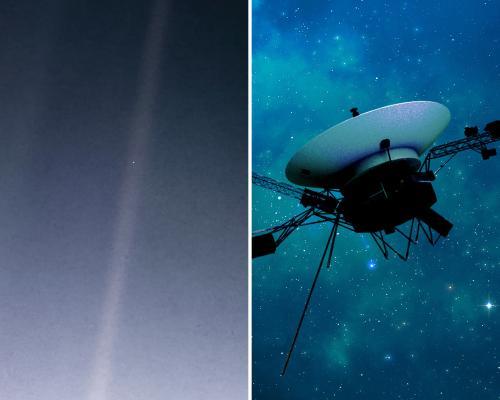
After 49 years, Nasa’s Voyager 1 is one light-day away from us. Can we save this ‘pale blue dot’? |
Talking Points: "After 49 Years, NASA’s Voyager 1 is One Light-Day Away from Us: Can We Save This ‘Pale Blue Dot’?"
-
Protagonist: Voyager 1, a robotic space probe launched by NASA in 1977, symbolizes human curiosity and ingenuity as it journeys through the cosmos, now one light-day away from Earth.
-
Argument: The narrative emphasizes the urgent need for humanity to reflect on its impact on Earth, highlighting the environmental degradation that has occurred since Voyager's launch, and calls for a paradigm shift towards prioritizing planetary health over economic growth.
-
Implications: As Voyager 1 continues its silent voyage, it serves as a poignant reminder of our shared responsibility to protect our "pale blue dot," urging us to cultivate a sustainable future for generations to come while recognizing our interconnectedness as inhabitants of this fragile planet.
-
Call to Action: We must harness the lessons from Voyager's journey to inspire collective action, fostering a global mindset that prioritizes ecological stewardship and unity in the face of existential challenges.
Stoic Response
Address to the Students of the Stoa
Greetings, students. Today, I wish to reflect upon the journey of Voyager 1, a remarkable testament to our human spirit, now one light-day away from our "pale blue dot."
The Challenge of Unhealthy Judgments
- Contemplate the Distance: Voyager 1 travels vast emptiness, yet it calls us to recognize our interconnectedness.
- Question Your Assumptions: Are we truly separate from the cosmos, or are we part of a greater whole?
- Reject Indifference: The environmental degradation since its launch demands our attention and action.
Discipline of Desire, Impulse, and Assent
To navigate the complexities of our existence, we must cultivate discipline in three areas:
-
Desire:
- Desire for Knowledge: Seek understanding of our planet and its needs.
- Desire for Connection: Foster relationships that emphasize community and responsibility.
-
Impulse:
- Control Your Reactions: Resist the impulse to act in ways that harm our environment.
- Act Thoughtfully: Before you act, consider the broader implications of your choices.
-
Assent:
- Evaluate Your Beliefs: Challenge the notion that economic growth is paramount over ecological health.
- Affirm Collective Responsibility: Acknowledge that our actions affect not just ourselves, but future generations.
Call to Action
- Reflect: Consider how Voyager 1 serves as a mirror to our own lives.
- Engage: Participate in discussions about sustainability and ecological stewardship.
- Act: Commit to choices that prioritize the health of our planet over fleeting gains.
Final Thoughts
As we gaze upon the stars, let us remember that we are not merely inhabitants of Earth; we are stewards of this fragile world. Let the journey of Voyager inspire us to look inward and take responsibility for our shared home.
Embrace this discipline, and together, we can cultivate a sustainable future for all.
Article Rewritten Through Stoic Lens
A Stoic Reflection on Voyager 1's Journey: A Test of Virtue
In the spirit of Stoicism, we can view the remarkable journey of Voyager 1 not merely as a tale of human achievement but as a profound test of our character. This narrative compels us to reflect on our virtues—wisdom, courage, justice, and temperance—as we confront the challenges of our time.
Wisdom: Understanding Our Place in the Cosmos
Voyager 1, launched in 1977, represents the pinnacle of human curiosity and ingenuity. As it travels through the vastness of space at 37,800 miles per hour, now one light-day away from Earth, it serves as a reminder of our interconnectedness and the fragility of our existence. The probe carries a gold-plated copper disk, a message to any potential extraterrestrial life, encapsulating the essence of humanity and our home, Earth.
Carl Sagan, who chaired the committee that designed this disk, urged NASA to turn Voyager's cameras back toward our planet. The resulting image, known as the "pale blue dot," compels us to confront our shared responsibility. “From this vantage point,” Sagan noted, “the Earth might not seem of any particular interest. But for us, it’s home.” This perspective encourages us to cultivate wisdom, recognizing that our actions have far-reaching consequences.
Courage: Facing Our Environmental Challenges
As Voyager 1 continues its silent voyage, it also serves as a stark reminder of the environmental degradation that has occurred since its launch. Scientists today assert that humanity has "gravely altered" the chemistry and biology of Earth. This reality presents a formidable challenge, one that requires courage to confront.
Kurt Vonnegut poignantly expressed this sentiment: “Dear Future Generations, please accept our apologies. We were rolling drunk on petroleum.” Acknowledging our past mistakes is the first step in fostering a courageous response to the crises we face. As we navigate these turbulent waters, we must summon the courage to prioritize ecological stewardship over economic growth, recognizing that our survival depends on a sustainable future.
Justice: Our Shared Responsibility
The journey of Voyager 1 is not just a testament to human ingenuity but also a call to justice. As we reflect on our impact on the planet, it becomes clear that we share a collective responsibility to protect our "pale blue dot." Ron Garan, an astronaut, emphasizes this point: “If humanity intends to flourish far into the future, it must shift its priorities from economy-first to planet-first.”
This shift requires us to cultivate a sense of justice, ensuring that our actions today do not compromise the well-being of future generations. The interconnectedness of all life on Earth demands that we act with fairness and compassion, striving for a world where both humanity and nature can thrive.
Temperance: Gratitude Without Attachment
As we celebrate the achievements of Voyager 1, we must also practice temperance, embracing gratitude without attachment. The probe's mission has provided us with invaluable insights into our universe and ourselves, yet we must remain grounded in the understanding that our successes are not solely ours to claim.
The journey of Voyager 1 teaches us that while we may marvel at our accomplishments, we must not become attached to them. Instead, we should express gratitude for the knowledge gained and the opportunities to improve our stewardship of the Earth. The future of our planet hinges on our ability to temper our desires with wisdom and to act in harmony with the greater good.
Conclusion: A Call to Virtue
As Voyager 1 approaches its eventual silence, we are left with a profound message: the importance of character in the face of adversity. Carl Sagan reminds us that “there is perhaps no better demonstration of the folly of human conceits than this distant image of our tiny world.”
In this light, let us view our conflicts as tests of virtue and our successes as opportunities for gratitude. By cultivating wisdom, courage, justice, and temperance, we can navigate the challenges ahead and ensure that we preserve and cherish our "pale blue dot" for generations to come.
Source Body Text
Imagine traveling nonstop for 49 years, alone in the dark with no destination in sight, powered by curiosity and engineering. Further imagine making that journey not at bullet train or jet plane speed, but much faster: at 37,800 miles per hour, free from friction in a vast sea of cold, soundless space, bombarded by radiation and cosmic rays yet still able to communicate with folks back home. Today, 18 November, that intrepid traveler – Voyager 1, a robotic space probe the size of a Mini Cooper – is exactly one light day away from us: 16.1bn miles. No other human-made object has ever gone this far. Radio signals from Earth (traveling at the speed of light, 186,000 miles per second) now take 24 hours to reach it, and another 24 hours to return. The return signals are so weak that scientists at Nasa’s Deep Space Network must use a massive satellite dish to hear them. Nasa launched Voyager 1 in early September 1977, just weeks after the first Star Wars movie hit theaters with Luke Skywalker and his charming sidekick droid, R2D2. It took photos of the planets Jupiter and Saturn, then continued onward. In 2012 it exited the sun’s protective shield of charged particles and magnetic fields, crossed a boundary called the heliopause, and entered interstellar space. That’s when it became a message in a bottle. That message consists of a 12in, gold-plated copper disk engraved with information to showcase human culture and the diversity of life on Earth, should any advanced civilization discover it. The disk contains photos and greetings in 55 human languages, music by Mozart and Chuck Berry, the sound of a baby crying and a whale singing. It also has a time stamp and a map that orients the position of our solar system to 14 pulsars – dense remnants of massive stars – that rotate rapidly and emit beams of radiation like flashing cosmic lighthouses. The message says, in essence: this is where we live and who we are. We thrive on connection. Come see us sometime. The astronomer Carl Sagan chaired a committee that designed the disk. In the late 1980s, as Voyager 1 hastened through the outer solar system, he tried to convince Nasa to turn the probe’s sensitive cameras back toward home. Nasa resisted, concerned about the risk of instrument damage. Finally, on Valentine’s Day 1990, the cameras turned. The result was one of the most profound images ever captured in space exploration. Sagan called it the “pale blue dot”, wherein Earth appears as a fraction of a pixel, “like a mote of dust caught in a sunbeam”. At that moment, Voyager 1 began to probe us, forcing us, from a great distance and with great irony, to take a close look at ourselves. “From this vantage point,” Sagan said, “the Earth might not seem of any particular interest. But for us, it’s home … On it everyone you love, everyone you know, everyone you ever heard of, every human being who ever was, lived out their lives.” On this small planet and against all odds, molecules composed themselves into organic matter that over billions of years evolved into complex living organisms. Geologic epochs came and went. Continents moved. Species thrived and perished, with one, only very recently, standing upright and coming to dominate all others. That’s us: a remarkable bi-ped capable of love, compassion and war; of making music, felling forests, creating literature, burning oil, building probes and exploring space. Scientists today say humans have “gravely altered” the chemistry, biology and physical structure of Earth’s land and water, with much of that damage occurring since Voyager 1 left us. We (or some among us) have destroyed countless habitats and damaged ecosystems to where wildlife populations are now collapsing worldwide. Building a global economy on fossil fuels has so warmed and toxified our planet that few places – if any – are pristine anymore. “Dear Future Generations,” the author Kurt Vonnegut said shortly before he died in 2007. “Please accept our apologies. We were rolling drunk on petroleum.” It wasn’t always this way. For most of human history, long before we stared at our computer screens and cell phones, we sat around campfires and studied the night sky. We found patterns in the stars, named them, and told stories. Much later, we invented science and turned our rational minds toward a better understanding of ourselves and everything around us. It is science today that tells us we are made of star stuff; that every element in us was forged in the fiery furnaces of stars. “When we look out into space,” says the professor of astronomy, Brian Cox, “we are looking into our own origins, because we are truly children of the stars.” When astronauts orbit Earth (many of them for months on end), they see no flags or national boundaries or competing interests. Instead, they see a single home shared by billions: spaceship Earth, a blue world wreathed in clouds and surrounded by a cold, sterile darkness. One of those astronauts, Ron Garan, concluded that if humanity intends to flourish far into the future, it must shift its priorities from economy-first to planet-first, followed by society, then economy. Without clean air, fresh water, stable ecosystems and a suitable climate, society and the economy mean nothing. They collapse. If we get things right and survive our technological adolescence, thousands of future generations will enjoy this still beautiful, bountiful planet: a world of suitable temperatures and robust (though rapidly diminishing) biodiversity. Much damage has been done, mostly by ignorance and greed. Global warming is accelerating, and hard challenges lie ahead. But this crisis and others can be mitigated if we set our hearts and minds to it; if we learn to live together and strive to belong, not to dominate. Sometime soon, probably in the 2030s, Voyager 1 will lose all power and go silent. But it will sail on, carried by inertia, headed not for Proxima Centauri, the nearest star to us after our sun, but toward the constellation Ophiuchus. In roughly 17,600 years, it will be one light year from Earth. And beyond that? Is anybody out there? “It has been said that astronomy is a humbling and character-building experience,” wrote Carl Sagan. “There is perhaps no better demonstration of the folly of human conceits than this distant image of our tiny world. “To me, it underscores our responsibility to deal more kindly with one another, and to preserve and cherish the pale blue dot, the only home we’ve ever known.” Kim Heacox is the author of many books, including The Only Kayak and Jimmy Bluefeather, both winners of the National Outdoor Book Award