
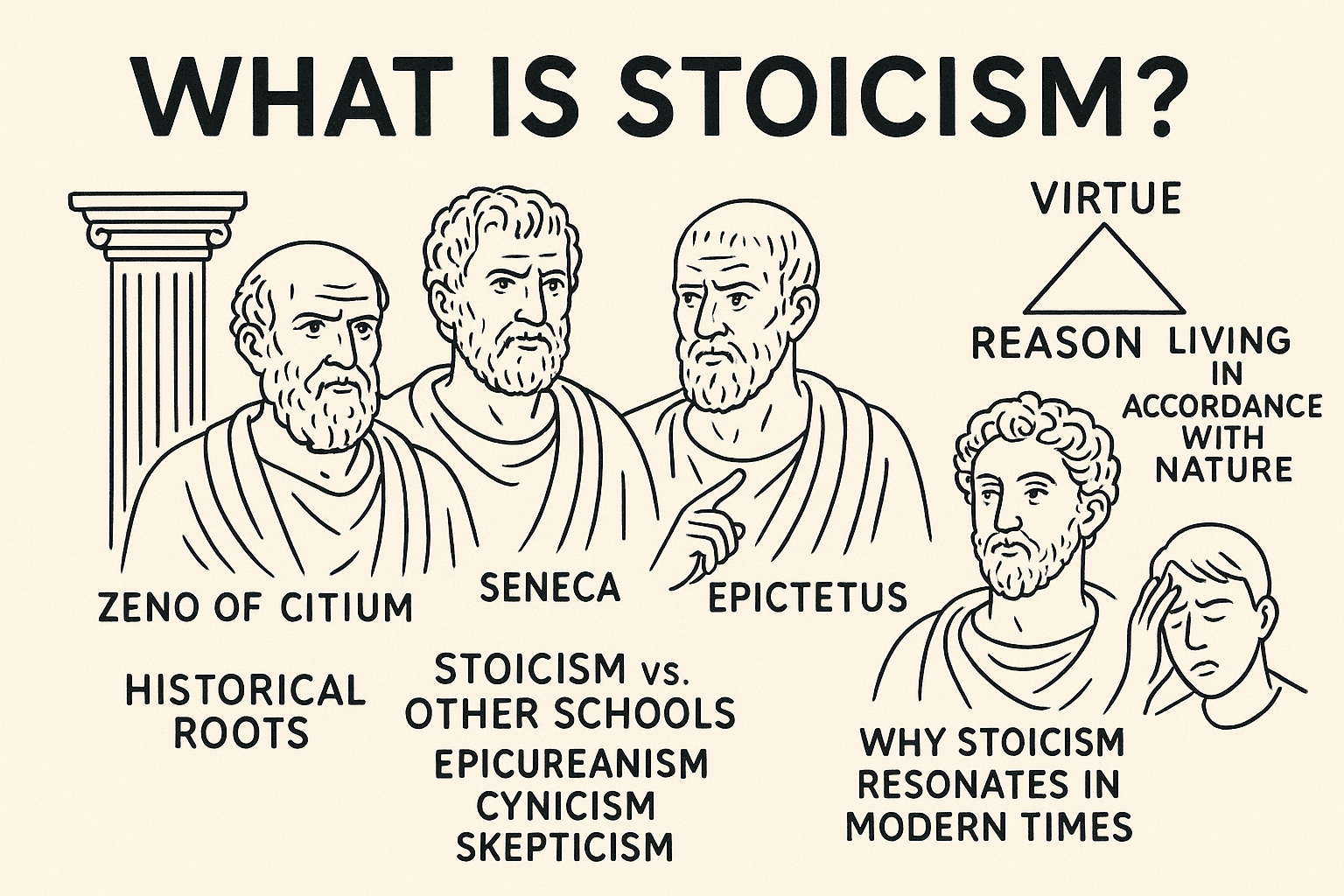
What Is Stoicism? The Philosophy of Resilience
Welcome to A Stoic Says — your guide to living with clarity, courage, and calm in a chaotic world.
Stoicism is not a set of dry academic theories locked away in ancient libraries. It is a living, breathing art of life — a practical philosophy forged in the fires of real human struggle and proven across two thousand years of emperors, slaves, soldiers, and everyday people who needed to stay steady when everything around them was falling apart.
Today, Stoicism is experiencing a massive revival because it answers the exact questions we face in the 21st century:
- How do I stay calm when the world feels out of control?
- How do I find meaning in suffering?
- How do I act with integrity when no one is watching — or when everyone is watching and judging?
This is the philosophy of resilience.
For bearings, revisit The Path of Stoicism before unpacking how resilience works in practice.
The Origins: From Athens to Rome (and Now to You)
Stoicism was founded in Athens around 301 BC by Zeno of Citium, a merchant who lost everything in a shipwreck and decided to rebuild his life — not around wealth or status, but around what could never be taken away: his character and reason.
The philosophy reached its golden age in Rome through three towering figures you will meet again and again:
- Seneca the Younger – playwright, billionaire advisor to Emperor Nero, and eventual victim of forced suicide. He wrote some of the most beautiful letters on living well while staring death in the face.
- Epictetus – born a slave, crippled by a cruel master, yet achieved total inner freedom. He taught that “It’s not what happens to you, but how you react to it that matters.”
- Marcus Aurelius – Roman Emperor at the height of the empire’s power, ruling while plague, war, betrayal, and personal grief raged around him. His private journal, Meditations, is still one of the most honest and humble leadership manuals ever written.
These men were not ivory-tower philosophers. They lived Stoicism under extreme pressure — and showed that it works.
The Core Idea: Live in Accordance with Nature
At its heart, Stoicism teaches one radical truth:
The only thing that is truly good is virtue (excellence of character). Everything else — health, wealth, reputation, even life itself — is indifferent.
This doesn’t mean you should be careless about your body or finances. It means you should care about them in the right way and for the right reasons.
Stoics observed that human beings are uniquely gifted with reason. To live “according to nature” is to use that reason to become the best version of yourself — wise, courageous, just, and self-disciplined — no matter what fate throws at you.
The Four Cardinal Virtues: Your Inner Compass
Every Stoic practice flows from these four virtues:
| Virtue | Greek Name | What It Means in Practice |
|---|---|---|
| Wisdom | Phronesis | Seeing reality clearly; knowing what’s truly important |
| Courage | Andreia | Facing fear, pain, or uncertainty without flinching |
| Justice | Dikaiosyne | Treating every human being with fairness and respect |
| Temperance | Sophrosyne | Mastering desires; knowing when enough is enough |
If you live by these four, you will never be lost.
The Dichotomy of Control: The Most Useful Idea in History
Epictetus gave us the single most liberating distinction in all philosophy:
“Some things are up to us, and some things are not up to us.”
- Up to us: our judgments, our values, our intentions, our actions (as far as we can execute them).
- Not up to us: outcomes, other people’s opinions, our reputation, the weather, illness, death, the economy.
The entire Stoic system is built on training yourself to pour 100% of your energy into the first column and develop radical acceptance (even cheerful acceptance) of the second.
This is the root of true freedom.
The 8 Stoic Laws: Your Modern Operating System
In this series, we distill ancient Stoic wisdom into eight clear, actionable laws designed for real life today.
Here they are at a glance:
- Embrace discomfort like a friend
- Stop being owned by your emotions
- Stop expecting fairness — life owes you nothing
- Focus on what you can control — let go of the rest
- Practice voluntary hardship to build unbreakable will
- Detach from outcomes — fall in love with the process
- Embrace death — live with urgency and purpose
- Be a warrior for virtue, not approval
These are not commandments carved in stone. They are training principles — like workouts for the soul.
Why Stoicism Works Today
Modern psychology has repeatedly confirmed what the Stoics discovered 2,000 years ago:
- Cognitive Behavioral Therapy (CBT) was explicitly modeled on Stoic techniques.
- Negative visualization reduces anxiety and increases gratitude.
- Focusing on process goals over outcome goals dramatically improves performance and peace of mind.
- Voluntary discomfort (exposure therapy) is one of the most effective ways to build resilience.
But Stoicism goes deeper than therapy. It’s not just about feeling better — it’s about becoming better.
This Series: Your Roadmap
Over the next 13 pages, we will explore each layer of Stoic practice:
- Daily exercises that take 5–15 minutes but change everything
- How to handle emotions without suppressing or indulging them
- How to face crisis, loss, and even death without breaking
- How to build a life of meaning in a culture obsessed with comfort and validation
You don’t need to become a monk on a mountain. You just need to start — one breath, one choice, one day at a time.
Ready?
→ Next: The Four Cardinal Virtues and the Warrior for Virtue (Law 1)
Or jump straight to any law using the menu above.
Remember the words of Marcus Aurelius:
“You have power over your mind — not outside events. Realize this, and you will find strength.”
Let’s begin.