
Stoic Bio
Zeno of Citium
Founder of Stoicism who taught on the Painted Porch in Athens and blended Cynic toughness with Socratic logic.
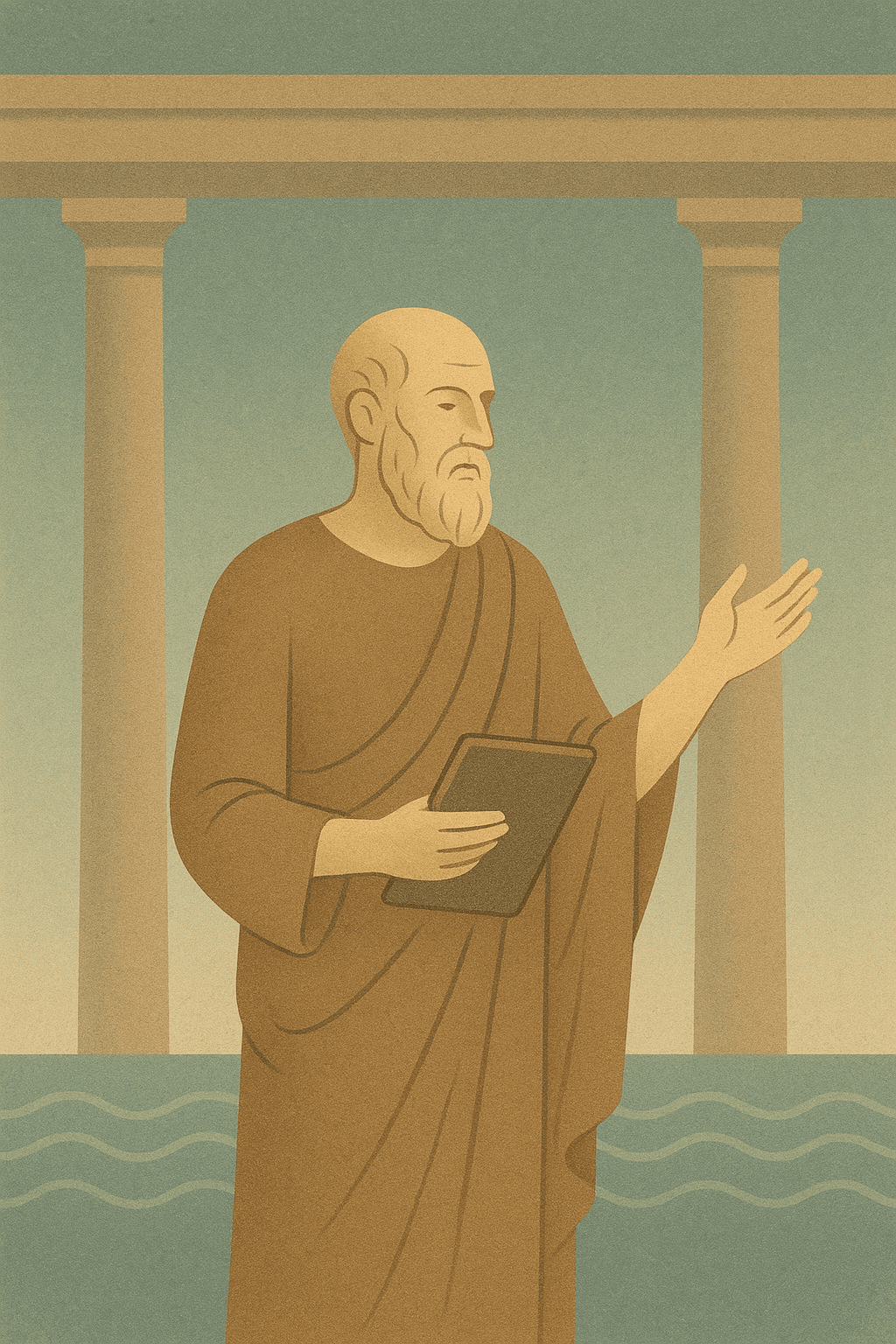
Zeno of Citium, rendered from classical references.

Zeno urged students to align with fate—the rational order of the cosmos.
Zeno of Citium
Zeno of Citium (c. 334–262 BCE) was a Greek philosopher who founded the Stoic school in Athens. His vision of philosophy emphasized living in harmony with nature, cultivating virtue, and practicing rational self‑control. Though none of his original writings survive, his ideas shaped centuries of thought and laid the foundation for Stoicism as a practical philosophy of resilience and ethical living.
Biography
Zeno was born in Citium, a city on Cyprus, around 334 BCE. After a shipwreck left him in Athens, he encountered philosophy and studied under Cynic and Megarian teachers. Inspired by Socratic ideals and the discipline of the Cynics, he developed his own system of thought. Around 300 BCE, Zeno began teaching in the Stoa Poikile (“Painted Porch”), a public colonnade in Athens. His followers became known as Stoics, taking their name from this setting. Zeno lived modestly, teaching that virtue was the only true good, and died in Athens around 262 BCE.
Key Teachings
- Virtue as the highest good: Happiness depends on living virtuously, not on wealth or status.
- Living in accordance with nature: Human beings flourish when they align their actions with reason and the natural order.
- Indifference to externals: Health, wealth, and reputation are “indifferent” — neither good nor bad in themselves.
- Unity of humanity: All people share reason and belong to a universal community.
- Discipline of desire and aversion: Train the mind to desire only what is good and avoid false judgments.
- Practical philosophy: Philosophy is not abstract speculation but guidance for daily life.
Influence & Legacy
- Founding Stoicism: Zeno’s teachings established the framework later refined by Cleanthes, Chrysippus, Seneca, Epictetus, and Marcus Aurelius.
- Enduring school: Stoicism became one of the most influential philosophies of the Hellenistic and Roman worlds.
- Ethical clarity: His focus on virtue and rational living continues to resonate in modern discussions of ethics and psychology.
- Cultural impact: The term “Stoic” itself originates from his teaching at the Stoa Poikile.
- Modern revival: Contemporary Stoic movements trace their lineage back to Zeno’s foundational ideas.
Memorable Quotes
Although Zeno’s original works are lost, later sources preserve fragments and reports of his sayings:
-
“Man conquers the world by conquering himself.”
— A reflection on self‑discipline as the path to mastery. -
“Well‑being is attained by little and little, and nevertheless is no little thing itself.”
— Emphasizes gradual progress in cultivating virtue. -
“The goal of life is living in agreement with nature.”
— The central Stoic principle, defining harmony between reason and the natural order. -
“Fate is the endless chain of causation, whereby things are; the reason or formula by which the world goes on.”
— A statement on determinism and the rational structure of the universe.
Zeno of Citium remains a pivotal figure in philosophy. His vision of a rational, virtuous life set the stage for Stoicism’s enduring influence, offering guidance for those seeking resilience, clarity, and ethical purpose in the face of life’s challenges.