
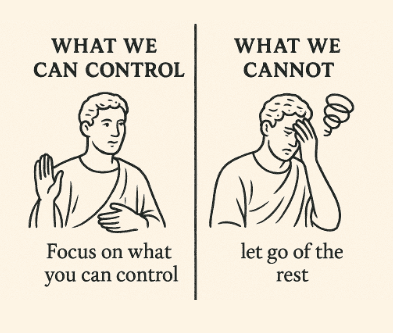
The Dichotomy of Control
And Law 2: Focus on What You Can Control – Let Go of the Rest
Epictetus opens his Enchiridion with the blunt truth:
“Some things are up to us, and some things are not up to us.”
That single sentence has saved more sanity than any self-help book. It is the razor that cuts through anxiety, resentment, and frustration in one clean stroke.
If the virtues from The Four Cardinal Virtues & The Warrior for Virtue and the basics from What Is Stoicism? are fresh, this control audit lands faster.
The Two Columns
| Up to Us (In Our Power) | Not Up to Us (Outside Our Power) |
|---|---|
| Our judgments and opinions | The past |
| Our desires and aversions (when trained) | Other people’s opinions and actions |
| Our motives and intentions | Our reputation |
| Our choices and actions (within reach) | Our body’s health and appearance (ultimately) |
| How we respond to any event | Wealth, status, fame |
| What we decide is good or bad | Weather, traffic, politics, illness, death |
| Our character and virtue | Outcomes of almost everything we attempt |
Everything in the left column is the only territory where freedom, peace, and excellence are possible. Everything in the right column is rented land; we may influence it, but we never own it.
Why This Changes Everything
Most suffering comes from reversing the columns. We rage at traffic instead of using the time well. We obsess over whether someone likes us instead of asking whether we acted with integrity. We feel crushed when a project fails instead of examining whether we gave our honest best effort.
Law 2 is therefore brutally simple: Focus 100% of your energy on the left column. Meet everything in the right column with calm indifference or cheerful acceptance.
Marcus Aurelius Living the Dichotomy
“You have power over your mind — not outside events. Realize this, and you will find strength.” (8.47)
“If you are distressed by anything external, the pain is not due to the thing itself, but to your estimate of it; and this you have the power to revoke at any moment.” (8.47)
“When jarred, unavoidably, by circumstances, revert at once to yourself, and don’t lose the rhythm more than you can help.” (6.11)
Even the emperor of Rome had to remind himself of this every single day.
Training the Dichotomy
- 10-second reframe: When something annoys you, ask “Is this in my control right now?” If not, “What is in my control right now?”
- Evening decision audit: Place every upsetting event into one of the two columns. Be ruthless.
- Trigger phrase: When uncontrollable events strike, say “Not up to me. Next right action.”
- Inner citadel visualization: Picture your mind as an impregnable fortress. Outside forces can batter the walls but never enter unless you open the gate by granting assent.
Common Misunderstandings
Focusing on the controllable is not passivity. Stoics marched into battle, spoke against tyrants, and risked their lives for justice. They simply distinguished between action (up to us) and outcome (not up to us). You fight with all your strength, then release the result with equanimity.
The Freedom Paradox
The stricter you are with the Dichotomy, the more power you gain. By refusing to bleed energy into uncontrollable realms, you become calmer, clearer, kinder, and more effective in the tiny sphere that is yours.
Law 2 in one line:
“Never let the things you can’t control interfere with the things you can.”