
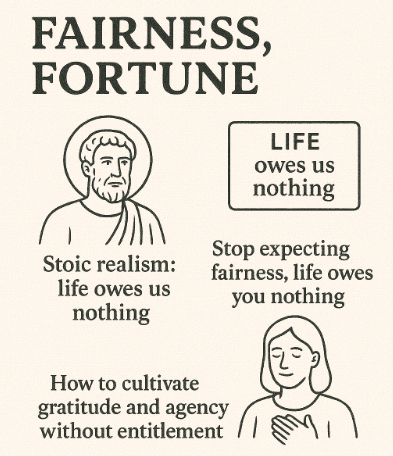
Fairness, Fortune, and Law 5
Stop Expecting Fairness – Life Owes You Nothing
Life is not a courtroom with a cosmic judge ensuring everyone gets their due.
Bad things happen to good people. Good things happen to bad people.
The innocent suffer. The guilty thrive.
Stoics looked this brutal reality in the eye and said: "So be it."
They called it amor fati — love of fate — not because they were masochists, but because raging against the universe is a fool's game.
Law 5:
Stop expecting fairness. Life owes you nothing.
This is not cynicism. It is liberation.
When you drop the illusion of entitlement, you gain unbreakable agency, genuine gratitude, and the power to thrive in an indifferent world.
Ground this fairness reset in the emotional sovereignty from Stoicism and Emotions and the discomfort training in Daily Stoic Exercises.
Stoic Realism: The World as It Is, Not as We Wish
The Stoics were radical realists. They observed nature closely:
- Storms destroy crops without mercy.
- Lions eat gazelles without guilt.
- Empires rise and fall on whims of fortune.
Human life is no different. Epictetus, born a slave, put it plainly:
"We are like actors in a play. The divine playwright assigns the roles: some get to be kings, others beggars, some free citizens, others slaves. Your job is to play your assigned role well." (Enchiridion 17, paraphrased)
Marcus Aurelius echoed this amid plague and war:
"Everything that happens is either endurable or not. If it’s endurable, then endure it. Stop complaining. If it’s unendurable… then stop complaining. Your destruction will mean its end as well." (Meditations 10.3)
They rejected the "why me?" whine because it presumes a "should" that does not exist.
Life is not unfair — it is simply not fair. It has no ledger of debts.
The Dangers of Expecting Fairness
Entitlement poisons everything:
- It breeds resentment: "I deserved that promotion!" → Bitterness erodes your character.
- It creates fragility: When "unfairness" strikes, you shatter instead of adapt.
- It paralyzes action: Waiting for the world to "make it right" means waiting forever.
- It blinds you to opportunity: While you sulk over what's owed, others seize what's available.
Seneca warned: "All cruelty springs from weakness." (On Clemency 2.4)
Expecting fairness is a weakness — it hands your happiness to external forces.
How to Cultivate Gratitude Without Entitlement
Stoics flipped the script: Instead of demanding more, they marveled at what they had.
This is not forced positivity. It is trained perspective.
1. The Gratitude Reframe (Daily, 2 minutes)
List three things you have that could easily be taken:
- A warm bed (millions lack it).
- Clean water (a luxury in history).
- A functioning body (fragile and temporary).
Then add: "None of this was owed to me. It is a gift."
Marcus did this obsessively: "When you arise in the morning, think of what a precious privilege it is to be alive — to breathe, to think, to enjoy, to love." (Meditations 5.1)
2. Agency Over Outcome (When Plans Fail)
Apply the Dichotomy (from Law 2):
- Not up to you: The "fair" result.
- Up to you: Your effort, attitude, and next move.
Example: Job rejection.
Entitled response: "This is unfair! I was perfect!" → Stagnation.
Stoic response: "Life owes me nothing. What can I learn? What's my next action?" → Growth.
3. The "Fortune's Wheel" Meditation (Weekly, 5 minutes)
Visualize the wheel of fortune spinning:
- Today you are up (health, wealth, love).
- Tomorrow you could be down (loss, poverty, betrayal).
- Accept both positions with equal calm.
Seneca practiced this by imagining himself bankrupt or exiled: "We should project our thoughts ahead of us at every turn and have in mind the possibility of every eventuality." (Letters 91.4)
It steels you against reversal and deepens appreciation for the present.
4. Acts of Anonymous Kindness (Ongoing)
Do good without expecting thanks or reciprocity.
- Help a stranger.
- Forgive a slight.
- Give without strings.
This breaks the entitlement cycle: You act justly because it is right, not for reward.
As Marcus noted: "What is it to you if others blame or criticize you for doing what is right?" (Meditations 8.17)
Law 5 in Modern Life: From Victim to Victor
In a world of social media highlight reels and "hustle culture," entitlement runs rampant.
People quit at the first setback, sue over every slight, and demand "safe spaces" from reality.
Stoics offer the antidote:
Own your life. Expect nothing. Earn everything. Be grateful for anything.
A real example: Viktor Frankl, Holocaust survivor and Stoic-inspired psychiatrist, wrote in Man's Search for Meaning: "Everything can be taken from a man but one thing: the last of the human freedoms — to choose one's attitude in any given set of circumstances."
He lost family, freedom, dignity — yet chose meaning over despair.
You face far less. What is your excuse?
The Ultimate Freedom
Dropping expectations does not make you passive. It makes you potent.
You stop wasting energy on "shoulds" and pour it into "cans."
Gratitude becomes effortless because every breath is bonus, not baseline.
As Epictetus said: "Don't demand that things happen as you wish, but wish that they happen as they do happen, and you will go on well." (Enchiridion 8)
Life owes you nothing.
That truth sets you free.