
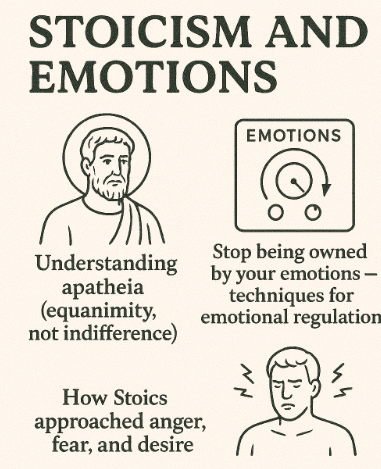
Stoicism and Emotions
Law 4: Stop Being Owned by Your Emotions
Emotions are not the enemy.
They are signals — raw data from your body and mind about the world.
The problem is when we let them drive the car.
We rage at a slight, crumble under fear, or chase desires that leave us empty.
Stoics called this being "enslaved" by passions.
Their solution? Not suppression, but sovereignty.
Law 4:
Stop being owned by your emotions.
Observe them, question them, and choose your response like a king surveying his kingdom.
This is the path to apatheia — not cold indifference, but clear-eyed equanimity.
A state where emotions inform you, but never overrule your reason.
Revisit Daily Stoic Exercises & Law 3 and The Dichotomy of Control & Law 2 to see how emotional regulation builds on those habits.
Understanding Apatheia: Equanimity, Not Indifference
The word "Stoic" in modern English means emotionless robot.
That is a tragic misunderstanding.
Stoics felt deeply: love for family, grief at loss, joy in beauty.
Marcus Aurelius wept for his children. Seneca adored his wife. Epictetus spoke of friendship with warmth.
But they refused to let emotions distort reality or dictate actions.
Apatheia (from Greek: a- "without" + pathos "suffering/passion") means freedom from irrational passions — those knee-jerk reactions that hijack your judgment.
It is like standing on a mountain above the storm: you see the lightning and feel the wind, but you are not tossed by it.
Seneca:
"Wild animals run from the dangers they actually see, and once they have escaped them worry no more. We however are tormented alike by what is past and what is to come." (Letters 5.9)
Stoics train to live in the present, responding wisely instead of reacting blindly.
How Stoics Approached Key Emotions
Anger: The Fire That Burns You First
Stoics saw anger as temporary madness — a choice to poison your own mind over someone else's actions.
Seneca's entire essay On Anger is a masterclass:
- Anger always exaggerates harm.
- It achieves nothing that calm persistence cannot do better.
- It hurts you more than your target.
Approach:
- Delay: Count to 10 (or 100). "The greatest remedy for anger is delay."
- Reframe: Is this worth my peace? What would a wise person do?
- Empathy: The offender is likely suffering from their own flaws. Pity them, don't hate them.
Marcus: "How much more grievous are the consequences of anger than the causes of it." (Meditations 11.18)
Fear: The Phantom Thief of Joy
Fear is imagination run amok — borrowing trouble from a future that may never come.
Stoics used premeditatio malorum (from Law 3) to shrink fear: visualize the worst, realize it is survivable, then act.
Epictetus: "Men are disturbed not by things, but by the views which they take of things." (Enchiridion 5)
Approach:
- Question: What evidence supports this fear? What is the probability?
- Prepare: Focus on your response (in your control), not the event (not in your control).
- Accept: If it happens, it happens. You will handle it.
Desire: The Endless Hunger
Uncontrolled desire leads to addiction — to pleasure, power, or possessions that never satisfy.
Stoics practiced moderation: enjoy things, but hold them lightly.
Seneca: "It is not the man who has too little, but the man who craves more, that is poor." (Letters 2.6)
Approach:
- Distinguish needs from wants: Food, shelter, virtue vs. luxury, status.
- Practice gratitude: Focus on what you have, not what you lack.
- Detach: Remind yourself everything is temporary. Desire less, enjoy more.
Techniques for Emotional Regulation
1. The Pause: Your Superpower (Instant)
When emotion surges:
- Breathe deeply 3 times.
- Label it: "This is anger/fear/desire arising."
- Ask: "Is this helpful? What does reason advise?"
This creates space between stimulus and response — the essence of freedom.
2. Journaling for Clarity (Evening, 5 minutes)
Write about an emotional event:
- What happened? (Facts only)
- What was my initial reaction?
- What judgment caused that reaction? (e.g., "This is unfair!")
- A wiser judgment? (e.g., "This is indifferent; my response matters.")
Over time, this rewires your defaults.
3. Role Models: The "What Would X Do?" Hack
Pick a Stoic hero (Marcus, Epictetus) or wise figure.
When emotions hit, ask: "How would they handle this?"
It pulls you out of the emotional fog.
4. Physical Anchors: Body Hacks for Mind Control
- Cold exposure (shower): Teaches discomfort tolerance.
- Exercise: Burns off excess energy from anger/fear.
- Nature walks: Restores perspective.
Modern bonus: These align with CBT and mindfulness, proven to reduce emotional volatility.
Law 4 in Action: A Real-World Example
Imagine a heated argument at work.
Old you: Snap back, stew for hours, lose sleep.
Stoic you:
- Pause: Breathe, label the anger.
- Reframe: "Their words are not in my control; my response is."
- Choose: Respond calmly or walk away.
- Reflect later: What triggered me? How to prevent next time?
Result: Peace preserved, respect earned, lesson learned.
The Payoff: True Inner Freedom
Mastering emotions does not make life easy.
It makes you unbreakable in a hard world.
As Epictetus said: "No man is free who is not master of himself."
Stop being owned. Start owning.